How Ontario sets school boundaries, at a glance. Sources: the Government of Ontario and the school boards named below.
Families move for a school. It is one of the oldest reasons to pick one street over another, and in the Greater Toronto Area it is still one of the strongest. Yet school boundaries are the part of that decision people check least carefully.
Usually the reason is a quiet misunderstanding. In practice, most buyers treat the line on the map as a feature of the house, like the lot size. In fact it is a decision your school board made, and a decision it is free to make again.
The short version
- Your board draws the line, not your deed. The Education Act gives every board the power to set the attendance area for each school it runs.
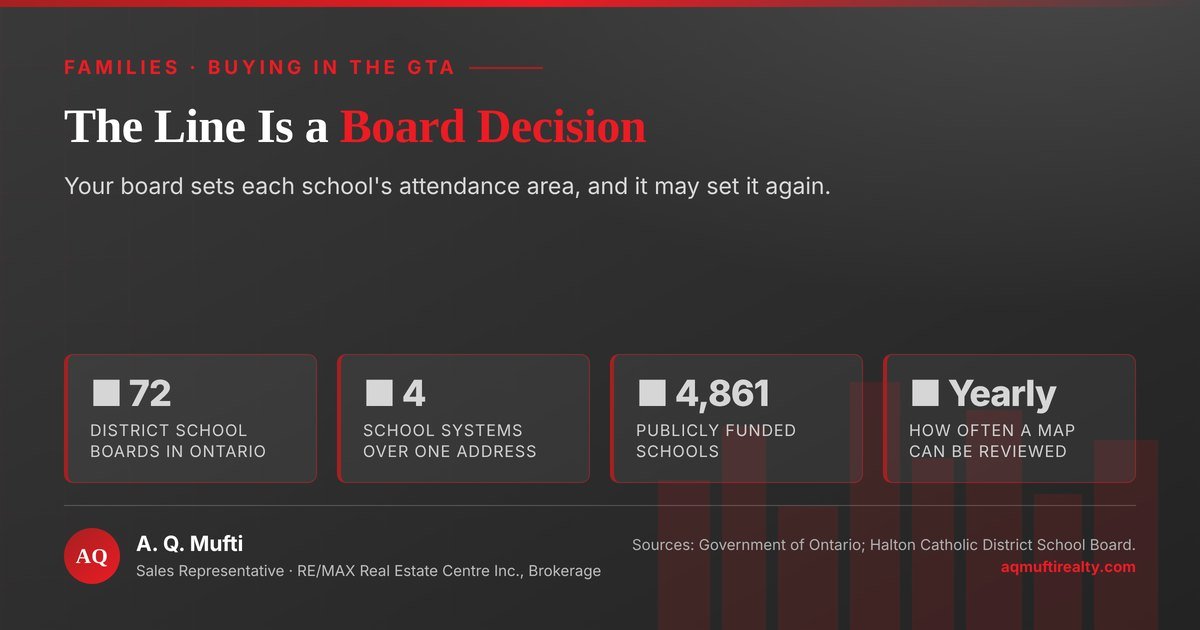
- One address sits in four systems. Ontario runs 72 boards across English public, English Catholic, French public and French Catholic, so there is never one answer.
- Boards review the lines yearly. One Halton board says plainly that school boundaries are subject to change on a yearly basis.
- New houses are the usual trigger. When closings fill a school, boards redirect new registrations until a new school opens.
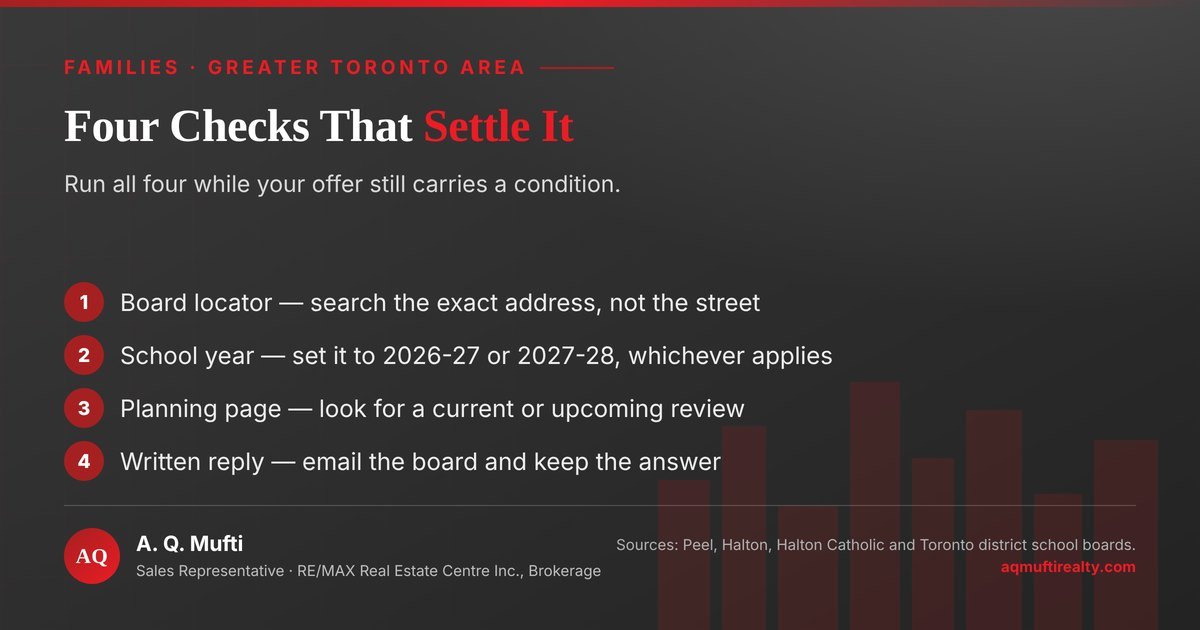
- Four checks settle it. Search the board locator, set the right school year, read the board’s planning page, and ask about out-of-area status in writing.
The numbers behind school boundaries in Ontario
Notably, every figure below comes from a government or school board page read on November 19, 2026. The provincial counts carry their own vintage, which the last column gives.
| Item | Figure | Source and vintage |
|---|---|---|
| District school boards in Ontario | 72 | ontario.ca, 2024-25 data |
| School systems over the same address | 4 | English and French, public and Catholic |
| English public boards | 31 | ontario.ca |
| English Catholic boards | 29 | ontario.ca |
| French public boards | 4 | ontario.ca |
| French Catholic boards | 8 | ontario.ca |
| Publicly funded schools | 4,861 | ontario.ca, 2024-25 |
| Students enrolled | 2,095,193 | ontario.ca, 2024-25 |
| Who sets each attendance area | The board | Education Act, s. 171(1), para. 7 |
| School years in the Peel and Halton finders | 2 | 2026-27 and 2027-28, read November 19, 2026 |
| Full-day kindergarten rooms that filled at Falgarwood PS | 4 | Halton District School Board |
| Students in each of those rooms at the trigger | 29 | Halton District School Board |
| How often a boundary map can move | Yearly | Halton Catholic District School Board |
Who actually draws school boundaries
First, the question almost nobody asks. Somebody decided which children go where, and it helps to know who.
The Education Act hands the job to your board
Ontario’s answer is one line in a statute. Under the heading “Powers of boards”, the Education Act says a board may “determine the number and kind of schools to be established and maintained and the attendance area for each school”.
That sits at section 171, subsection 1, paragraph 7, under the note “schools and attendance areas”. Note the verb: a board may. The text runs current to September 22, 2026, so it is live law rather than an old copy.
Read it once more and the consequence lands. Your board decides each attendance area, so it can revisit school boundaries the same way it made them. Moreover, nothing in your title deed speaks to the matter.
Four systems, four sets of school boundaries, one street
Then there is the part that catches newcomers. Ontario’s education facts page reports 72 district school boards “organized into 4 school systems”: English Public, English Catholic, French Public and French Catholic.
The split runs 31, 29, 4 and 8 boards in that order, across 4,861 publicly funded schools and 2,095,193 students. Those counts cover the 2024-25 school year, as of October 17, 2025.
So a single Mississauga address sits inside four separate maps at once. Therefore, asking about school boundaries without naming the system you mean gets you an answer to a different question.
Why school boundaries change more often than buyers expect
Next, the moving part. Boards are candid about this on their own websites, which is the best place to hear it.
The boards say so themselves
The Halton Catholic board puts it in a single sentence on its school finder page: “Please note that school boundaries are subject to change on a yearly basis.” That is the whole lesson in one sentence.
Its Halton public neighbor goes further. The local school finder carries a warning clause: “a degree of error or change is inherent”, and the map comes “as is” without warranty. In short, a board will not vouch for its own school boundaries.
Most tellingly, that same page speaks to people in your position. It tells anyone “moving into a new area” to check for “a current or upcoming boundary review”, which amounts to telling movers to check school boundaries twice.
New homes are the usual trigger
Here is the mechanism behind nearly every change. A subdivision sells, families close, and children arrive at a school the board sized years earlier. Yet nothing about the street itself changed.
Halton’s own wording on one Oakville case is blunt: “As home closings are continuing in the area, accommodation pressures are increasing.” In other words, the buyers themselves move the line.
Accordingly, boards manage this with a device worth knowing by name. A holding school takes children from a new neighborhood until the board finishes their own school, and then it redraws school boundaries and they move again.
What a change to school boundaries looks like up close
Now a real case, documented by the board itself rather than by a news report. Notably, it shows how fast this can move.
Capacity decided it, not the map
Halton’s published record dates the trigger to October 31, 2024. Falgarwood Public School in Oakville was, in the board’s words, “one of the holding schools for the future school opening”.
Put simply, the trigger was arithmetic. The school’s “four (4) FDK classrooms have reached their maximum number of students (29 students in each classroom)”, so new kindergarten registrations from the affected zones went to another school instead.
Notice who felt this and who did not. Children already in the school stayed put, and grades one to eight kept signing up as before. A redirection hits newcomers first, and a family who just bought is exactly that.
The board also said the grade one to eight ranges could follow “once classes have reached full capacity”. So the same school boundaries can mean one school for a kindergarten child and another for an older sibling.
It ended, and it can restart
The ending is the reassuring half. A new school opened in September 2025, fresh school boundaries took effect for the 2025-26 year, and the board paused the redirection.
Even so, the board left the door open in writing, warning that “a redirection will be considered and may be reinstated” should the school fill again. Clearly, a paused arrangement is not a closed one.
Fortunately, one practical kindness sits in the record. The board bused redirected students who met its distance rules, so a redirection is not the same thing as a long walk.
Four checks that settle school boundaries for an address
Finally, the part you can act on. All four take an evening, none costs anything, and together they turn school boundaries from a rumor into a documented answer.
The four-step check on school boundaries
- Search the board’s own locator by address. Use the Peel, Halton or Halton Catholic tool, and type the address rather than the street name.
- Set the school year the child will start. Peel and Halton both let you pick 2026-27 or 2027-28, and the two tools hold those answers apart for a reason.
- Read the board’s accommodation planning page. Halton publishes current and upcoming reviews, and a review already underway is the loudest signal you will get.
- Ask about out-of-area status in writing. Email the board, name the address and the school year, and keep the reply with your file.
Do all four while your offer still has a condition on it. A firm deal is a poor moment to learn that school boundaries are under review three streets away.
Why the written answer matters most
An email from the board is worth more than any listing remark, and it costs one message. Conversely, a line in a feature sheet carries no weight at all and was often copied from an older map.
Above all, keep that reply. If the line moves later, you will at least know what the board told you and when, which is the difference between a surprise and a decision you made with your eyes open.
Because this is a family decision rather than a property one, I will say plainly what I do not do: I do not rate schools and I do not steer anyone toward a catchment. What I can do is point you at the board’s own page and read it with you.
What school boundaries will not tell you
Meanwhile three things sit outside the map entirely, and each one trips somebody up every September.
Out-of-area admission is a request, not a right
Toronto’s board runs this under Policy P013, whose stated objective is “To provide policy direction about access to schools outside a student’s Designated Attendance Area”. That policy carries a date of September 18, 2026.
Halton Catholic shows how boards judge such requests. Its cross-boundary page marks each school “Open or Closed to applications” according to how full it already is. So a crowded school shuts the door.
Significantly, the pressure that moves school boundaries is the pressure that shuts out-of-area applications, so the two problems arrive together.
Busing and French Immersion run on separate rules
Busing is its own question. Halton Catholic ties it to “the student’s primary home address as registered with the school”, and distance rules rather than school boundaries decide who qualifies.
French Immersion is separate again. Halton’s finder returns “English and French Immersion home school” as two results for one address, so the immersion school boundaries can send a child somewhere the English answer never would.
Specialized and regional programs sit outside all of this once more, since they admit by application. Where a program decides the school, school boundaries stop being the deciding factor altogether.
If a school drives the move, the order of operations matters. My home valuation tells you what your current house is worth before you commit to a neighborhood, and the monthly market updates show which areas are actually moving.
Common questions about school boundaries
Short answers to what families in Mississauga and across the GTA ask me most often when a move involves children.
Can school boundaries change after I buy?
Yes, and they do. Boards hold the power to set each school’s attendance area under the Education Act, and they review it as enrollment shifts. The Halton Catholic board states on its own site that school boundaries are subject to change on a yearly basis, and the Halton public board asks movers to check for an active review.
Does a listing tell me the right school?
Treat it as a starting point and nothing more. Listing remarks are often copied from an older map, and no listing shows whether a boundary review is underway. The board’s own locator, set to the correct school year, is the only source worth relying on.
Why do new subdivisions lose their nearby school?
Because the board sized the school before the houses sold. Halton’s record on one Oakville school says accommodation pressures rose “as home closings are continuing in the area”. Boards then use a holding school until a new building opens, after which boards redraw school boundaries again.
Can I apply to a school outside my area?
You can ask, but it is a request rather than a right. Toronto’s board runs out-of-area admissions under a dedicated policy, and Halton Catholic marks each school Open or Closed to applications based on how full it is. A crowded school shuts the door on these requests.
How many school systems cover one GTA address?
Four. Ontario runs 72 district school boards organized into English Public, English Catholic, French Public and French Catholic systems, so every address has four answers. Ask about school boundaries without naming the system and you will get the wrong map.
Sources and further reading
- Ontario – Education Act — s. 171(1), para. 7, attendance areas
- Ontario – education facts — 72 boards, 4 systems
- Halton DSB – the Oakville redirection — holding schools and capacity
- Halton DSB – accommodation planning — current boundary reviews
- Halton DSB – find a local school — locator and warning clause
- Halton Catholic DSB – school finder — yearly change, cross-boundary status
- Peel DSB – school finder — search by school year
- Toronto DSB – Policy P013 — out-of-area admissions
Keep reading on the blog
More homeowner guides and market analysis from this blog.
- Oakville or Milton: Which Suits You — comparing two towns
- Buyer Representation Agreement in Ontario — before you shop
- Radon Testing in the GTA — a winter household job
- Fall Home Maintenance in the GTA — seasonal care
Ready to move with a family in tow?
Send me the addresses you are weighing and the ages of your children. I will pull up each board’s own locator with you, show you where to look for an active review, and help you word the email that gets a written answer. No pressure, and no obligation.
Prefer to start with a number? Get a tailored home valuation or run the figures in the mortgage calculator.
Disclaimer: Sources: the Government of Ontario and the Peel, Halton, Halton Catholic and Toronto district school boards, all read on November 19, 2026. General information only. This post explains how boards set and change attendance areas. It does not rate, rank or compare any school. Boundaries, busing and program entry differ by board, and boards review them often, so confirm your address with the board in writing. The Oakville redirection above remains paused. A. Q. Mufti – Sales Representative, RE/MAX Real Estate Centre Inc., Brokerage.
A. Q. Mufti — Sales Representative
RE/MAX Real Estate Centre Inc., Brokerage
MSc, PMP®, ABR®, SRS®, CNE®
416 908 5600 · 905 270 2000
info@aqmuftirealty.com
141-1140 Burnhamthorpe Rd. W., Mississauga ON L5C 4E9
Serving Mississauga, Oakville, Milton, Brampton, Toronto and the wider GTHA. More about how I work.