
Hiring a contractor in Ontario, at a glance. Sources: Government of Ontario and the Electrical Safety Authority.
In fact, Ontario guards homeowners better than most people think. There is a written-contract rule, a window to cancel, a ceiling on overruns and a public list of bad operators. Yet hiring a contractor still goes wrong for someone on my street every season.
The reason is narrow, and it is worth an hour of your time. Indeed, almost every one of those rights switches on only when you write something down. On a handshake, most of them are simply not there.
The short version
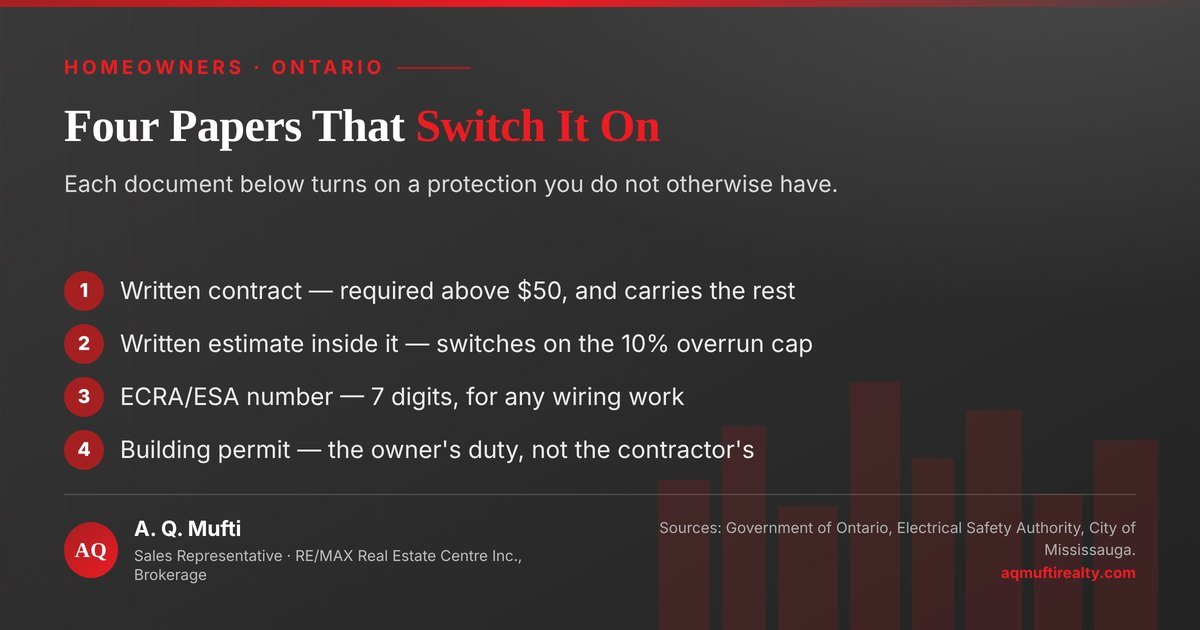
- Get it in writing above $50. Ontario says any home renovation contract worth more than $50 must be in writing. In short, that one line carries most of the rest.
- You have 10 days if you signed at home. You can cancel a contract signed in your house for any reason, with no fee, inside 10 calendar days.
- The 10% cap is conditional. Your final price cannot exceed the estimate by more than 10%, but only if that estimate sits inside the contract.
- Wiring is different. Only a Licensed Electrical Contractor may take on wiring work, and its ECRA/ESA number runs to seven digits.
- The permit is yours. Ontario puts the building permit on the owner, so hiring a contractor never moves that duty.
The numbers behind hiring a contractor in Ontario
Notably, every figure below comes from a government or regulator page. The right-hand column matters as much as the number: some of these are law, and two are only advice.
| Item | Figure | Status |
|---|---|---|
| Written contract threshold | More than $50 | Required |
| Cooling-off, signed in your home | 10 calendar days | Your right |
| Refund after you cancel | Within 15 days | Required |
| Cancel if you never got a copy | Within one year | Your right |
| Final price over a written estimate | 10% maximum | Required, if the estimate is in the contract |
| Deposit size | No more than 10% | Recommended, not a legal cap |
| Written estimates to collect | At least 3 | Recommended |
| Electrical contractor ECRA/ESA number | 7 digits | Required |
| Unlicensed wiring work | Up to 4x faultier | Electrical Safety Authority finding |
| Consumer Beware List entry | 21 to 27 months | How long it stays |
| Building permit | The owner’s job | Ontario’s position |
What the law gives you when hiring a contractor
First, start with the one rule everything else hangs off. It is short, and small jobs skip it most often.
The written contract is the whole foundation
Ontario puts it plainly: “Under Ontario law, any home renovation contract worth more than $50 must be in writing.” That is the province’s own guidance for homeowners, and $50 covers almost every job worth hiring a contractor for.
One wrinkle, because precision matters here. The same page words it as “worth $50 or more” further down. Only a job priced at exactly $50 turns on that gap, so the practical answer holds either way. Write it down.
Ontario sets out what belongs in it, too. Its guide for renovation firms lists the work and materials, an itemized list of products and services, and any warranties.
Equally, the rest of that list is just as useful. It covers the total cost with taxes, start and finish dates, any sub-trades and who pays them, a payment schedule with the deposit, and who cleans up at the end.
Hiring a contractor does not mean hiring a licensed trade
Here is the part that surprises people. For general renovation work, Ontario licenses nobody at all. Likewise no provincial permit hangs on the wall, so hiring a contractor is not like hiring a lawyer or a realtor.
So your cover is the contract plus a few legal rights, not a regulator standing behind the trade. Ontario does suggest you ask whether the crew holds papers from Skilled Trades Ontario, and whether it carries workplace safety coverage.
Two clocks that start after hiring a contractor
Next, two rights to cancel that most homeowners never hear about when hiring a contractor. Both are free, and both run on a clock.
Hiring a contractor at home opens a 10-day window
Sign in your kitchen rather than at an office and a window opens. Ontario says “you have the right to a 10 calendar-day cooling-off period”, and “You may cancel this contract for any reason and without having to pay any cancellation fees within these 10 days.”
Your money comes back quickly as well. Cancel, and the refund is due “including any deposits, within 15 days of the customer’s notice of cancellation”. So hiring a contractor at your kitchen table is safer than it feels.
There is a catch, and a fair one. Ask for work to start inside those 10 days and you owe reasonable pay for what the crew has done and for materials nobody can return. Do not rush the start on a job you are still weighing.
The one-year rule nobody mentions
Then there is a much longer window. You can cancel most contracts within one year if the firm never gave you a copy meeting Ontario’s rules.
Read that twice, because it reframes the paperwork. Instead, the copy in your drawer is no formality. Its absence lets you walk away from the deal for a full twelve months.
What hiring a contractor costs above the estimate
Now the money, where belief and the rules part company most widely. This section is the reason for the headline.
The 10% cap when hiring a contractor needs paper
Ontario caps overruns: “the final price for all goods and services cannot be more than 10% over the original estimate unless you have agreed to new work or a new price.” It is a real protection, and a strong one.
Notice the hinge, though. The business guide spells it out: “If an estimate is included in a contract, you cannot charge more than 10% above the estimated cost.”
No estimate inside the contract, no ceiling. Conversely, a number said out loud in a driveway caps nothing. That is the trap, and it is why hiring a contractor on a verbal quote costs people money.
The protection sat there the whole time. It just needed a line of text to attach itself to, which costs you nothing but a minute with a pen.
So treat the written estimate as part of hiring a contractor, not an afterthought once the crew is on site.
Keep the deposit small, and know it is only advice
On deposits Ontario is cautious rather than binding. It advises you to keep down payments “to a minimum (we recommend no more than 10%)”, and says plainly “never pay the full amount of the contract before the work is done.”
Be clear that this is guidance, not a legal ceiling. Nothing stops a trade from asking for more, so treat a big up-front demand as a signal about who you are dealing with. Ontario also warns against a large deposit framed as paying for materials.
Hiring a contractor for wiring work or a permit
Meanwhile two kinds of work sit outside the general rule, and both carry real consequences. Besides, neither is a place to save money.
Wiring work needs a licensed electrical contractor
Indeed, wiring is the clearest case in the province. The Electrical Safety Authority states that “Licensed Electrical Contractors (LECs) are the only businesses in Ontario legally authorized to do electrical work” in a home.
Still, checking takes a moment. The ESA says a licensed firm has “a 7-digit ECRA/ESA licence number” that appears on vehicles, cards and estimates, and tells you to “Always ask to see this number before you hire anyone”.
ESA also runs a locator tool for licensed firms, so one search settles it before you sign.
Those stakes are not abstract. The ESA reports that unlicensed work “has been found to be up to four times faultier” than licensed work.
Your insurer may take the same view. The ESA warns that “Insurance claims linked to work performed by an unlicensed contractor may be denied by your insurance company.”
One more step belongs to the trade, not to you. Anyone doing the work must file a notification with the ESA before it starts, and the ESA calls it “a red flag if a contractor asks you to file a notification of work in your name.”
A Certificate of Acceptance follows the ESA’s review, and the ESA calls it important for insurance and for resale. Ask for a copy and file it.
Hiring a contractor does not move the permit duty
Permits catch people out for the same reason. Ontario is direct: “It’s your responsibility to get building permits and meet any legal requirements you’ll need to renovate.” So hiring a contractor leaves that duty exactly where it was.
You can pass it over, provided you do so on purpose. Ontario says that if you want the trade to pull permits, spell it out in the contract, and let nobody start building until you have seen them.
What needs one is wider than most people expect. In Mississauga, the list takes in finishing a basement for living space, a second unit, a deck more than about two feet high and a detached garage.
It runs further than that. New or resized windows and doors, skylights, solar panels, moving a sink or a toilet, and a shed over 15 square metres all need one too.
A short honesty note on one threshold. The city writes the deck limit as under 600 millimetres on its no-permit list and over 0.61 metres on its permit list, a centimetre apart. If your deck sits near two feet, call the city rather than guess from a web page.
An hour of checks before hiring a contractor
Finally, the practical part. None of this needs a lawyer, and all of it fits in one evening.
Three written estimates, never one
Ontario’s advice is specific: “Always get at least 3 written estimates from different contractors.” It also says never to take an estimate over the phone, or from a trade that has not looked at the area.
Each estimate should carry a description of the work and an itemized list of products and services with prices. Three of those side by side tell you more about a price than any single quote can.
What to verify before you sign
Then work down a short list. Each item takes minutes, and each one has saved somebody a great deal.
- Search the Consumer Beware List. Ontario publishes a searchable list, and an entry stays on it for 21 to 27 months.
- Ask for the ECRA/ESA number on any wiring job. Seven digits, and the ESA will confirm it. No number means no wiring work.
- Confirm workplace safety coverage. Ontario notes that construction workers and independent operators must hold it, with some exceptions.
- Put the estimate inside the contract. This step switches on the 10% ceiling, and it costs nothing.
- Name in writing who pulls the permit. The duty is yours by default, so say who does it and see the permit before work starts.
- Know the complaint route. Ontario explains how to file a complaint against a contractor, and the ESA takes reports of unlicensed wiring activity.
Keep every piece of it afterward as well. Permits, contracts, invoices and warranties are the papers a buyer’s lawyer asks for years later, which is the quiet case for hiring a contractor properly the first time.
If the work is part of a move rather than a repair, the order matters. My home valuation will tell you what a job is likely to return before you commit, and the monthly market updates track what buyers pay for.
Common questions about hiring a contractor
Short answers to what homeowners in Mississauga and across the GTA ask me most often about renovation work.
Does a contractor in Ontario need a license?
Not for general renovation work. Ontario licenses no general home renovation trade, so hiring a contractor means leaning on the written contract and your legal rights. Wiring is the exception: only a Licensed Electrical Contractor may take it on.
Can I cancel a renovation contract after signing?
Sign it in your home and Ontario gives you a 10 calendar-day cooling-off period, for any reason and with no cancellation fee, with the refund including deposits due within 15 days. Separately, you can cancel most contracts within one year if you never got a compliant copy.
How much can a final bill exceed the estimate?
By no more than 10%, provided the estimate sits inside the contract, unless you agreed to new work or a new price. A verbal quote that never reached the contract carries no ceiling at all, which is the costliest gap in this whole subject.
Who is responsible for the building permit?
You are. Ontario puts the duty on the owner rather than the trade, so hiring a contractor does not transfer it. You may agree that the contractor pulls permits, but Ontario says to spell that out in the contract and to see the permit before anyone starts.
How large a deposit should I pay?
Ontario recommends no more than 10% of the project cost and says never to pay in full before the work is done. Treat that as guidance rather than a legal cap, because nothing stops a trade from asking for more. A big up-front demand tells you something about who you are dealing with.
Sources and further reading
- Ontario – your rights when renovating — the $50 rule, 10 days and 10%
- Ontario – guide for renovation firms — contract contents
- Electrical Safety Authority – licensing — the 7-digit number
- Electrical Safety Authority – notifications — permits and certificates
- Mississauga – when a permit is required — the project list
- Ontario – Consumer Beware List — checking a firm
- Ontario – filing a complaint — if it goes wrong
Keep reading on the blog
More homeowner guides and market analysis from this blog.
- Renovations That Add Value in the GTA — what pays back
- Title Fraud in Ontario — protecting your home
- Stopping Frozen Pipes Before They Burst — winter care
- Fall Home Maintenance in the GTA — seasonal jobs
Ready to weigh a renovation against a move?
Send me your address and what you are thinking of doing. I will walk the house with you, tell you plainly what a buyer in your price band will pay for, and point you to trades I have seen do good work. No pressure, and no obligation.
Prefer to start with a number? Get a tailored home valuation or run the figures in the mortgage calculator.
Disclaimer: Sources: the Government of Ontario, the Electrical Safety Authority and the City of Mississauga, all read on November 9, 2026. General information only, not legal advice. Ontario words the $50 threshold and the deposit guidance in more than one way, and this post gives both readings. Deposit percentages and the three-estimate rule are recommendations, not law. This post does not cover construction lien rights or holdbacks. Permit rules differ by city, so confirm yours. Gas, wiring and roof work belong to licensed trades. A. Q. Mufti – Sales Representative, RE/MAX Real Estate Centre Inc., Brokerage.
A. Q. Mufti — Sales Representative
RE/MAX Real Estate Centre Inc., Brokerage
MSc, PMP®, ABR®, SRS®, CNE®
416 908 5600 · 905 270 2000
info@aqmuftirealty.com
141-1140 Burnhamthorpe Rd. W., Mississauga ON L5C 4E9
Serving Mississauga, Oakville, Milton, Brampton, Toronto and the wider GTHA. More about how I work.