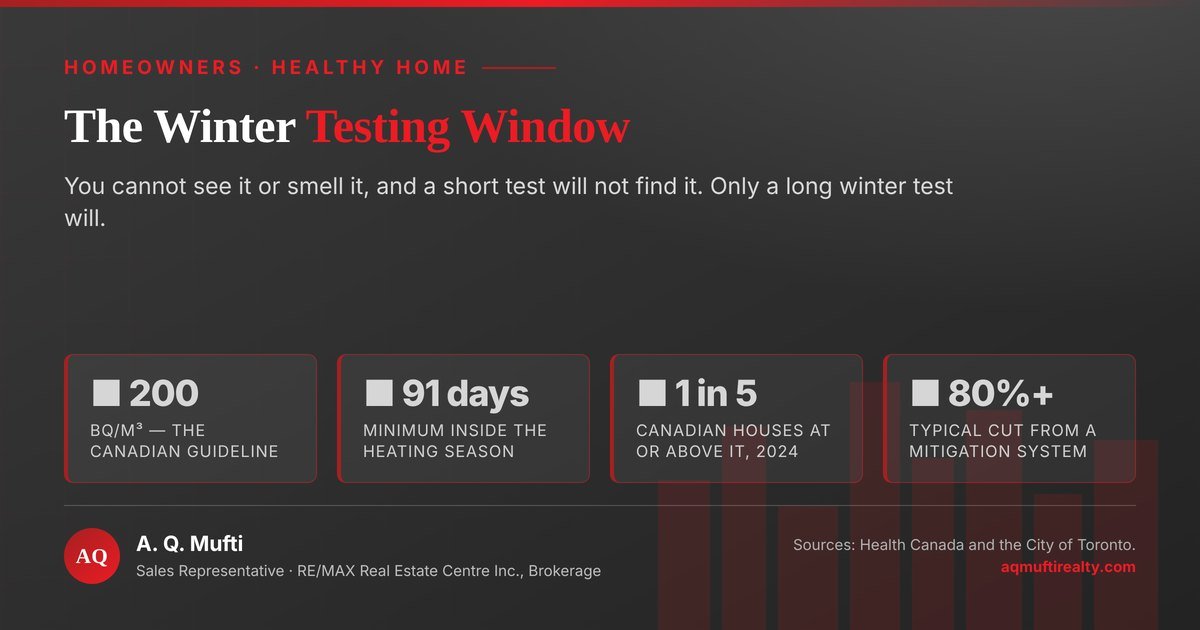
Radon testing in four numbers. Sources: Health Canada and the City of Toronto.
One job on the winter list defeats the human eye. You cannot see, smell or taste radon. So radon testing is the only way a household learns what it has been breathing.
Health Canada is blunt about the stakes. It calls radon “the #1 cause of lung cancer in non-smokers”, and the gas turns up in almost every home in the country at some level.
Here is the part that surprises people. The window for a result you can trust opens with the heating season and shuts in the spring.
The short version
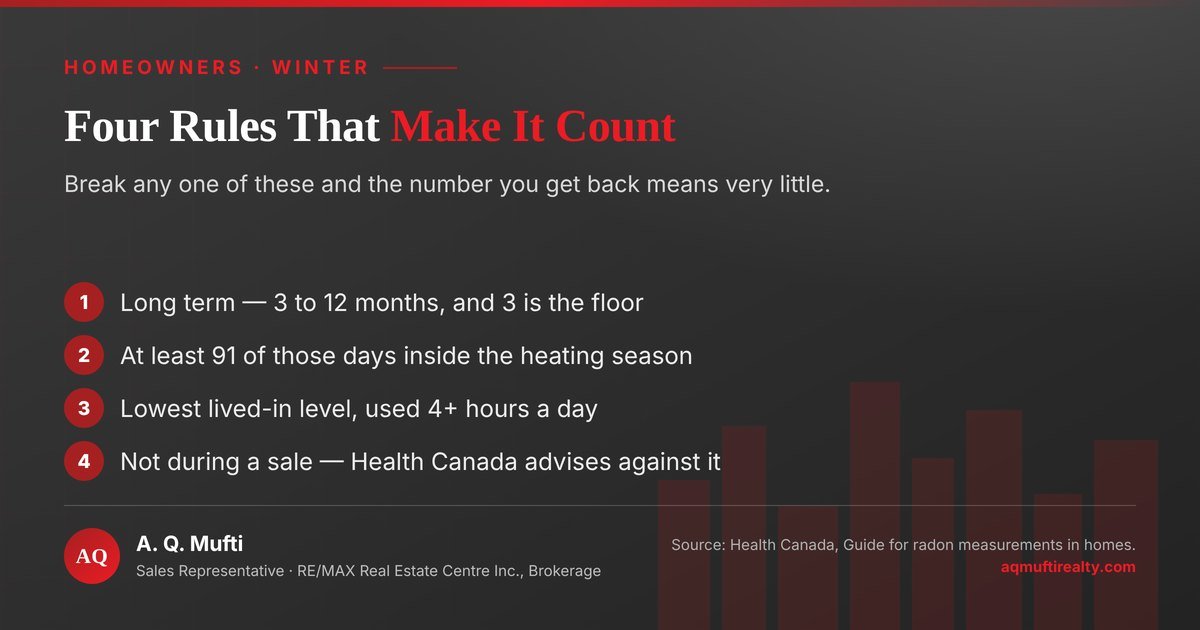
- Winter is the window. Health Canada wants at least 91 test days inside the heating season. So radon testing begun in the cold months yields the reading it trusts.
- Short tests do not count. The recommended test runs three to twelve months. Three months is the floor.
- 200 is the number. Above 200 Bq/m³, Health Canada advises you to fix it within one year.
- Place it with care. Test the lowest lived-in level, in a room somebody uses more than four hours a day.
- Not during a sale. Health Canada steers people away from testing mid-deal. Test before you list, or after you move in.
The numbers behind radon testing in Canada
Notably, every figure below sits on a government page read for this post. The third column matters as much as the number, because three of these count different things.
| Item | Figure | Source and what it counts |
|---|---|---|
| Canadian radon guideline | 200 Bq/m³ | Health Canada, average annual level |
| Act within this long if you are over it | 1 year | Health Canada recommendation |
| Shortest test worth doing | 3 months | Health Canada, long-term test |
| Recommended test length | 3 to 12 months | Health Canada technical guide |
| Test days inside the heating season | At least 91 | Health Canada technical guide |
| What counts as a lived-in space | More than 4 hours a day | Health Canada, normal occupancy area |
| Houses at or above the guideline | About 1 in 5 (17.8%) | 2024 Cross-Canada Survey, houses |
| Canadians living above the guideline | 6.9% | Earlier two-year survey, people |
| Ontario homes above the guideline | 4.6% | Same survey, population-weighted |
| Ontario health regions over 10% of homes | 13 of 36 | Same survey |
| Toronto buildings with a possible risk | About 7% | City of Toronto, all building types |
| Toronto deaths a year that are preventable | 10 | City of Toronto |
| Lung cancer deaths linked to radon | 16% | Health Canada and City of Toronto |
| Typical cut from a mitigation system | More than 80% | Health Canada |
| Time to install that system | Less than a day | Health Canada |
Why radon testing belongs on the winter list
First, what the gas is and how it reaches a living room. Neither is obvious. Both explain why radon testing has a season.
A soil gas, not a building fault
Radon rises out of the ground. Health Canada calls it “a radioactive gas that comes from the breakdown of uranium in soil and rock”, and adds that it is “invisible, odourless and tasteless” to anyone in the room.
Outdoors it disperses and troubles nobody. Indoors it can build up. Therefore, radon testing belongs on a household list rather than an environmental one, and the winter list in particular.
The mechanism is a pressure difference, and it runs with the seasons. Health Canada’s page on radon explains that indoor air pressure “is usually lower than in the soil surrounding the foundation”, so the house pulls soil gas inward.
Then the gas finds the ordinary gaps. Health Canada lists “cracks in foundation floor and walls, construction joints, gaps around service pipes, support posts, window casements, floor drains, sumps or cavities inside walls” as entry points. Most houses have several.
Your neighbor’s result tells you nothing
Even so, most people get this part wrong. Health Canada is direct: levels “will vary from one house to another, even if they are similar designs and next door to each other”, which makes borrowed numbers worthless.
So no map and no postal code stands in for radon testing in your own house. Ontario has districts measuring low on average, with high streets inside them.
What the radon testing numbers actually say
Next, the figures. Three of them look like they disagree, and they do not. Certainly, a few minutes here is worth it.
The guideline, and why it is a choice
Specifically, the threshold is one number. Health Canada’s radon guideline sets it at “200 becquerels per cubic metre (Bq/m³)”, and Halton Region repeats that figure for residents here.
The next line on that page is unusually candid for a standard. Health Canada says “there is no level that is considered risk free”, then adds that it is “the choice of each homeowner to decide what level of radon exposure they are willing to accept”. Read that twice.
Of course, nothing obliges anyone to test, or to fix. That makes radon testing a decision rather than a rule, which is exactly why it slips down the list.
Three counts of how many homes
Here the sources need care. Firstly, Health Canada’s Cross-Canada Survey page reports that the 2024 survey found “approximately 1 in 5 (17.8%) houses in Canada” at or above the guideline. That is a share of houses.
The same page carries an older two-year survey with a smaller number. It found “6.9% of Canadians are living in homes with radon levels above the current radon guideline”, and for Ontario “the population-weighted estimate was 4.6%” of homes. Those count people, not houses.
Still, the two do not contradict each other. One counts houses in a 2024 study. The other counts people, from fieldwork spread over two winters more than a decade ago.
Closer to home, the City of Toronto uses a third measure. It estimates that “seven per cent of buildings in Toronto, including homes, workplaces and schools” hold levels that may pose a health risk. Offices and schools sit in that count too.
All three point one way regardless. Health Canada’s survey says plainly that no part of the country is “radon free”, and that testing is the only way to know a home, “regardless of location”. Hence radon testing rather than guesswork.
Why the health numbers carry the argument
Clearly, the consequence is measured, not theoretical. Toronto Public Health states that radon “is the leading cause of lung cancer after smoking and causes 16% of lung cancer deaths each year” in Canada. That share is what makes radon testing worth an evening.
Likewise, the city puts a local figure beside that one. Toronto counts 10 deaths a year that “could be prevented” if levels came below the guideline. Ten neighbors, every year.
One more line belongs with radon testing in a house with a smoker. Health Canada warns that radon and tobacco together “can significantly increase your risk of lung cancer”, so the two risks compound.
Radon testing only counts if it runs long enough
Now the method, where a well-meant job goes to waste. Equally, it is what makes radon testing a winter post rather than a spring one.
Three months is the floor for radon testing
Health Canada’s testing page gives one instruction above the rest. Run “a long-term test for a minimum of 3 months”, it says. Its technical guide puts the useful range at three to twelve months.
Typically, a two-day kit measures a mood. Levels swing with the weather, with the furnace, and with every open window. So short radon testing cannot stand in for a yearly average, and the quick kit on the shelf is the wrong tool.
The 91 days that have to fall in the cold
Notably, one sentence sets the calendar. The Guide for radon measurements in homes asks for “a minimum of 91 days of the test” inside the heating season. That is the rule behind the timing.
Moreover, Health Canada explains why it insists. A heating-season test “will generally provide a conservative estimate of the annual radon level”, because indoor levels run higher in colder months. Winter gives the cautious reading.
Two things drive that, and the guide names both: “reduced ventilation from closed windows and doors” and more soil gas pulled in “by the stack effect”. A warm house acts like a chimney.
Miss the window and the work may not count. The guide warns that a test with fewer than 91 heating-season days “may require a re-test”. So radon testing begun in May buys you a number, not an answer.
Importantly, Health Canada defines the season by behavior, not by dates. It is the stretch when “home heating appliances are used to supply heat”, which “generally coincides with the colder months of the year”. A GTA test begun on November 20, 2026 reaches 91 days on February 19, 2027, well inside the cold.
Where to put the radon testing device
Generally, placement decides whether the number means anything. For radon testing, the guide wants the device in “a normal occupancy area of the lowest lived-in level”, meaning a space somebody uses more than four hours a day. A finished basement usually qualifies.
Then a short list of mistakes, straight from Health Canada’s own instructions for radon testing:
- Not on the floor, ceiling or an outside wall. The guide tells you to keep the device clear of all three.
- Not in a closet, a drawer or a damp room. Tight spaces and humidity both skew a reading.
- Not where somebody will knock it. Leave air space around it and pick a spot nobody needs.
- Not with the house on best behavior. Health Canada says residents “should not alter their lifestyle during a long-term radon test”, so live as you always do.
Besides, upper floors deserve a look. The guide says a home whose lowest lived-in level sits off the ground “should still be tested”, since the reading can still beat the guideline. Many condo owners skip radon testing for that reason, and they should not.
Why radon testing does not belong inside a sale
Meanwhile, a word about the one moment this job does not fit. It is the moment my own trade would reach for it.
Radon testing before you list, not during
Health Canada’s brochure for REALTORS®, published in December 2019, says it outright. A three-month test is “the only way to accurately find out” a home’s level, and it “doesn’t recommend conducting a radon test during a real estate transaction”. That is their wording, not mine.
In practice, the arithmetic explains the advice. No conditional period in this market runs ninety days. So radon testing squeezed into a deal either reports a short test nobody should lean on, or stalls a closing for a season.
The two moments that do work
Fortunately, Health Canada names both. “Test before you sell”, so a seller can “include the low radon level as a selling feature”. Then “Test after you buy”, with a long-term test once the family moves in. Simple, and both sit outside the deal.
Additionally, the brochure names a third route where the question will not wait. Some agents use “a hold back to allow for radon testing after a transaction is complete”, and the funds then pay for the fix. Ask your lawyer whether that suits your agreement.
For a seller the practical reading is simple. Radon testing done the winter before you list is cheap, quiet and entirely yours. A low number is a line you get to put in the listing.
What to do if radon testing comes back high
Finally, the good news. This is a solved problem. Ultimately a high reading is a repair, not a verdict on the house.
A certified trade, and roughly a day
Health Canada’s guidance on reducing levels is encouraging. A system goes in “in less than a day” and in most homes cuts the level “by more than 80%”, for “about the same cost as other common home repairs”. No dollar figure appears on that page.
Furthermore, the page names who should do the work. Health Canada wants a contractor “certified as a radon mitigation professional from the Canadian National Radon Proficiency Program (C-NRPP)”. This is no weekend project, and radon testing is the only part a household handles alone.
Usually, the fix is mechanical and unglamorous. A pipe runs through the foundation floor and out. A small fan then draws the soil gas away before it enters, and Health Canada calls the method sub-slab depressurization.
The clock, and the rooms that matter most
In addition, there is a recommended pace. Above 200 Bq/m³, Health Canada asks you to “take corrective action to lower the level within 1 year”, and sooner the higher the reading. Nobody needs to rush, but nobody should forget either.
In particular, one GTA detail deserves a flag. The guideline counts a finished basement with “a family room, guest room, office or work shop” as lived-in space, and says it “would also include a basement apartment”. That wording matters here.
In a region with as many basement suites as ours, that puts radon testing on the list for anyone with a tenant downstairs or a parent living below grade. A crawl space, an unfinished basement, a cold room and a laundry room all fall outside the definition.
Later, test again when the ground story changes. The guide asks for a fresh test after a system goes in, when a basement becomes the lowest lived-in level, after damage below grade, and two years after a new build. Test that new home its first heating season as well.
If a move is on the horizon rather than a repair, the order matters. My home valuation tells you where your house sits today, and the monthly market updates track what GTA buyers pay for.
Common questions about radon testing
Short answers to the questions buyers and sellers ask most.
How long does radon testing take?
Health Canada recommends a long-term test of three to twelve months, with three months the minimum. It also wants at least 91 of those days inside the heating season. That is why radon testing begun in late autumn or winter gives the most reliable reading.
What radon level is too high in Canada?
The Canadian guideline is 200 Bq/m³ as an average annual level in a lived-in part of the home. Above that, Health Canada advises corrective action within one year, and sooner the higher the reading. It also notes that no level counts as risk free.
Where in the house should the device go?
On the lowest lived-in level, in a room somebody occupies more than four hours a day. Keep it off the floor, away from outside walls, and out of closets and damp rooms. Carry on living normally while radon testing runs.
Should radon testing happen when buying a home?
Health Canada steers people away from testing during a real estate transaction, because a proper test takes three months. It suggests testing after you move in, or before you list if you are selling. Some deals use a holdback so the work can happen after closing.
Can a high radon result be fixed?
Yes, and usually fast. Health Canada says a mitigation system goes in within a day and in most homes cuts the level by more than 80%, for about what other common home repairs cost. Use a contractor certified by the Canadian National Radon Proficiency Program.
Sources and further reading
- Health Canada – radon — the main hub
- Health Canada – about radon — how it gets in
- Health Canada – testing your home — the 3-month minimum
- Health Canada – guide for measurements — the 91-day rule
- Health Canada – the radon guideline — 200 Bq/m3 and the 1-year clock
- Health Canada – radon in real estate — why not during a sale
- Health Canada – reducing levels — mitigation and C-NRPP
- Health Canada – Cross-Canada Survey — the national figures
- City of Toronto – radon and your health — the Toronto figures
- Halton Region – radon — local guidance
Keep reading on the blog
More seasonal home care and market analysis from this blog.
- Stopping Frozen Pipes Before They Burst — the other winter job
- Fall Home Maintenance in the GTA — furnace and alarms
- Hiring a Contractor in Ontario — quotes and contracts
- Title Fraud in Ontario — protecting your home
Ready to talk about a healthier move?
If a move is coming, tell me when. I will give you a straight read on what your house is worth today, what a buyer in your band actually pays for, and which jobs are worth doing before the sign goes up. No pressure, and no obligation.
Prefer to start with a number? Get a tailored home valuation or run the figures in the mortgage calculator.
Disclaimer: Sources: Health Canada, the City of Toronto and Halton Region, all read on November 16, 2026. General information only, not medical or legal advice. The Canadian guideline is voluntary, and Health Canada says no radon level counts as risk free. The figures quoted here count different things over different periods, and this post says which is which. No dollar cost appears, because Health Canada’s current pages give none. Mitigation is work for a C-NRPP certified professional. A. Q. Mufti – Sales Representative, RE/MAX Real Estate Centre Inc., Brokerage.
A. Q. Mufti — Sales Representative
RE/MAX Real Estate Centre Inc., Brokerage
MSc, PMP®, ABR®, SRS®, CNE®
416 908 5600 · 905 270 2000
info@aqmuftirealty.com
141-1140 Burnhamthorpe Rd. W., Mississauga ON L5C 4E9
Serving Mississauga, Oakville, Milton, Brampton, Toronto and the wider GTHA. More about how I work.