What a buyer representation agreement settles before you see a single listing. Sources: RECO and TRREB. Dollar example calculated.
Signing nothing feels like the careful choice. No fee, no commitment, and you can still tour homes this weekend. Yet in Ontario that instinct works against you, and a buyer representation agreement is the reason.
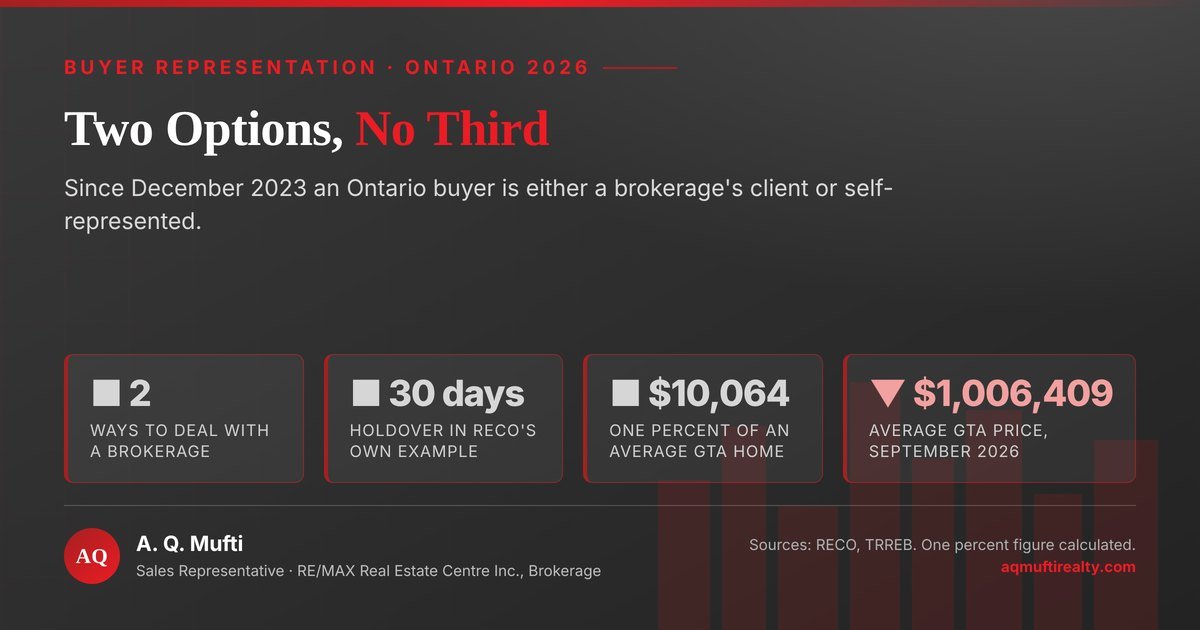
Since December 2023 the province allows two ways to deal with a brokerage. There is no middle one. So the paper you sign decides what help you may receive, not merely what you pay.
The short version
- Two options, not three. You are either a brokerage’s client under a buyer representation agreement or a self-represented party. The old customer route ended on December 1, 2023.
- Unsigned means unadvised. An agent who works for the seller may not give you services, opinions or advice, and must pass on what you say.
- You set the expiry date. It must sit on page one, and RECO says no standard term exists.
- The holdover clause is the trap. It can make you owe a fee after the agreement ends. RECO’s own example runs 30 days, and no law sets a floor.
- No rule sets the fee. You and the brokerage settle it. The agreement must also say what happens if the seller covers less than you owe.
The rules in numbers
First, here is what RECO publishes. Every line below shapes what a buyer representation agreement can and cannot hold, and none of it is a matter of opinion.
| Measure | Figure | Source |
|---|---|---|
| Date customer relationships ended | Dec 1, 2023 | RECO |
| Ways to deal with a brokerage now | 2 | RECO |
| Expiry dates one agreement may carry | 1 | RECO |
| Where the expiry date must appear | Page one | RECO |
| Minimum holdover period set by law | None | RECO |
| Holdover length in RECO’s own example | 30 days | RECO |
| Standard set of services | None | RECO |
| Standard fee or commission rate | None | RECO |
| Average GTA selling price, September 2026 | $1,006,409 | TRREB |
| One percent of that average price | $10,064 | Calculated |
What a buyer representation agreement actually does
Start with the shape of it. Indeed the paper does two jobs at once, and buyers tend to notice only the second.
Two ways to deal with a brokerage, and no third
Ontario used to offer a middle path. An agent could give you opinions and advice under a customer arrangement, with no full duty of care, and many buyers worked that way for years.
That path closed. “Effective December 1, 2023, customer relationships and agreements are not permitted,” RECO told the sector. Two groups remain: “A client of a brokerage, or” “A self-represented party.”
Why a buyer representation agreement must be written
So the signing is not a ritual. “Your agreement must be put in writing and presented to you as soon as possible,” RECO tells buyers.
Then it states the result without softening it. “If you don’t want to sign an agreement, you should not expect the real estate agent to provide you with any services.”
What the agreement must spell out
Here RECO gets specific. A brokerage must set out the terms “clearly, comprehensibly and prominently,” its sector advisory says, naming “the services that the brokerage will provide under the agreement.”
Also on that list: how the fee is worked out, how it gets paid, when it may change, and both the date the buyer representation agreement starts and the date it ends.
The buyer representation agreement you decide not to sign
Next, the route that looks free. Plenty of buyers tour a home, like it, and write an offer through the listing agent with nothing signed.
What the other side’s agent owes you
Not much, in the sense you would hope for. That agent “has a legal obligation to act in the best interests of their client,” RECO warns. Their client is the seller.
Then comes the line worth reading twice. “The agent is obligated to share anything you tell them with their client,” which covers your motivation, your price limits and your preferred terms. RECO adds four words: “Be careful what you share.”
What that agent may not do
Meanwhile the rules cut the other way too, which catches people who expect at least a hint. An agent who works for the seller cannot “provide you with any services, opinions, or advice.”
Nor may they “do anything that would encourage you to rely on their knowledge, skill, or judgement.” Any help they offer is “a service to their client, not you.”
Put simply, with no buyer representation agreement you carry the whole load. “It will be your responsibility to look after your own best interests and protect yourself,” RECO says, and it urges you to “seek independent professional advice” first.
Signing a buyer representation agreement later is allowed
Still, the door stays open. “You can choose to become a client of a real estate brokerage at any point during the transaction,” the same page notes.
Of course the seller has heard whatever you said before that. Hence waiting costs you information rather than money.
Three terms in every buyer representation agreement
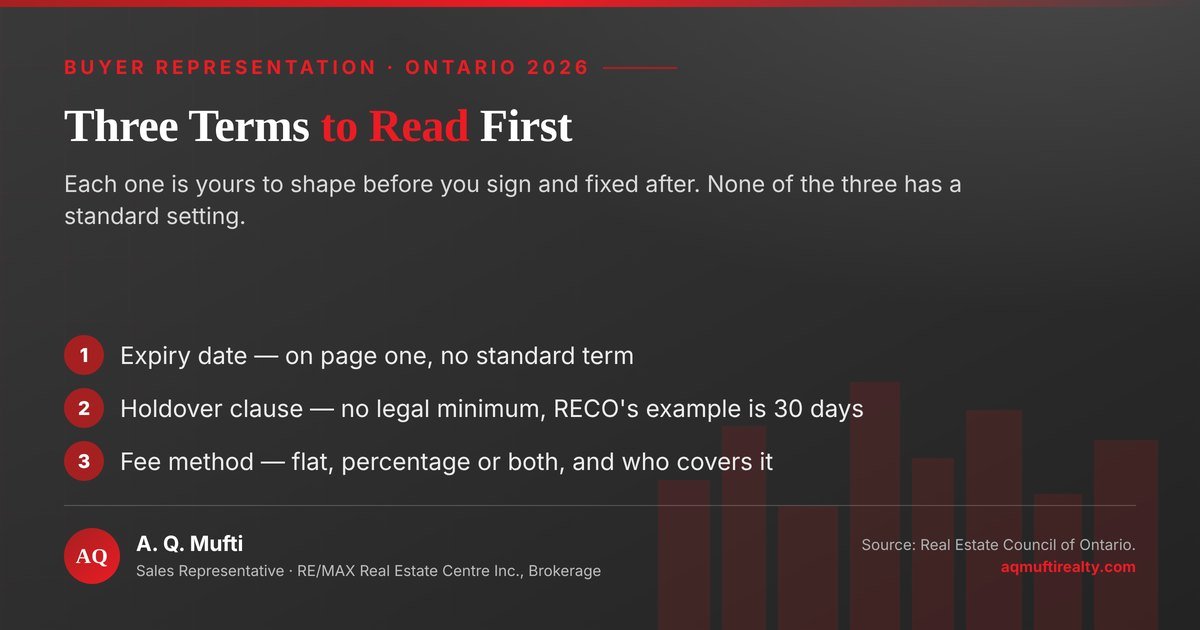
Now the part to read slowly. Three terms decide what the deal costs you, and each one is yours to shape before you sign.
The expiry date, on page one
First, how long it runs. “The agreement’s expiry date must appear prominently on the first page,” RECO states, and the advisory asks that an agreement “contains only one date on which the agreement expires.”
Yet nothing sets the length. “There is no set time or standard term for a representation agreement,” so a six-month default is an opening offer, not a rule. A week is as valid as a year.
The holdover clause and its quiet 30 days
Second, the term that outlives the buyer representation agreement. “Most representation agreements include what is often called a holdover clause,” RECO says, and it “may require you to pay the brokerage fees for a purchase or sale even when the transaction happens” later.
Then RECO says plainly whose side the clause takes. “A holdover clause is designed to protect the brokerage, and there is no minimum or set time for a holdover period.”
RECO’s own example uses 30 days, and warns a buyer who buys inside that window “might be obligated to pay the brokerage commission.” So a deal ending November 30 can still reach December 30 (calculated).
The fee method, and what the seller may not cover
Third, the money. “You and the brokerage decide the amount you will pay for services,” and you “can agree to pay a fixed dollar amount, a percentage of the sale price, or a combination of both.”
Also check one clause nobody reads aloud: “how the amount you agree to pay will change if the seller agrees to cover some or all of your brokerage fees.” Because “a seller might not offer any amount” at all.
What a buyer representation agreement costs in the GTA
Next, turn a percentage into dollars. Rates in the abstract help nobody choose, and GTA prices give the math real weight.
Why no rate is standard
Begin with what is not true. Ontario sets no rate, and RECO frames the fee as something you and the brokerage settle between you.
So a quoted figure is a starting point. Equally, a lower rate that drops services you need is no saving, which is why the fee clause and the services clause belong together.
What one percent looks like on an average price
Here is the scale. The average GTA selling price was $1,006,409 in September, down 5.1% in a year, on 5,040 sales and 16,500 new listings, TRREB reported.
One percent of that price comes to $10,064, which I worked out. So every quarter point you discuss before you sign a buyer representation agreement is worth about $2,500 on an average buy, which earns ten minutes of talk.
Yet the fee is rarely the biggest number in the file. A badly timed offer or a missed condition can cost far more. That risk is what the services clause really buys.
Services a buyer representation agreement may leave out
Now the clause people skim. It looks routine, it runs a few lines, and it governs everything the brokerage owes you.
There is no standard list
RECO says so outright. “There is no standard set of services,” and buyers should not “assume a particular service will be provided if it’s not included in the agreement.”
So read the list as a list, not as comfort. A buyer representation agreement may also narrow its own reach, since it “might identify a specific property, a geographic area you are searching in, a type of property you are looking for, or other specific requirements.”
Multiple representation is yours to refuse
Then there is the case where one brokerage sits on both sides. “You do not have to agree to multiple representation,” RECO states, and saying no carries results the paper should describe.
Namely, “the agreement could terminate completely, or you might be referred to another brokerage.” Under designated representation, “the brokerage cannot appoint a different designated representative unless you agree.”
How a buyer representation agreement ends
Finally, the exit. “The agreement should list all circumstances when the agreement can be terminated,” and buyers should “make sure you are aware of any penalties or costs that might apply in each case.”
Even so, the exit and the holdover are two questions. Ending a buyer representation agreement early does not switch off a holdover clause by itself, so read both at once.
How to read a buyer representation agreement before signing
Finally, the practical part. None of this needs a lawyer, though a lawyer is never a waste on a buy this large.
Before you sign
- Ask for the RECO Information Guide first. An agent is “required to provide and explain the RECO Information Guide before providing any services,” per RECO’s own pages.
- Set the expiry date yourself. No standard term exists, so a short first buyer representation agreement lets you judge the service before you extend it.
- Next, read the holdover period aloud. Ask how long it runs and which homes it covers. RECO says to agree the length before you sign.
- Check the fee clause twice. Once for the method, once for what shifts if the seller covers less than you owe.
- Confirm the services in writing. If a service matters to you and the list leaves it out, nobody promised it.
Before you tour a home with nothing signed
- Assume everything you say travels. The listing agent must pass your motivation and your limits to the seller.
- Expect no view on price. An agent cannot advise a self-represented party, however much they would like to.
- Then get the disclosure form. You should receive RECO’s Information and Disclosure to Self-represented Party form before any help.
- Also price the home on your own. I can put recent Mississauga, Oakville and Milton sales beside the one you like.
Reading a buyer representation agreement takes twenty minutes once. Living with the wrong one can run the length of your search, which is the whole argument for the twenty minutes.
Want help with the rest of the purchase? My step-by-step guide for buyers walks through the whole process, the mortgage calculator turns a price into a monthly figure, and my monthly market updates track the price figures above.
Your questions on a buyer representation agreement
Short answers to what buyers in Mississauga, Oakville and Milton ask me most before they sign anything.
Do I have to sign a buyer representation agreement?
No. Nobody can make you sign one. Without it you are a self-represented party, so no agent in the deal may give you services, opinions or advice, and the listing agent must report what you say to the seller.
How long does the agreement last?
Whatever length you and the brokerage agree. RECO says no set time or standard term exists, and the expiry date has to sit on the first page.
What is a holdover clause?
A term that can make you owe the brokerage fee on a home you buy after the agreement ends. RECO’s example runs 30 days, and no law sets a floor or a ceiling, so ask before you sign.
Who pays my brokerage under a buyer representation agreement?
Your agreement says what you owe, and a seller often covers part or all of it. Still, RECO warns a seller might offer nothing, so the clause covering that gap matters more than the headline rate.
Can I cancel a buyer representation agreement early?
Sometimes, and the paper itself is the answer. It should list every case in which it can end, along with any penalty or cost. Because the exit clause and the holdover clause are separate, read both.
Sources and further reading
- Signing a brokerage contract, from RECO — the buyer page
- Risks of representing yourself, from RECO — the unsigned route
- Sector advisory on agreements, from RECO — the required terms
- Bulletin 2.6 on customer relationships, from RECO — the 2023 change
- TRESA questions and answers, from RECO — the information guide
- September 2026 market release, from TRREB — the market
Keep reading on the blog
More guides and market analysis from this blog.
- Firm, Conditional or Bully Offers in Ontario — the offer itself
- Closing Costs in Ontario, Itemized — the cash you need
- Land Transfer Tax in the GTA — on closing day
- GTA Home Sales, September 2026 — the market
Ready to see the paperwork before you commit?
Send me the agreement you have been handed, or ask me for mine, and I will walk you through every clause line by line so you know what you are signing. No pressure, and no obligation.
Prefer to start with a number? Get a tailored home valuation or run the figures in the mortgage calculator.
Disclaimer: This article draws on RECO’s buyer guidance, its sector advisory, Bulletin 2.6 and its TRESA questions and answers, plus TRREB’s September 2026 release. It offers information only. I worked out the $10,064 one percent figure and the December 30 holdover example. Rules change and every buyer representation agreement differs, so read your own paper and take legal advice before you sign. Nothing here is legal advice. A. Q. Mufti – Sales Representative, RE/MAX Real Estate Centre Inc., Brokerage.
A. Q. Mufti — Sales Representative
RE/MAX Real Estate Centre Inc., Brokerage
MSc, PMP®, ABR®, SRS®, CNE®
416 908 5600 · 905 270 2000
info@aqmuftirealty.com
141-1140 Burnhamthorpe Rd. W., Mississauga ON L5C 4E9
Serving Mississauga, Oakville, Milton, Brampton, Toronto and the wider GTHA. More about how I work.