
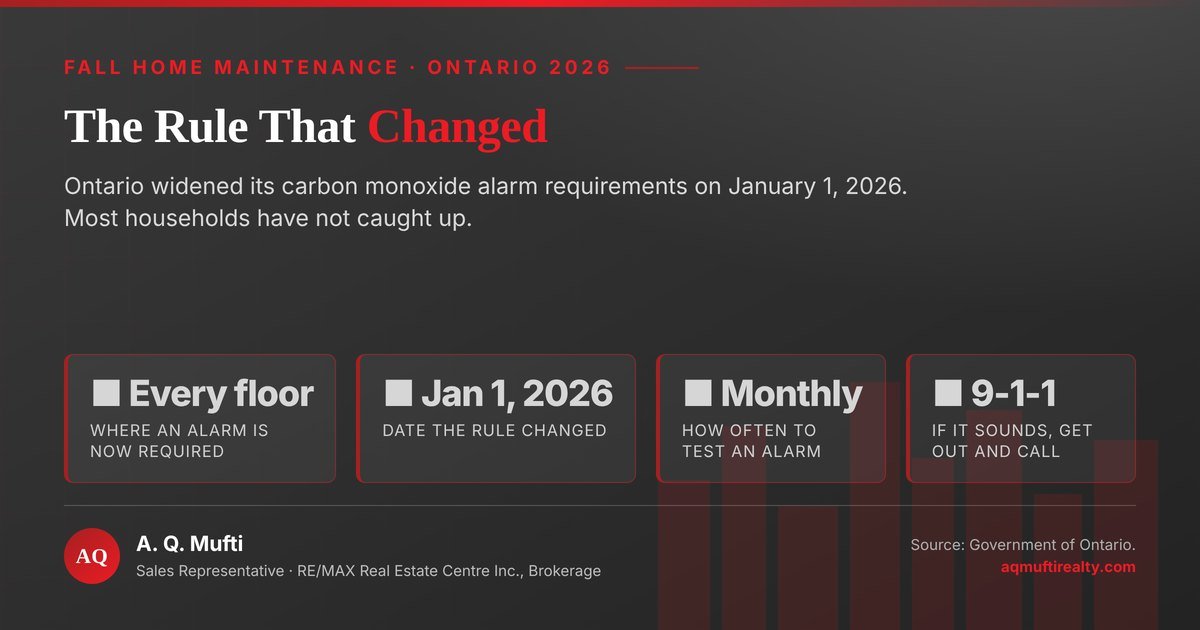
The fall home maintenance that matters most costs almost nothing and takes an afternoon. Source: the Government of Ontario.
Most seasonal checklists read the same every year, which is why most of us skim them. This one has something new in it, and it is the law.
Ontario changed its carbon monoxide alarm rules on January 1, 2026, and the change caught a lot of households off guard. So this year fall home maintenance starts indoors, with an alarm rather than a rake.
The short version
- Alarms now go on every level. Since January 1, 2026 Ontario requires a carbon monoxide alarm on every floor of a home, not only beside the bedrooms.
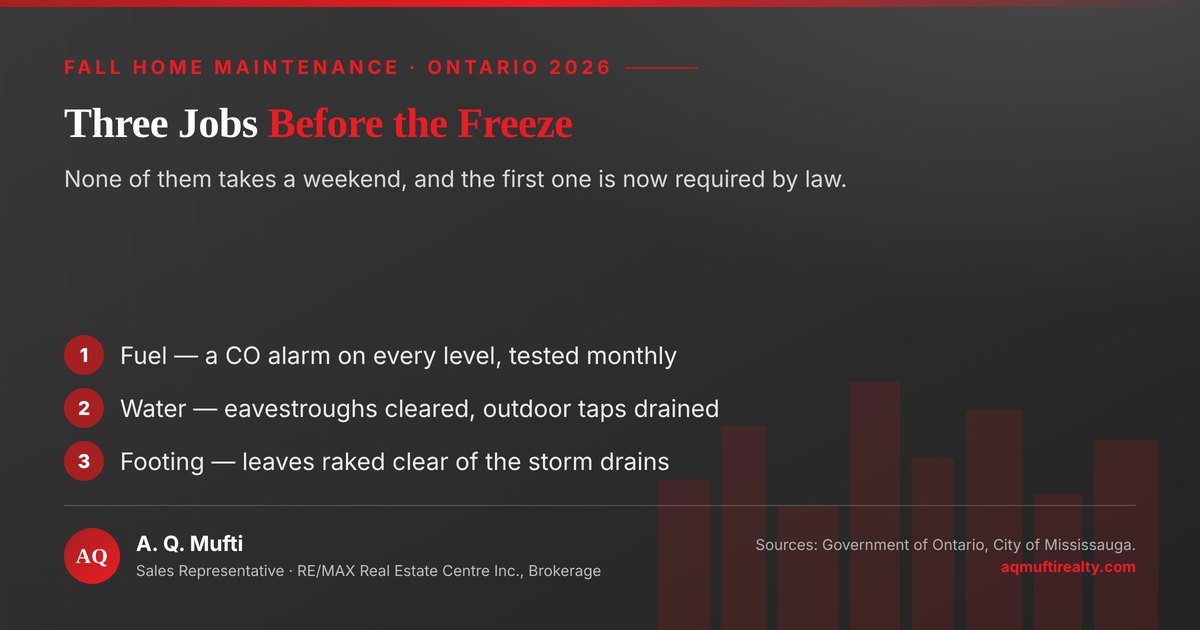
- One job is fuel, one is water, one is footing. That is the whole of fall home maintenance, and none of the three takes a weekend.
- Test monthly, not yearly. The province says to press the test button every month and change batteries once a year.
- Keep leaves out of the storm drains. Mississauga asks for it directly, and a blocked drain is what floods a street in a December thaw.
- Call a licensed technician for anything that burns fuel. Furnaces, fireplaces and water heaters are not homeowner jobs.
The rules in numbers
First, here is what Ontario and the City publish. Every line below shapes what fall home maintenance has to cover in a GTA house, and none of it is a matter of opinion.
| Measure | Figure | Source |
|---|---|---|
| Date the every-floor alarm rule took effect | Jan 1, 2026 | Ontario |
| Alarms required next to each sleeping area | Yes | Ontario |
| Floors of a house needing an alarm | Every one | Ontario |
| What triggers the requirement | Fuel appliance, fireplace or attached garage | Ontario |
| How often to press the test button | Monthly | Ontario |
| How often to change the batteries | Yearly | Ontario |
| Who is responsible in an owned home | The owner | Ontario |
| Removing a battery to stop the noise | Illegal | Ontario |
| If an alarm sounds | Leave, then call 9-1-1 | Ontario |
| Raked leaves near a curbside storm drain | Keep clear | Mississauga |
Why fall home maintenance changed this year
Start indoors, because this is the part that is genuinely new. Indeed a household that did everything right last fall may be short an alarm this fall.
What changed on January 1, 2026
Ontario widened where alarms are required. A home now needs one “on every storey of your home, including storeys that do not have sleeping areas,” the province sets out on its carbon monoxide safety page.
Then it added a trigger. Being heated by air from a fuel-burning appliance that sits outside the home now brings a house inside the rule, which catches setups that were previously exempt.
Where the alarms have to sit
The older rule still stands alongside the new one. An alarm goes “adjacent to each sleeping area,” so a bedroom hallway needs one whatever else you have.
Also check what put your house in scope in the first place. For a house it is a fuel-burning appliance, a fireplace, or an attached garage, which covers most homes in Mississauga, Oakville and Milton.
Fall home maintenance starts with a test button
Here is the part almost nobody does often enough, and it belongs at the top of any fall home maintenance list. Ontario asks you to test alarms monthly and replace the batteries yearly, and it is blunt about shortcuts: removing batteries or tampering with an alarm is illegal.
Still, a chirp is not always a flat battery. An alarm chirps when the battery is low, and also when the unit has reached the end of its life and needs replacing outright.
Fall home maintenance job one: the air you breathe
Next, the appliance behind the alarm. An alarm tells you something has already gone wrong, so the real work is making sure it never sounds.
Fall home maintenance stops at anything burning fuel
Be plain about this one. A furnace, a gas fireplace, a boiler or a gas water heater is not a homeowner job, and the yearly service call before the heating season is the single most useful thing on any fall home maintenance list.
Of course a filter is different. Changing a furnace filter is a two-minute job you can do yourself, and a clogged one makes the system work harder all winter.
What the symptoms look like
Know these, because they imitate ordinary winter illness. Ontario lists headaches, nausea, dizziness, confusion, drowsiness, loss of consciousness and death. No amount of fall home maintenance replaces knowing them.
Therefore treat a whole household feeling unwell indoors, and better outdoors, as a reason to leave and check. If an alarm sounds, get everyone out immediately and call 9-1-1 from outside.
Even so, know which alarm you are hearing. A carbon monoxide alarm sounds different from a smoke alarm, and the province asks that everyone in the home can tell them apart, including children old enough to act on it.
Fall home maintenance job two: water before it freezes
Now outdoors, and this job is pure arithmetic. Water that cannot run away freezes where it stands, and ice moves things that were never built to move.
Eavestroughs and downspouts
Clear them once the leaves are mostly down. This is the fall home maintenance job with the shortest window. A full eavestrough holds water, water freezes, and the weight pulls at the fascia and pushes melt back under the shingles.
Then check where the downspout actually ends. Pointing it well away from the foundation is the cheapest basement insurance there is, and it costs an afternoon.
Outdoor taps and hoses
Disconnect every hose. A hose left attached traps water in the tap, and that is where a burst usually starts, inside the wall rather than outside it.
Next, shut off the indoor valve that feeds each outdoor tap and open the outdoor tap to drain the line. Two minutes per tap, and it is the part of fall home maintenance people most often skip.
Ladders and roofs are where people get hurt
Say the quiet part out loud. More homeowners are injured clearing eavestroughs than by almost any other seasonal job, so if the roof is steep, the ladder is old, or you are working alone, hire it out.
Fall home maintenance job three: leaves and drains
Finally, the ground. This is the job that protects your street as much as your house, and the one your neighbors notice.
What Mississauga asks for
The City collects raked leaves from the boulevard, and it asks for two things in particular. Pile leaves at the edge of the boulevard or in the ditch a day or two before your collection week, and “keep the road and curbside storm drains clear of raked leaves,” its fall leaf pickup page says.
Also keep wood, bricks and brush out of the pile, and do not set garbage bags or bins on top of loose leaves. Dates shift with rain and early snow, so check the route map or call 311 rather than guessing.
Why a blocked drain is a December problem
Here is the connection people miss, and it is why fall home maintenance is partly a street-level job. A storm drain packed with wet leaves freezes solid, and then the first thaw has nowhere to go but along the curb and toward the lowest driveway on the street.
Fall home maintenance for the people who visit you
Then walk your own path as a visitor would, because this is the fall home maintenance that other people feel. A loose step, a wobbly handrail or a dark walkway is a small job in October and a serious one in January, particularly for grandparents and for anyone carrying a child.
So check the handrail is firm, replace the bulb by the door, and decide now where the salt and the shovel will live. Equally, pick a salt that is safe around pets if you have them, since the cheapest bag rarely is.
- Walk every floor and count your alarms. One next to each sleeping area, and one on every level, including the basement.
- Press every test button. Then put a monthly reminder in your phone, because monthly is what the province actually asks for.
- Book the furnace service. Before the first cold snap, not during it, when every technician in the GTA is booked.
- Clear the eavestroughs and drain the taps. Or hire it out if the roof is steep.
- Rake to the boulevard, not into the drain. And check your collection week rather than assuming last year’s dates.
What fall home maintenance protects beyond this winter
One last thought, and then I will leave you to the rake. These jobs are about the people in the house first, but they do quietly protect the house itself.
What fall home maintenance tells an inspector
A home inspector reads the same signs you do, only later. Water staining at the fascia, a downspout emptying against the foundation, or a furnace with no service record are all things that turn into questions during a sale.
So a year of steady fall home maintenance is not a selling tactic. It simply means the questions have good answers when somebody eventually asks them.
And the market, briefly
For context rather than pressure: the average GTA selling price was $1,006,409 in September, down 5.1% in a year, TRREB reported. A softer market rewards a home that has obviously been looked after.
Want a hand with any of that? My home valuation tells you where your house stands today, the mortgage calculator handles the money side, my step-by-step guide for buyers covers a purchase, and my monthly market updates track the figures above.
Your questions on fall home maintenance
Short answers to what homeowners in Mississauga, Oakville and Milton ask me most once the clocks go back.
Does fall home maintenance mean an alarm on every floor?
In Ontario, yes, since January 1, 2026. The province requires one on every level of a home, including levels with no bedrooms, on top of the existing alarm next to each sleeping area.
My alarm chirps. Is it just the battery?
Not always. A chirp means a low battery or that the unit has reached the end of its life and needs replacing. Check the date on the back before you assume it is the battery, and make that check part of your fall home maintenance.
What is the one fall home maintenance job people skip?
Draining the outdoor taps. A hose left connected traps water in the line, and the burst that follows usually happens inside the wall rather than outside it.
Can I do the furnace myself?
Change the filter yourself, and leave the rest to a licensed technician. Anything that burns fuel is a safety job, and an annual service before the heating season is worth booking early.
Where do I put my raked leaves in Mississauga?
At the edge of the boulevard or in your ditch, a day or two before your collection week, with the road and the curbside storm drains kept clear. Keep wood and brush out, and check the route map, since rain and early snow move the dates.
Sources and further reading
- Carbon monoxide safety, from the Government of Ontario — the alarm rules
- Fall leaf pickup, from the City of Mississauga — the leaves
- September 2026 market release, from TRREB — the market line
Keep reading on the blog
More guides and market analysis from this blog.
- Interest Rate Hike and Your GTA Mortgage — the rate news
- Renovations That Add Value in the GTA — bigger jobs
- GTA Home Sales, September 2026 — the market
- GTA Home Pricing Strategy — if you are selling
Ready to talk about the house itself?
Whether you are selling in the spring or staying put for another ten years, I am happy to walk through what is worth doing and what is not. No pressure, and no obligation.
Prefer to start with a number? Get a tailored home valuation or run the figures in the mortgage calculator.
Disclaimer: This fall home maintenance guide draws on the Government of Ontario’s carbon monoxide safety page, the City of Mississauga’s fall leaf pickup page and TRREB’s September 2026 release. It offers general information only and is not a substitute for a professional inspection. Any work on a furnace, fireplace, gas line, chimney or electrical system needs a licensed technician, and roof and ladder work carries real risk of injury. Rules differ between municipalities, so confirm your own before you act. A. Q. Mufti – Sales Representative, RE/MAX Real Estate Centre Inc., Brokerage.
A. Q. Mufti — Sales Representative
RE/MAX Real Estate Centre Inc., Brokerage
MSc, PMP®, ABR®, SRS®, CNE®
416 908 5600 · 905 270 2000
info@aqmuftirealty.com
141-1140 Burnhamthorpe Rd. W., Mississauga ON L5C 4E9
Serving Mississauga, Oakville, Milton, Brampton, Toronto and the wider GTHA. More about how I work.