
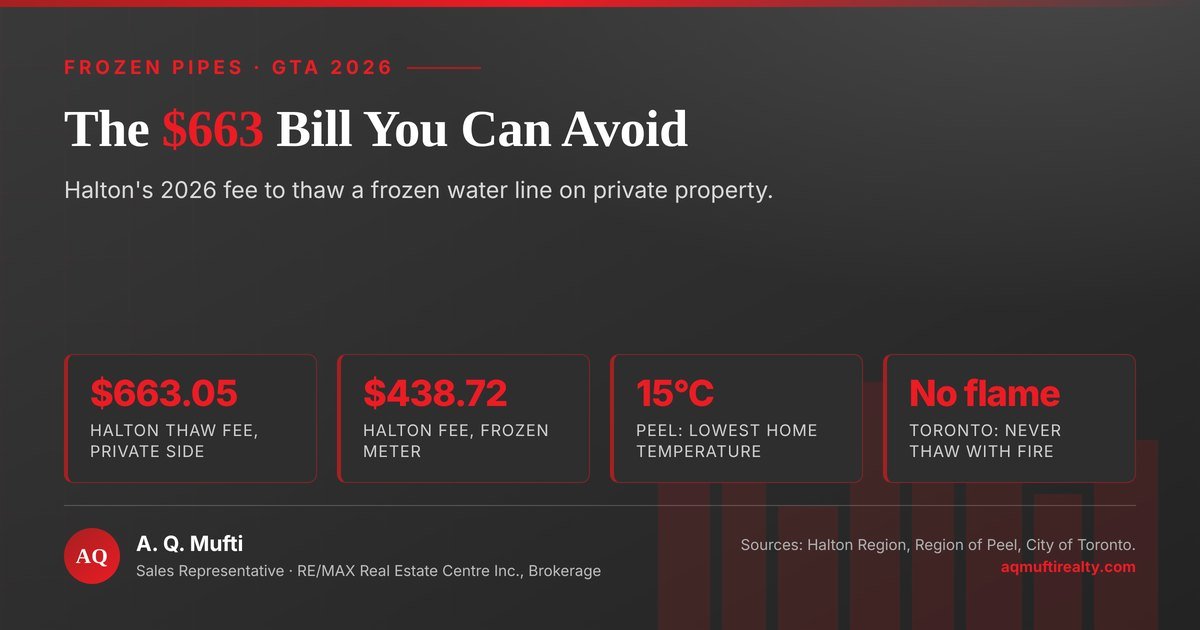
Frozen pipes at a glance: what three GTA water authorities say, and what a thaw can cost. Sources: City of Toronto, Region of Peel, Halton Region.
Most of us only think about the water pipes when a tap gives a cough and then nothing. By then the job is harder, colder and often more expensive than it needed to be.
So here is a number to start with. Halton Region bills $663.05, at its 2026 rate, each time it thaws a frozen water line on your side of the property line. Most frozen pipes are cheap to prevent and slow to fix. The work is also far easier in November than in a January cold snap.
The short version
- Prevention is cheap. Drain the outdoor taps, insulate exposed pipes, seal drafts and find the main shut-off valve. That covers most frozen pipes before they start.
- Keep the house warm, even when away. Peel says no lower than 15°C, Halton says indoor air above 12°C, and Toronto says pipe areas above 8°C.
- Do not run taps by habit. Toronto says a thin stream may help below -15°C, but you pay for the water. Halton asks you to do it only when it contacts you.
- Never use a flame. Toronto calls a blowtorch, propane heater or any open flame a fire and carbon monoxide hazard.
- Know who owns which pipe. The city or region owns the street side of the line. You own the rest, plumbing included.
The rules in numbers
First, here is what the three water authorities that serve most of the GTA publish. Every line below shapes how you handle frozen pipes, and each one comes from the authority itself.
| Measure | Figure | Source |
|---|---|---|
| Fee to thaw a frozen line on private property (15-25 mm) | $663.05 (2026 rate) | Halton |
| Fee if freezing damages the water meter (15-25 mm) | $438.72 (2026 rate) | Halton |
| Both fees in one freeze (calculated) | $1,101.77 | Calculated |
| Keep areas with water pipes above | 8°C | Toronto |
| Keep indoor air above | 12°C (54°F) | Halton |
| Keep the home no lower than | 15°C (60°F) | Peel |
| Night low when a thin stream may help | Below -15°C | Toronto |
| Who pays for water left running | You do | Toronto |
| How long a thaw can take | 1 to 6 hours | Toronto |
| Thawing with an open flame | Never | Toronto |
Why frozen pipes start in the coldest corner
Start with the cause, because it tells you where to look. “When water freezes, it expands,” Peel says. A pipe has nowhere to give, so it splits. Then the leak only shows up once the ice melts.
Where frozen pipes usually start
Toronto points first to pipes along exterior walls. It also names the spot where the water line comes in through the foundation. Peel adds the basement, a crawlspace, and pipes near an outside wall, a window or a cracked foundation.
Halton adds the garage and the attic. And it names the root cause plainly: plumbing in a space without enough heat. So the risk is not the whole house. Instead it is the one cold corner where a pipe runs past a draft.
Who owns which part of the pipe
This matters as soon as something goes wrong, so know it now. In Toronto, the City owns the line from the watermain to the property line. Owners and landlords own the part “that runs from the property line into the home,” says the City’s frozen pipes page.
Halton draws the line at the curb stop, a valve that usually sits just outside the property line. From there in, however, the pipe is yours. Homeowners are also “responsible for all indoor plumbing,” Halton adds, and for keeping the water meter from freezing.
Renters have one extra step. Toronto suggests asking the landlord who handles outdoor taps, plumbing and shut-off valves. Ask before the first cold night, not during it.
Three regions, three numbers for frozen pipes
Here is where it gets confusing, and it is worth a minute. Each of the three water authorities gives a different minimum, yet they are not really arguing with each other.
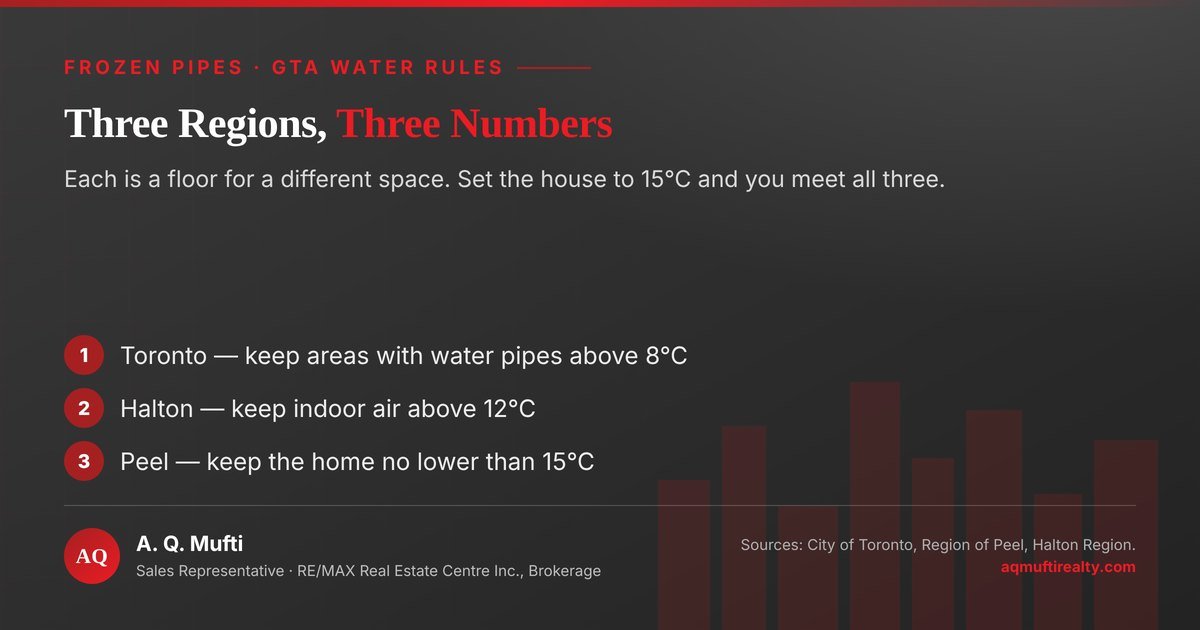
Toronto says keep areas with water pipes above 8°C, especially near the water meter. Halton, by contrast, says keep indoor air above 12°C. And Peel, which supplies Mississauga and Brampton, says keep the temperature in your home no lower than 15°C.
How to read them together
Each figure is a floor, and each one measures a different space: the cold corner, the air, and the whole house. So my own reading is simple. Set the thermostat to 15°C or more and you meet all three. That holds as long as the corner by the meter is not much colder than the rest of the house.
Then check that corner. A cheap thermometer near the water meter tells you more about frozen pipes than the thermostat upstairs ever will.
If you travel over the holidays
Toronto says to keep your home warm overnight and while you are away. For a long trip, Peel and Halton go further. Turn off the main shut-off valve and drain the system through a tap on the lowest level. Then have someone check the house while you are gone.
Peel also asks for a daily check that the heat is on. Halton also suggests you flush the toilets after the valve is off. Both steps take minutes, and they turn frozen pipes from a flood into a nuisance.
Stop frozen pipes before the first hard frost
Now the work itself, and most of it costs very little. Toronto, Peel and Halton list nearly the same jobs. That is a good sign they are the ones that matter.
- Drain the outdoor taps. Disconnect the hoses and turn off the indoor valve for each outdoor tap. Then open the tap outside so the line drains.
- Insulate exposed pipes. Toronto suggests foam pipe covers in basements, crawl spaces, garages and attics.
- Seal the drafts. Around windows, doors, vents, wiring and the pipes themselves.
- Find the main shut-off valve. And make sure it turns, because a seized valve is no help at 3 a.m.
- Keep the garage door closed. If water pipes run through it, an open door is the fastest way to freeze them.
The meter needs its own attention
Peel notes that the meter usually sits in the lowest part of the home, next to the main shut-off valve. For the meter pipes, it suggests foam insulation or a heat wrap. Use these “only as directed,” Peel adds, and look for a CSA or UL mark. Toronto also suggests opening the cabinet doors under sinks so warm air reaches the plumbing, a free guard against frozen pipes.
Should you leave a tap running for frozen pipes?
Only with care, and the rules differ. Toronto says that when night lows drop below -15°C, you may choose to run “a pencil-thin stream of water from vulnerable taps” at your own cost. It also asks you to keep the drain clear.
Halton is stricter. It asks you to run water nonstop only when Halton contacts you. Do it on your own, and you pay for the extra water. So in Oakville, Milton or Burlington, wait for the call rather than guessing.
What to do when frozen pipes leave you with no water
First, a quick test that tells you whose problem it is. If only some fixtures are dry, your indoor plumbing has likely frozen, Halton says. But if no tap, shower or toilet has water, the service line is frozen.
Thawing frozen pipes safely
Toronto’s steps are short and sensible. Open the basement cold water tap, ideally in the laundry room, so water can flow as the ice melts. Then warm the pipe with a heating pad, a hair dryer or warm towels. Never leave a heating device unattended.
Be patient, too. Thawing frozen pipes can take one to six hours, depending on the weather and how frozen the pipe is.
The one rule with no exceptions
Never use a flame. “Never use a blowtorch, propane heater or any open flame,” Toronto warns. Each one is a fire and carbon monoxide hazard. Similarly, Halton says you should never pour antifreeze or any other product into your water system.
When to call a licensed plumber
Call one if you cannot find the frozen section or the pipe has split. Call, too, if you still have no water after trying. And if a pipe bursts, close the main shut-off valve at once, since every minute adds water to the floor.
For a frozen service line, though, call your city or region. In Toronto, 311 staff will come and look. If the freeze is on private property, though, they will tell you to call a plumber. In Halton, call 311 and clear the snow off your curb box, so the crew can find it. Likewise, Peel’s page sends you to a licensed plumber if you cannot find the frozen pipe.
Meanwhile, keep some drinking water on hand while you wait. Halton may also lend a hose so a neighbor can share water.
What frozen pipes mean when you buy or sell
One last thought, and then I will let you get to the outdoor taps. These jobs protect the people in the house first, but they also protect the house.
What an inspector notices
Typically, a home inspector looks for the traces that frozen pipes leave behind. Think of water stains on a basement ceiling, a patched pipe, or a meter that is plainly new. None of these sinks a sale, but each one becomes a question, and a receipt is the best answer.
So keep a simple record. Note when you insulated a pipe, fixed a draft or had a plumber in, and keep the invoice. Equally, if you are buying, ask the seller where the main shut-off valve is on the day you visit.
A quick word on the money
Say one freeze takes out both the line and the meter. By my math, Halton’s two 2026 fees then come to $1,101.77. Compare that with a few foam pipe covers and an afternoon, and the case for prevention makes itself.
Want help with the bigger picture? My home valuation shows where your house stands. My fall home maintenance guide covers the rest of the pre-winter list. And my step-by-step guide for buyers and monthly market updates cover the rest.
Your questions about frozen pipes
Short answers to what homeowners in Mississauga, Oakville and Milton ask me once the first cold night arrives.
How cold does it get before frozen pipes happen?
It depends less on the forecast than on the space. Halton lists plumbing in a space without enough heat as a main cause of frozen pipes. So the cold corner matters more than the weather report. Toronto’s thin-stream advice starts when night lows fall below -15°C.
Should I leave a tap dripping all winter?
No. Toronto says a pencil-thin stream may help when night lows fall below -15°C, and you pay for the water. Halton asks you to run water only when it contacts you.
Can I thaw a pipe with a torch?
Never. Toronto calls a blowtorch, propane heater or any open flame a fire and carbon monoxide hazard. For frozen pipes, use a heating pad, a hair dryer or warm towels, and stay with them.
Who pays for frozen pipes in Oakville or Milton?
Halton thaws a frozen line for free if the frozen section is on Region property, or if the side is unclear. On private property alone, the 2026 fee is $663.05 for a 15 to 25 mm line. Add $438.72 if freezing damages the meter.
What temperature should I leave the house at when I travel?
Peel says no lower than 15°C, and Toronto says keep the home warm while you are away. For a long trip, turn off the main valve and drain the pipes. Then ask someone to check the house, as Peel and Halton both suggest.
Sources and further reading
- Prevent or thaw frozen pipes, from the City of Toronto — prevention, thawing and the -15°C advice
- Preventing frozen pipes, from the Region of Peel — Mississauga and Brampton
- Frozen water pipes, from Halton Region — the 2026 fees, for Oakville, Milton and Burlington
Keep reading on the blog
More household guides from this blog.
- Fall Home Maintenance: 3 Overlooked Jobs for a Safe Winter — the rest of the pre-winter list
- Why Home Inspections Are Crucial for Every Buyer — what an inspector looks for
- Spring Home Care Tips: 8 Essential Jobs for Your House — for when the thaw comes
- Renovations That Add Value: The Surprising Truth — bigger jobs
Ready to talk about the house itself?
Whether you are selling in the spring or staying put for another ten years, I am happy to walk through what is worth doing and what is not. No pressure, and no obligation.
Prefer to start with a number? Get a tailored home valuation or run the figures in the mortgage calculator.
Disclaimer: This guide to frozen pipes draws on the frozen pipes pages of the City of Toronto, the Region of Peel and Halton Region, read on 1 November 2026. Halton’s fees are its 2026 rates and may change. This is general information only, not a substitute for a licensed plumber. A split or burst pipe, the water service line, and any wiring for heat cable all need a licensed pro. Rules differ between municipalities, so confirm your own before you act. A. Q. Mufti – Sales Representative, RE/MAX Real Estate Centre Inc., Brokerage.
A. Q. Mufti — Sales Representative
RE/MAX Real Estate Centre Inc., Brokerage
MSc, PMP®, ABR®, SRS®, CNE®
416 908 5600 · 905 270 2000
info@aqmuftirealty.com
141-1140 Burnhamthorpe Rd. W., Mississauga ON L5C 4E9
Serving Mississauga, Oakville, Milton, Brampton, Toronto and the wider GTHA. More about how I work.