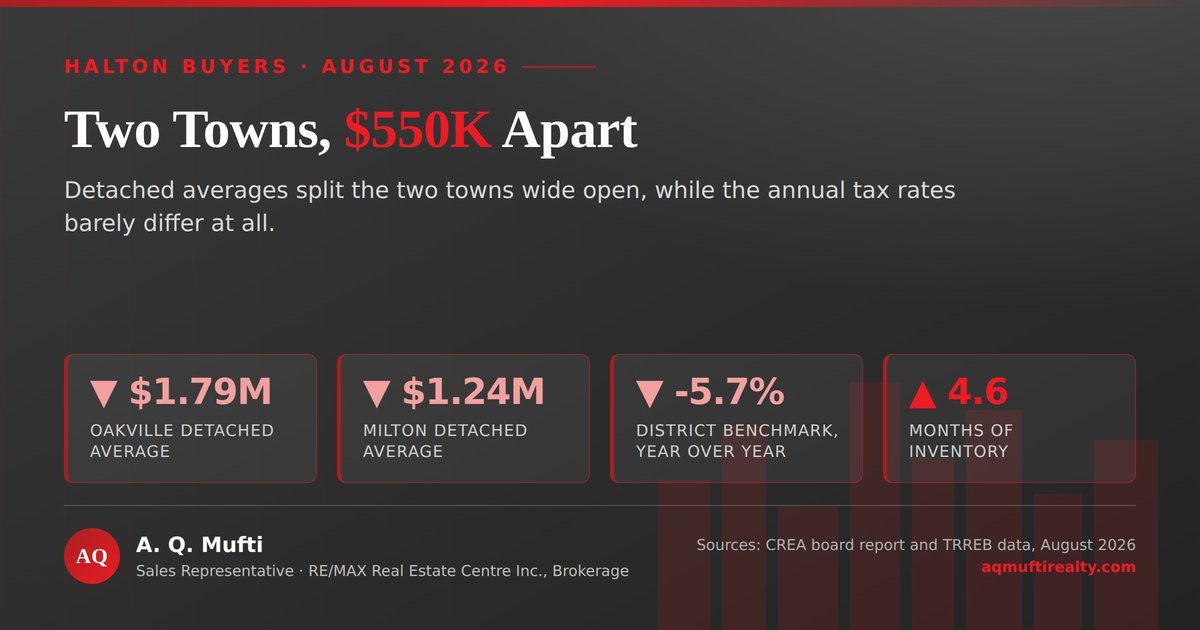
Oakville or Milton, at a glance. Sources: the Oakville, Milton and District Real Estate Board figures published by CREA, and TRREB data for August 2026. Gaps calculated.
Families moving west out of Mississauga usually arrive at the same fork in the road. Typically, they have a budget, two school-age children and a shortlist of exactly two towns. So the question becomes Oakville or Milton, and it is almost never settled by lifestyle alone.
Meanwhile, the numbers settle more of it than most buyers expect. Indeed, the gap between the two towns is wide in purchase price and almost invisible in annual tax. Therefore the decision turns on what shape of house your money buys, rather than on carrying cost.
The short version
- The purchase gap is large. First, an average detached house sold for $1,787,896 in Oakville and $1,238,259 in Milton in August 2026. That is roughly $550,000, or 44% more (calculated).
- The tax gap is tiny. Notably, the 2026 residential rates are 0.8635% in Milton and 0.8510% in Oakville. On the same assessed value that is about $100 a year (calculated).
- The real trade is form against address. In practice, an average Oakville freehold townhouse cost $1,052,614, which is less than an average Milton detached house.
- Land transfer tax follows the price. Consequently, the Ontario tax on those two averages differs by about $10,993 (calculated), payable on closing day.
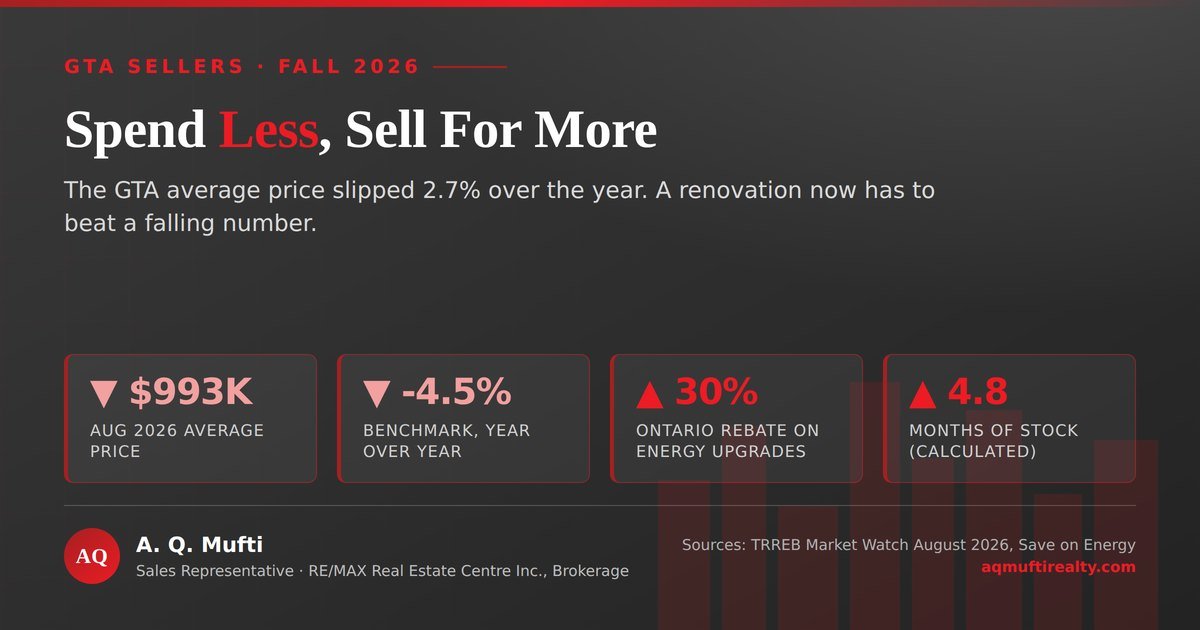
- Both markets are softening. Across the district the benchmark price fell 5.7% over the year. Therefore a buyer weighing Oakville or Milton has no reason to overpay this fall.
Oakville or Milton: the August 2026 price gap
These are average sold prices for August 2026, drawn from TRREB and CREA data. Averages move with the mix of houses that sold. So read them as a direction, not as a quote on your street.
| Property type | Oakville average | Milton average |
|---|---|---|
| Detached | $1,787,896 | $1,238,259 |
| Freehold townhouse | $1,052,614 | $798,419 |
| Condo townhouse | $602,353 | $597,000 |
| Apartment | $705,448 | $526,250 |
| All property types | $1,324,472 | $977,576 |
| MLS® benchmark home | $1,135,400 | $862,300 |
What the Oakville or Milton price gap actually is
Start with the market both towns sit inside. Generally, a single board reports them together, which makes the district figure a useful sanity check on the town ones.
The Oakville, Milton and District Real Estate Board recorded 382 sales in August 2026 at an average price of $1,152,029. Meanwhile the composite benchmark price came in at $1,044,000, down 5.7% against August 2025. In addition, sales themselves fell 9%.
Also, the board reported $440.1 million of dollar volume. Divide that by 382 sales and you land on the same average (calculated). That is the cross-check I run before I use a published figure.
Where the gap is widest
Detached houses carry almost the whole difference. Specifically, the Oakville average was $1,787,896 and the Milton average $1,238,259. Therefore the gap is $549,637, or about 44% more in Oakville (both calculated).
Benchmark values tell a steadier story, because they track a like-for-like home rather than whatever sold. Oakville’s benchmark sat at $1,135,400 and Milton’s at $862,300. In other words, roughly $273,100 apart (calculated).
Put simply, a buyer weighing Oakville or Milton is not comparing two versions of the same house. Instead, they are comparing two different housing stocks that a single board happens to report in one release.
The real Oakville or Milton trade: form versus address
Here is the comparison that actually decides it. Rather than asking which town is cheaper, ask what one budget buys in each.
First, an average Oakville freehold townhouse sold for $1,052,614. Meanwhile an average Milton detached house sold for $1,238,259. So the detached house in Milton cost about $185,645 more than the townhouse in Oakville (calculated), and the two sit in the same broad budget.
Same money, two different houses
That is the choice in one line. Within roughly $1.05 million to $1.25 million, you are picking between an attached home in Oakville and a detached one in Milton. The Milton house usually adds a yard and a double garage.
Equally, apartments repeat the pattern at a lower price. For example, the Oakville average was $705,448 against $526,250 in Milton, a difference of $179,198 (calculated). Condo townhouses, however, are the one segment that nearly matches, at $602,353 and $597,000.
What sells also differs. Furthermore, townhouses made up 37 of Milton’s 122 sales, or about 30%, against 37 of Oakville’s 203, or roughly 18% (calculated). Consequently, the Milton market offers more attached stock to choose from.
Ultimately, the Oakville or Milton question is a question about form. Buyers who need a fourth bedroom and a yard tend to move west. Conversely, buyers who want the address accept less square footage for it.
Property taxes barely separate Oakville or Milton
Almost every buyer I meet believes the newer town taxes harder. Admittedly, the direction is right. However, the size of it is not what people imagine.
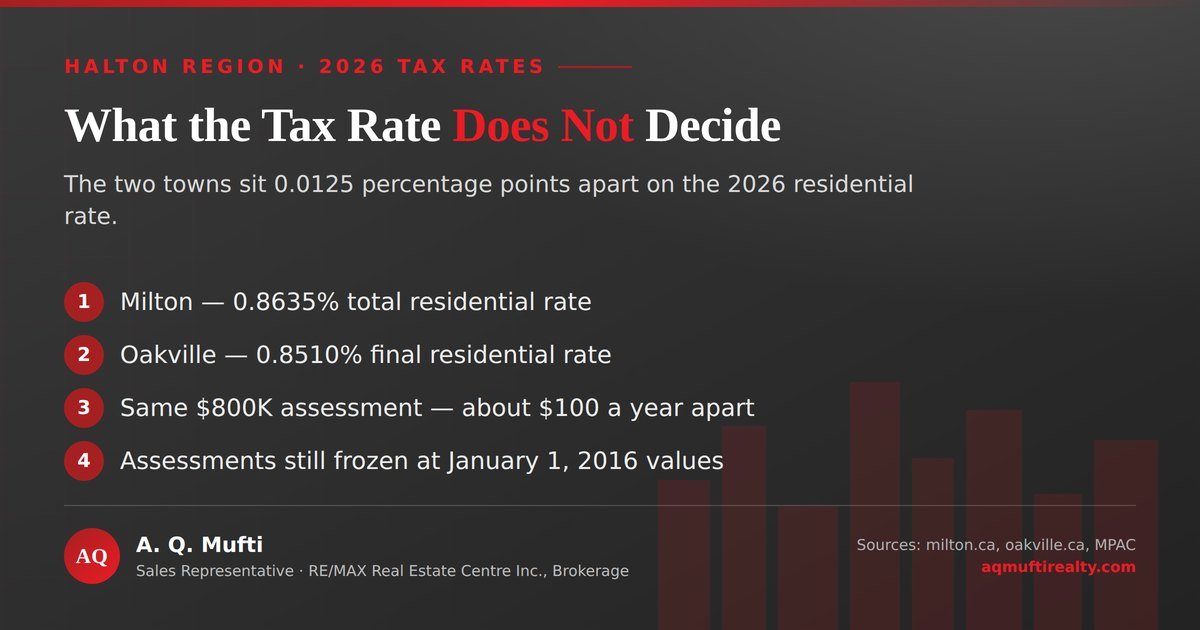
Milton publishes a 2026 total urban residential rate of 0.00863509, built from municipal, regional and education portions. Meanwhile, Oakville publishes a 2026 final residential rate of 0.850960 percent. So the two sit 0.0125 percentage points apart.
Apply both to the same $800,000 assessment and the bills come to about $6,908 and $6,808 (calculated). Therefore the rate difference is worth roughly $100 a year. That is a tank of gas, not a reason to choose a town.
Why your purchase price is not your tax base
Something more important hides behind those rates. Ontario bills property tax on assessed value, and assessed value is badly out of date.
Oakville states plainly that assessment values are currently based on a January 1, 2016, value. It also notes that the province postponed the update expected in 2021. The assessment authority says the same, calling the fixed valuation date for 2026 January 1, 2016.
In practice, that means two neighbors paying very different tax on similar houses, purely because of when each was last assessed. So a buyer comparing Oakville or Milton should ask for the actual tax bill on each listing. And never estimate it from the asking price.
Land transfer tax on an Oakville or Milton purchase
One cost does follow the purchase price exactly. Moreover, it is due in full on closing day, in cash, and no lender will add it to the mortgage.
Here, Ontario charges land transfer tax in bands. The province lists 0.5% on amounts up to and including $55,000, then 1.0% to $250,000, 1.5% to $400,000, and 2.0% above that. Also, amounts above $2,000,000 on a one or two family home attract 2.5%.
One-time costs that follow the price
Run the two averages through those bands. The Oakville detached average produces about $32,233. Meanwhile the Milton average produces about $21,240 (both calculated). Hence the difference is roughly $10,993.
Furthermore, that number lands beside the legal fees, title insurance and adjustments every Ontario buyer pays. Many first-time buyers qualify for a refund of part of the tax, so check your own position with your lawyer before closing.
Taken together with the purchase gap, the money favors the same side in both lines. So the Oakville or Milton decision costs more up front in Oakville, and then costs very nearly the same every year afterward.
Buying in Oakville or Milton while prices fall
Timing matters more than usual right now. Notably, this district is doing two things at once that normally pull against each other.
In fact, supply tightened sharply. New listings came in at 833, down 30.2% over the year, and active listings at 1,766, down 20.5%. Yet prices still slipped, and inventory read 4.6 months against 5.3 a year earlier.
Thinner listings, softer prices
Normally, fewer listings lift prices. Here they have not. Instead, every benchmark segment fell over the year: single-family homes 7.2%, townhouses 7.6% and apartments 6.4%.
Neither town escaped it, which matters for anyone treating Oakville or Milton as a bet on one market holding up better than the other. Both softened, and by similar amounts.
Read that carefully, because a thin market is not the same as a strong one. Specifically, sellers who do not have to move have stopped listing, which shrinks choice without rescuing price.
For a buyer, therefore, the practical lesson about Oakville or Milton is patience with a deadline. Choice is limited, so move decisively on the right house. Equally, nothing in these figures rewards paying over asking.
How to choose between Oakville or Milton
Averages describe a market. Still, they never describe a family. So I work through five questions with clients weighing Oakville or Milton before we tour anything.
- Attached or detached? Settle the shape of the house first, because that single answer usually picks the town for you.
- What is the actual tax bill? Ask for last year’s bill on every listing, since the 2016 assessment base makes similar houses pay unlike amounts.
- How much cash closes the deal? Run the numbers through my payment calculator and add land transfer tax on top.
- How long is the commute, on a Tuesday? Drive it at 7:30 a.m. rather than on a Sunday afternoon.
- What are you giving up to resell well? Odd layouts and backing onto an arterial road cost you later, in both towns.
Answer those honestly and the Oakville or Milton shortlist usually collapses to one town and three streets. Afterward, the search becomes quick rather than exhausting.
Looking for help narrowing it down? For instance, my step-by-step guide for buyers sets out the order of events from pre-approval to keys. The home finder form lets me send listings that fit before they hit the portals. And my market updates track these numbers every month.
Your questions about Oakville or Milton
Short answers to what buyers are asking me this fall.
Is Milton cheaper than Oakville?
Yes, and by a wide margin on detached houses. For example, an average detached home sold for $1,238,259 in Milton against $1,787,896 in Oakville in August 2026, a gap of about $549,637 (calculated).
Are property taxes higher in Oakville or Milton?
In fact, Milton’s rate is slightly higher. Its 2026 total residential rate is 0.00863509 against Oakville’s 0.850960 percent, which is about $100 a year on the same assessed value (calculated). Oakville bills are usually larger simply because the houses are assessed higher.
What does an Oakville townhouse cost against a Milton house?
An average Oakville freehold townhouse sold for $1,052,614, while an average Milton detached house sold for $1,238,259. Consequently, one budget often reaches an attached home in Oakville or a detached one in Milton.
How much land transfer tax will I pay?
It follows the price. On the two averages above, Ontario’s bands produce about $21,240 and about $32,233 (both calculated). So the Oakville or Milton gap costs roughly $10,993 more in tax. Also, first-time buyers may claim a refund.
Is this a good time to buy in Oakville or Milton?
Overall, it favors a prepared buyer. The district benchmark fell 5.7% over the year and inventory sits at 4.6 months, yet new listings dropped 30.2%. So choice is thin while prices are soft, which rewards patience and punishes overpaying.
Sources and further reading
- CREA – Oakville, Milton and District Real Estate Board, August 2026 — district sales, average, benchmark and inventory
- WOWA – Oakville housing market, August 2026 — average prices by property type
- WOWA – Milton housing market, August 2026 — average prices by property type
- Town of Milton – property tax rates — the 2026 residential rate
- Town of Oakville – tax rates — the 2026 residential rate
- Town of Oakville – property assessments and appeals — the 2016 valuation date
- MPAC – notices and notifications — the postponed assessment update
- Government of Ontario – calculating land transfer tax — the rate bands
Keep reading on the blog
More market analysis and practical guides from this blog.
- GTA Home Prices: August 2026 — the wider market
- Closing Costs in Ontario, Itemized — the rest of closing day
- New Home HST Rebate: The Surprising $130,000 Gap — for new builds
- GTA Real Estate Fall 2026: What Buyers Must Do Now — a softer market
Ready to talk about your next move?
Tell me your budget and the shape of house you need, and I will show you what each town actually offers at that number. I will also pull the real tax bill on anything you like before you write an offer. No pressure, and no obligation.
Prefer to start with a number? Get a tailored home valuation or run the figures in the mortgage calculator.
Disclaimer: This article draws on the Oakville, Milton and District Real Estate Board figures through CREA, on TRREB data published by WOWA, on the town tax rate pages, on MPAC and on Government of Ontario guidance. It offers information only. I calculated every gap, the annual tax difference and the land transfer tax figures. Average sold prices move with the mix of homes sold. Rates and assessments change, so confirm your position first. Nothing here is financial, mortgage, tax or legal advice. A. Q. Mufti – Sales Representative, RE/MAX Real Estate Centre Inc., Brokerage.
A. Q. Mufti — Sales Representative
RE/MAX Real Estate Centre Inc., Brokerage
MSc, PMP®, ABR®, SRS®, CNE®
416 908 5600 · 905 270 2000
info@aqmuftirealty.com
141-1140 Burnhamthorpe Rd. W., Mississauga ON L5C 4E9
Serving Mississauga, Oakville, Milton, Brampton, Toronto and the wider GTHA. More about how I work.