
GTA real estate fall 2026 at a glance. Prices are still below last year, but supply fell far faster than demand. Source: TRREB Market Watch, July 2026.
Something quiet but important has shifted in the GTA real estate fall 2026 market. Prices are still lower than a year ago, so the headlines read like a buyer’s market. Yet underneath those headlines, the supply of homes for sale has collapsed. In July, sellers listed 17.8% fewer properties than in July 2025, while sales barely moved. That gap is the whole story.
Because fewer homes compete for the same buyers, the discount you can negotiate is shrinking month by month. Daniel Steinfeld, President of the Toronto Regional Real Estate Board, put it plainly: “With sales accounting for a larger share of listings, buyers may find there is less room to negotiate moving forward.”
So this article does two things. First, it walks through the July numbers and what they actually mean. Then it sets out the specific moves worth making before the Bank of Canada speaks again on September 2.
GTA real estate fall 2026: the short version
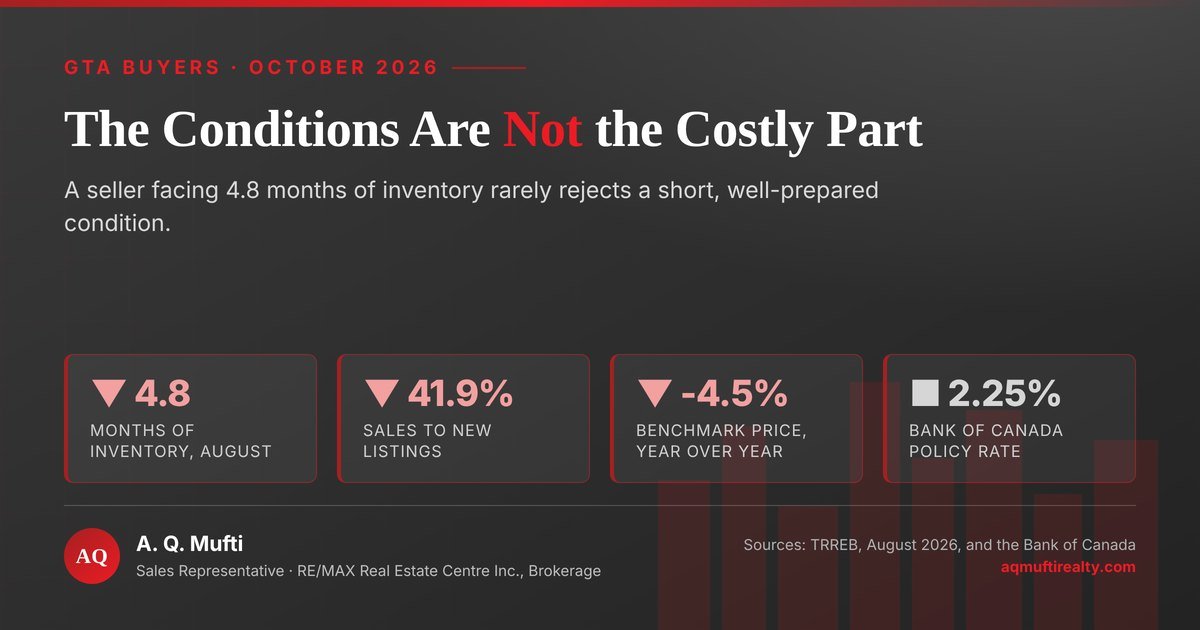
- Prices are down, supply is down more. Average price fell 4.5% year over year. New listings fell 17.8%.
- The market is tightening fast. The Toronto housing market’s sales-to-new-listings ratio jumped from roughly 34% to about 41% in twelve months.
- Rate cuts are likely finished. The Bank of Canada has left the rate at 2.25% through its recent decisions, and RBC now expects the next move to be up.
- Negotiating room is closing. TRREB’s own president warns buyers will find less of it from here.
- The window is months, not years. Buy while prices lag and competition is still thin. That is the GTA real estate fall market in one line.
GTA real estate fall 2026: July in numbers
Here is what the Toronto Regional Real Estate Board reported for the month, with last year’s figures for comparison.
| Measure | July 2026 | July 2025 | Change |
|---|---|---|---|
| Home sales | 5,995 | 6,049 (est.) | down 0.9% |
| New listings | 14,484 | 17,620 (est.) | down 17.8% |
| Average selling price | $1,003,956 | $1,051,262 (est.) | down 4.5% |
| MLS® HPI Composite benchmark | not published | not published | down 4.6% |
| Sales-to-new-listings ratio | about 41% | about 34% | up 7 points |
| Bank of Canada policy rate | 2.25% | 2.75% | down 0.50 points |
Why the GTA real estate fall discount is shrinking even though prices fell
At first glance, the two facts look contradictory. Prices are down 4.5% and the benchmark is down 4.6%, so surely buyers hold the cards. But price is a lagging measure. It tells you what closed sixty to ninety days ago. Supply and demand tell you what happens next.
The cleanest way to read that balance is the sales-to-new-listings ratio. Divide the month’s sales by the month’s new listings. Below about 40%, the market favours buyers. Above roughly 60%, it favours sellers. Between those two lines, it is balanced.
In July 2025, that ratio sat near 34%, which is a genuine buyer’s market. Twelve months later, it reached about 41%. So the GTA has already climbed out of buyer’s territory and into balance. Meanwhile, the price data has not caught up yet, and that lag is exactly the opportunity. It is the most useful fact about the GTA real estate fall market.
With sales accounting for a larger share of listings, buyers may find there is less room to negotiate moving forward.
Daniel Steinfeld, President, Toronto Regional Real Estate Board
Why sellers stepped back
Many owners who listed in 2024 and 2025 did not sell at the price they wanted. Instead of cutting further, they pulled the listing and waited. Others refinanced and stayed put. As a result, the resale pool thinned out sharply, and builders slowed new projects at the same time.
That matters because supply cannot be rebuilt quickly. A seller who decides in September to list will complete in October or November at the earliest. So the shortage you see today is largely locked in for this autumn.
The rate story behind GTA real estate fall 2026
On 15 July, the Bank of Canada held its overnight rate at 2.25%, with the Bank Rate at 2.5%. That extends the hold in place through the spring and summer. The Bank also noted that CPI inflation rose to 3.2% in May, largely on higher gasoline prices, and it expects inflation to return to around 2% in early 2027.
Jason Mercer, TRREB’s Chief Information Officer, framed the mood well: “While uncertainty about the economy and borrowing costs persists, recent news has been more positive than expected.” Growth reached an estimated 2.5% in the second quarter, which is stronger than most forecasters pencilled in.
Here is the part buyers should not miss. RBC Economics now argues that the cutting cycle is over, and that “the next change in interest rates is more likely to be a hike.” After 275 basis points of cuts since June 2024, the cheap-money tailwind has stopped blowing.
Therefore, the calculation has flipped. Waiting used to buy you a lower rate. Now waiting mostly buys you more competition, because every month of steady rates pulls more sidelined buyers back in. The next decision lands on 2 September 2026.
For anyone weighing a purchase in the GTA real estate fall 2026 market against another year of renting, that shift matters more than any single monthly price print. Borrowing costs have stopped improving. Supply has stopped growing. Only the price data still points backwards.
What GTA real estate fall 2026 means if you are buying
You are shopping in a narrow, unusual window of the Toronto housing market. Prices still reflect a soft spring. Competition reflects a tightening summer. Those two things rarely sit together for long.
Practically, that means three things. First, your negotiating leverage is real but fading, so use it now rather than in December. Second, inventory is thin, so the good listings move quickly and you need financing arranged before you view. Third, a hold at 2.25% is a known quantity, and you can budget against it with some confidence.
Five moves worth making this month
- Get a real pre-approval, not an online estimate. Hold the rate for 90 to 120 days so a September surprise cannot reprice your budget.
- Stress-test one rate higher. Run your payment at plus one percentage point in the payment calculator so a future hike is an inconvenience, not a crisis.
- Look where the discount is deepest. Condo apartments still carry the largest gap between asking and closing prices across the region.
- Write cleaner offers, not just lower ones. With fewer listings, a firm closing date and a tidy deposit often beat another five thousand dollars.
- Decide your walk-away number in advance. Balanced markets punish hesitation and reward preparation in roughly equal measure.
If you are buying for the first time, the sequencing matters more than the tactics. My step-by-step guide for buyers sets out the order to do things in, and the home finder will alert you when a matching listing appears.
What GTA real estate fall 2026 means if you are selling
Sellers have the opposite problem in this Toronto housing market, and it is a nicer one. You face less competition than at any point in two years. However, buyers are still price-sensitive, and the benchmark is down 4.6%, so an ambitious list price will still sit. This GTA real estate fall, price for the buyers who are actually shopping.
So price to the current market rather than to the 2022 peak. Then let the shortage of alternatives do the work. Homes that are priced correctly and presented well are drawing multiple offers again in several Mississauga and Oakville pockets, which was not true in March.
One timing note. If you list in early autumn, you compete with very little. Wait for spring instead, and you compete with everyone else who waited. Start with a current valuation of your home and work backwards from there. My guide for sellers covers the preparation sequence in more detail.
In short, the GTA real estate fall 2026 market rewards whichever side moves first. Buyers still have a price advantage. Sellers have a scarcity advantage. Both advantages shrink as the market moves back toward balance.
Your GTA real estate fall 2026 questions, answered
Short answers to what buyers and sellers are asking me most this month.
Q – Is the GTA still a buyer’s market in fall 2026?
A – Only just. The sales-to-new-listings ratio reached about 41% in July, up from roughly 34% a year earlier. Below 40% is a buyer’s market, so the region has effectively moved into balanced territory. Prices simply have not caught up yet.
Q – Will prices fall further before they recover?
A – Nobody can promise a bottom. But the mechanism that pushed prices down was abundant supply, and that supply has fallen 17.8% year over year. When listings drop that sharply while sales hold flat, continued price declines become much harder to sustain.
Q – Should I wait for another rate cut before I buy?
A – That was a reasonable plan a year ago. It is a weaker one now. The Bank has left the rate at 2.25% through its recent decisions, and RBC Economics expects the next move to be a hike rather than a cut. Waiting for a cut that may never arrive costs you the thin competition you enjoy today.
Q – What does the sales-to-new-listings ratio actually tell me?
A – It measures how much of the month’s fresh supply gets absorbed by buyers. Under 40% means sellers are competing for you. Over 60% means you are competing for homes. It turns before prices do, which is why it is the single most useful number in a monthly report.
Q – Which property type offers the best value right now?
A – Condo apartments still show the widest gap between listing prices and what buyers actually pay, so the negotiating room is deepest there. Detached homes in Mississauga and Oakville have tightened faster, and several pockets are already seeing competing offers again.
Q – How should I prepare for the September 2 rate decision?
A – Lock a pre-approval before the announcement and make sure the hold runs at least 90 days. Then run your payment at one point higher than your quoted rate. If that number still works, a hold or a hike will not derail your plans either way.
Sources and further reading
- TRREB: GTA housing market tightens in July — July 2026 Market Watch release
- Bank of Canada: policy rate held at 2.25% — 15 July 2026 decision and Monetary Policy Report
- RBC Economics: the Bank is done cutting — outlook for the rest of 2026
- Bank of Canada: 2026 announcement schedule — next decision 2 September 2026
Keep reading on the blog
More market analysis and practical guides from this blog.
- GTA Housing Market Report, June 2026 — the month before the supply squeeze showed up
- Five Reasons Buyers Must Act Now, May 2026 — how the spring market set up this autumn
- How a Rate Cut Opens a Buying Window — what happened the last time borrowing costs moved
- Ten Essential Steps for First-Time Buyers in Mississauga — start here if this is your first purchase
Ready to move on the fall market?
The numbers behind the GTA real estate fall 2026 market point one way: less choice, firmer prices, and a shorter runway than most buyers assume. Let us look at your budget, your neighbourhood and your timeline together, and decide what actually makes sense for you. No pressure, and no obligation.
Prefer to start with a number? Get a tailored home valuation or run the figures in the mortgage calculator.
Disclaimer: This analysis draws on the TRREB Market Watch release for July 2026 and Bank of Canada publications, and it is provided for information only. It is not financial, mortgage or legal advice, and market conditions change. A. Q. Mufti is a registered Sales Representative with RE/MAX Real Estate Centre Inc., Brokerage, Ontario, Canada.
A. Q. Mufti — Sales Representative
RE/MAX Real Estate Centre Inc., Brokerage
MSc, PMP®, ABR®, SRS®, CNE®
416 908 5600 · 905 270 2000
info@aqmuftirealty.com
141-1140 Burnhamthorpe Rd. W., Mississauga ON L5C 4E9
Serving Mississauga, Oakville, Milton, Brampton, Toronto and the wider GTHA. More about how I work.