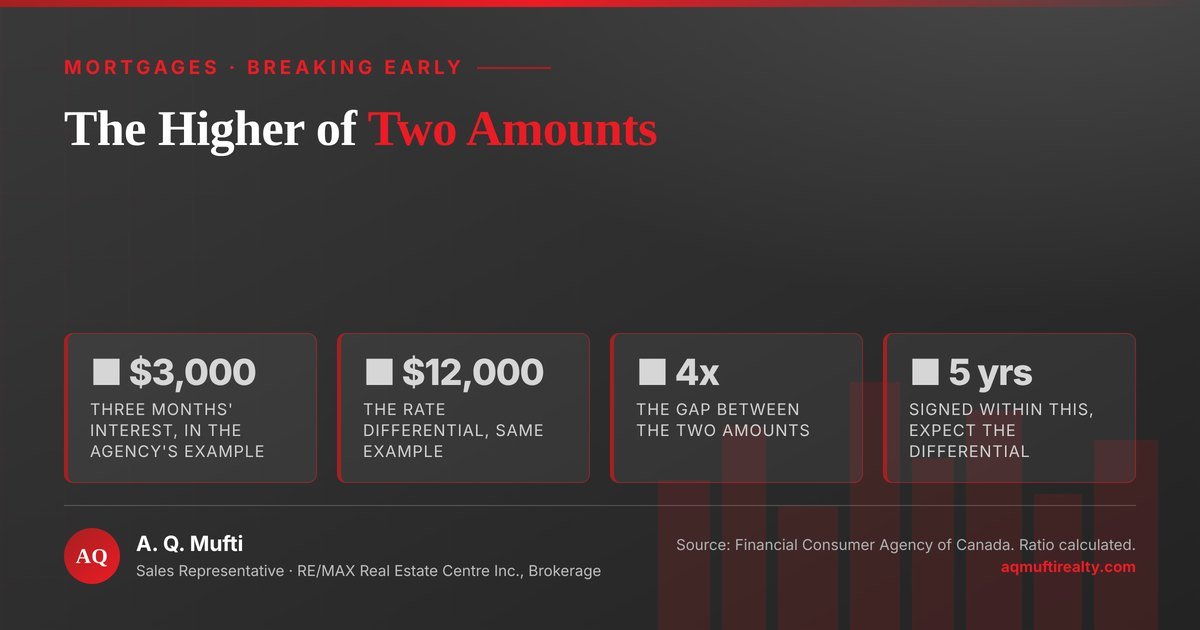
A prepayment penalty at a glance, using the federal government’s own published example. Source: Financial Consumer Agency of Canada. Ratio calculated.
You decide to sell, or to refinance, and the mortgage still has years to run. Then one number decides whether the plan works: your prepayment penalty.
Most owners guess at three months of interest. However, the government’s own worked example lands four times higher.
The short version
- It is the higher of two amounts. A prepayment penalty on a closed mortgage is “usually the higher of” three months of interest or the rate differential, the federal consumer agency says.
- The bigger one often wins. In the agency’s published example the two amounts are $3,000 and $12,000, and the borrower pays $12,000.
- Two rates drive it. Furthermore, the lender weighs two interest rates. The agency lists two options for each one, so the pair your lender picks changes your prepayment penalty.
- Your lender has to explain it. Notably, a lender “must tell you how they calculate your prepayment penalty,” the agency states.
- An open mortgage has none. By contrast, an open mortgage lets you end the loan with no prepayment penalty at all.
A prepayment penalty in numbers
First, here is what the federal consumer agency publishes. I read these pages on November 21, 2026. The right-hand column matters, because three rows are the agency’s own example and one is my own math.
| Item | Figure | Source |
|---|---|---|
| Penalty on a closed mortgage | The higher of two amounts | FCAC |
| The first amount | 3 months’ interest on what you owe | FCAC |
| The second amount | The interest rate differential | FCAC |
| Rates compared for the differential | 2 | FCAC |
| Differential used if you signed | Less than 5 years ago | FCAC |
| Example balance | $200,000 | FCAC example |
| Example, 3 months’ interest | $3,000 | FCAC example |
| Example, rate differential | $12,000 | FCAC example |
| The gap between them | $9,000, or 4 times | Calculated |
| Penalty on an open mortgage | None | FCAC |
| Variable-rate calculation | Not stated by the agency | FCAC |
What a prepayment penalty is, and when it applies
First, the word itself is slightly misleading. You pay it for ending a mortgage early, not for paying early in the ordinary sense.
The prepayment penalty on a closed mortgage
Start with the closed mortgage, because that is where the charge lives. So one line in the agency’s guide to breaking a mortgage contract is the one that matters.
“If you break your closed mortgage contract, you normally pay a prepayment penalty,” it says. That is the default rather than the exception.
Breaking it covers more than you might think. Selling the home can do it. So can moving to a new lender mid-term, or refinancing to pull out equity.
Why an open mortgage carries no prepayment penalty
Meanwhile the other kind behaves differently. “An open mortgage allows you to break the contract without paying a prepayment penalty,” the same page states.
That freedom comes with a trade, though. A closed mortgage limits “the amount of extra money you may put toward your mortgage each year,” the agency notes, while an open one allows “more flexibility.” Check which one you signed.
Therefore the first step is simply to look. Your mortgage agreement says which kind you hold, and a prepayment penalty only arises on the closed one.
The two amounts behind every prepayment penalty
Next, the mechanism. The agency is unusually direct here, and the wording repays a careful read.
Three months of interest, the easy number
One amount is simple math. The agency’s page on prepayment penalties puts it at “3 months’ interest on what you still owe,” which you can work out yourself.
That is the figure most owners picture. Consequently it is also the figure that makes breaking a mortgage sound cheap.
The differential, the number that often wins
The other amount is the interest rate differential, or IRD. In short, it measures what the lender gives up by losing your rate for the rest of the term.
Then comes the sentence that decides your bill. “The prepayment penalty will usually be the higher of” the two, the agency writes. You do not choose.
Also, the agency says when the IRD tends to apply. It names two conditions together: your rate sits above the current rate, and “you signed your current mortgage contract less than 5 years ago,” the page states.
So both conditions catch a great many owners. Anyone who locked a rate in 2022 or 2023 should treat the IRD as the live number, not the comfortable one.
The government’s own prepayment penalty example
Now put numbers on it. The agency publishes a worked case, which saves anyone the trouble of trusting my arithmetic.
What the example shows about a prepayment penalty
Its figures are a $200,000 balance at a rate of 6%, with “36 months left in a 5-year term,” as the page puts it. The lender’s posted rate for a 36-month term is 4%.
Three months of interest comes to $3,000. The IRD comes to $12,000.
Then the agency closes the case. “You have to pay a prepayment penalty of $12,000, which is the higher of the 2 amounts,” it writes.
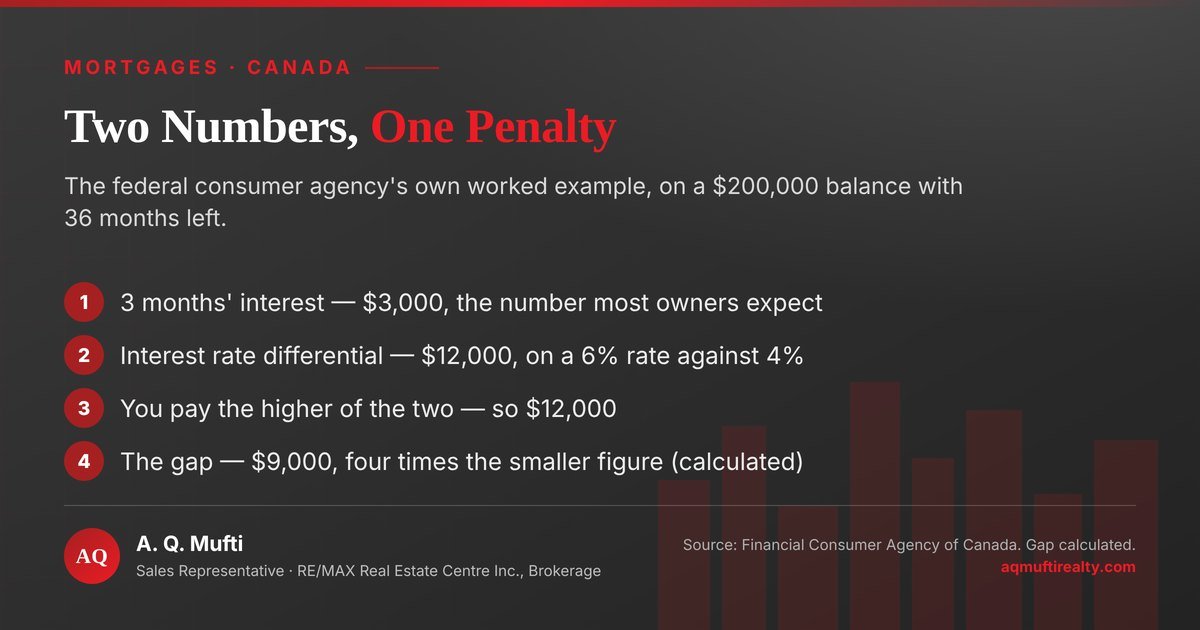
That gap is $9,000, or four times the smaller figure (both calculated). Hence the shape of the problem. The number you expect and the number you owe are not close.
What the example does not say
Still, one thing is missing, and honesty is better than tidiness here. The agency does not say which pair of rates produced its $12,000.
That matters, as the next section shows. Separately, “you may also have to pay an administration fee,” the page adds.
Why two rates decide your prepayment penalty
Here is the part almost nobody is told. The differential is not one calculation but a family of them.
The first rate in a prepayment penalty calculation
The agency sets it out. Your lender “typically uses 2 interest rates” to reach the IRD, it says.
For the first, a lender may take “the posted rate at the time you signed your mortgage contract,” the page notes. Or it may use “your current rate or discounted rate as described in your contract,” which is a different number.
Those two can differ sharply. A posted rate is “the rate lenders advertise for their products,” the agency writes. A discounted rate “is lower than the lender’s posted rates,” it adds.
The second rate, and the discount question
For the second rate, the choice repeats. A lender may use “the current posted rate for a term with a similar length,” the page says. Or it may take that rate “minus the discount you were originally offered,” which is lower again.
In other words, a hard-won discount can come back to bite. Say your lender keeps it in one rate and drops it from the other. Then the spread widens, and so does the prepayment penalty.
Above all, the agency states the consequence itself. “The way your prepayment penalty is calculated varies from lender to lender,” it writes. No single formula governs the market.
Accordingly, two neighbors with the same balance, rate and term can owe different amounts. The contract decides, and each lender writes its own.
What your lender must tell you about a prepayment penalty
Fortunately, you are not left guessing. Federal rules put real duties on the lender, and few borrowers lean on them.
The information box in your agreement
The agency is specific about who is covered. A lender that is “a federally regulated financial institution, such as a bank” has to provide certain information, it says.
Then it names where that information sits. Some details “must appear in an information box at the beginning of your mortgage agreement,” it says. Prepayment privileges and penalties are among them.
The one question that settles a prepayment penalty
Next, the two lines worth memorizing. Your lender “must tell you how they calculate your prepayment penalty,” the agency writes. That lender “must also tell you what factors they use to determine the penalty,” the page adds.
The agency sets a standard for that answer too. Such details “must be clear, simple and not misleading,” it says.
So the quick check is one question, asked in writing: which two rates will you use, and what is my prepayment penalty today? Keep the reply.
Ask early, too. A figure quoted months before you list is only an estimate. Rates move, and the term shortens as the calendar runs.
A prepayment penalty when you sell or refinance in the GTA
Finally, the practical part. A move is where this usually surfaces, and it surfaces late.
Check before you list, not after
A sale ends the mortgage unless you carry it to the next home. Therefore the cost belongs in your plan, beside the commission and the legal fees. It should not reach you in a call from your lawyer.
- Find your renewal date first. The remaining term drives the differential, so a mortgage with four months to run behaves nothing like one with thirty.
- Ask for the figure in writing. Your lender has to explain the calculation, and a written prepayment penalty quote is something you can plan around.
- Ask whether the mortgage can move with you. Carrying a mortgage to a new property may avoid the charge, and only your lender can say whether yours qualifies.
- Then run the whole number. Put the quote beside your likely proceeds using my payment calculator before you commit to a date.
The other costs that ride along
Also, the charge rarely travels alone. Before you break a contract, the agency says to ask about four more. They are an administration fee, an appraisal fee, a reinvestment fee and a discharge fee.
Prepayment privileges are worth a look in the same sitting. “Most lenders limit the allowed prepayment amount per year,” the agency notes on its page about paying a mortgage off faster.
Typically you cannot carry an unused amount forward. So the room resets each year, and an unused one is simply gone.
Using that room first can shrink the balance a prepayment penalty is measured against. Equally, going over it can create a charge where you expected none.
Want the wider picture? For instance, my monthly market updates track what homes are selling for. The guide for sellers covers what else a move costs.
Your questions about breaking a mortgage
Short answers to what owners in Mississauga, Oakville and Milton ask me most once a move is on the table.
How is a prepayment penalty calculated?
On a closed mortgage it is “usually the higher of” three months’ interest or the rate differential, the federal consumer agency says. Your own contract governs the detail.
Why is my prepayment penalty so much larger than I expected?
Generally because the differential beats the three-month figure. In the agency’s own example the two amounts are $3,000 and $12,000, and the borrower pays the higher one.
Can I find out my prepayment penalty before I list?
Yes, and you should. Your lender must tell you how they calculate it and what factors they use. Ask in writing, and keep the answer with your listing paperwork.
Does a variable-rate mortgage work the same way?
The agency’s page does not say. It sets out the two amounts without ever naming variable-rate mortgages. So check your own contract rather than assuming.
Is there any mortgage with no prepayment penalty?
An open mortgage. It “allows you to break the contract without paying a prepayment penalty,” the agency states. Check your agreement to see which kind you signed.
Sources and further reading
- FCAC – mortgage prepayment penalties — the two amounts and the example
- FCAC – breaking your mortgage contract — open versus closed, and the other fees
- FCAC – choosing a mortgage — fixed, variable, open and closed
- FCAC – interest on mortgages — posted and discounted rates
- FCAC – paying your mortgage off faster — prepayment privileges
Keep reading on the blog
More guides and market analysis from this blog.
- GTA Mortgage Renewal in 2027 — renewing, not breaking
- Closing Costs in Ontario — the other extras
- Land Transfer Tax in the GTA — what a move costs
- Days on Market in the GTA — timing a sale
Ready to plan a move around your mortgage?
Send me your renewal date and the penalty figure your lender quotes. I will put it beside what your home is likely to fetch, and what the move will cost in total. You will know the real number before you list. No pressure, and no obligation.
Prefer to start with a number? Get a tailored home valuation or run the figures in the mortgage calculator.
Disclaimer: Sources: the Financial Consumer Agency of Canada, pages dated October 15, 2025 and February 23, 2024, all read on November 21, 2026. The $9,000 gap and the four-times comparison are my arithmetic on the agency’s published example. General information only. Every mortgage contract differs. The agency itself says the calculation varies from lender to lender, so only your lender can quote your figure. Nothing here is financial, mortgage, tax or legal advice, and I am not a mortgage broker. A. Q. Mufti – Sales Representative, RE/MAX Real Estate Centre Inc., Brokerage.
A. Q. Mufti — Sales Representative
RE/MAX Real Estate Centre Inc., Brokerage
MSc, PMP®, ABR®, SRS®, CNE®
416 908 5600 · 905 270 2000
info@aqmuftirealty.com
141-1140 Burnhamthorpe Rd. W., Mississauga ON L5C 4E9
Serving Mississauga, Oakville, Milton, Brampton, Toronto and the wider GTHA. More about how I work.