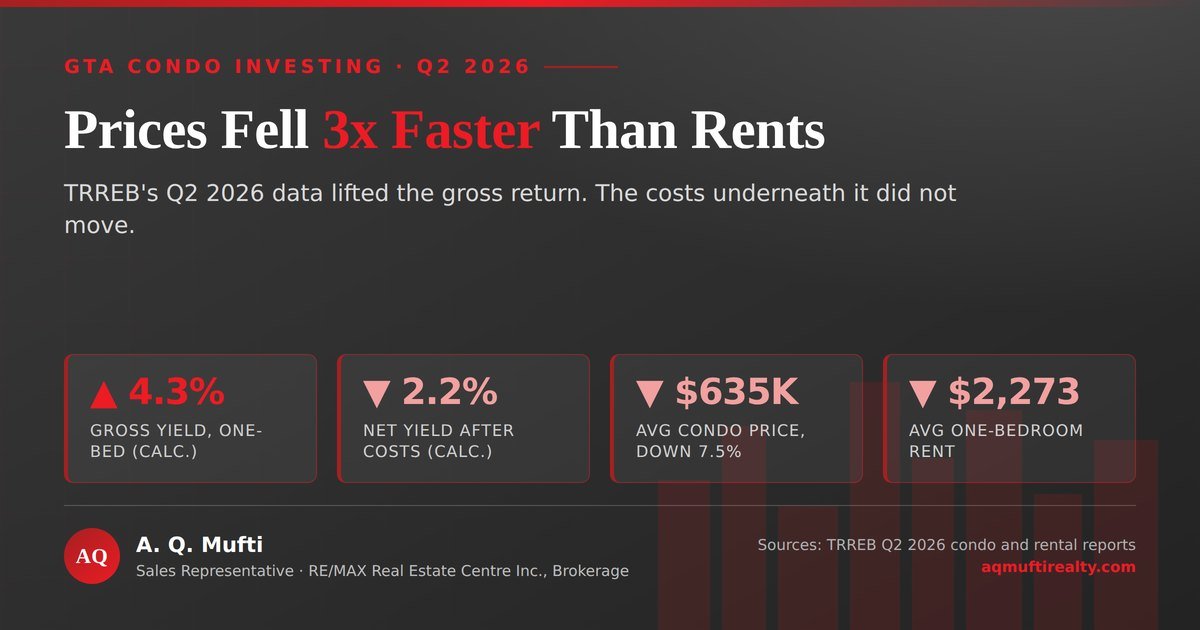
Q2 2026 at a glance. The gross return improved because prices fell far faster than rents. Sources: TRREB Q2 2026 Condo Market Report and Rental Market Report. Yields calculated.
On paper, GTA condo rental yield looks better than it has in years. The average condominium apartment sold for $634,972 in the second quarter of 2026, down 7.5% from a year earlier. Average rents barely moved. So the ratio between the two improved, and a lot of people are reading that as a green light.
The ratio did improve. Cash flow did not. Those are separate questions, and mixing them up is the most expensive mistake I see investors make. This post works through both. It uses the figures the Toronto Regional Real Estate Board published on 31 August. Then it shows what the same unit really costs to carry.
The short version
- The gross return went up. GTA condo rental yield on a one-bedroom now works out to about 4.3%, against about 4.1% a year earlier (calculated).
- Prices did the work, not rents. Condo prices fell 7.5% while one-bedroom rents fell 2.3%, so prices dropped roughly three times faster.
- After costs, the picture changes. Strip out condo fees, property tax and insurance and the return drops to roughly 2.2% (calculated).
- Financing is the whole story. At 20% down, a unit at the average price runs a monthly shortfall on a one-bedroom rent (calculated).
- Supply is tightening. New condo listings fell 19.0% year over year, so the discount window is narrowing.
GTA condo rental yield: the underlying numbers
Every figure below comes from TRREB’s Q2 2026 condo and rental reports. Both were released on 31 August 2026. The GTA condo rental yield lines are calculated from those figures.
| Measure | Q2 2026 | Q2 2025 | Change |
|---|---|---|---|
| Average condo apartment price | $634,972 | $686,387 | down 7.5% |
| Average one-bedroom rent | $2,273 | $2,327 (est.) | down 2.3% |
| Average two-bedroom rent | $3,013 | not used | down 1.7% |
| Condo apartment sales | 4,783 | 4,395 | up 8.8% |
| New condo listings | 14,042 | not published | down 19.0% |
| Rental transactions | 21,251 | 20,396 | up 4.2% |
| Gross yield, one-bedroom | about 4.3% | about 4.1% | up 0.2 points |
| Net yield after operating costs | about 2.2% | not used | calculated |
Why GTA condo rental yield rose while prices fell
Yield is a fraction. Rent sits on top, price sits underneath. So the fraction can improve for a cheerful reason or a gloomy one, and right now it is the gloomy one.
Between the second quarter of 2025 and the second quarter of 2026, the average condominium apartment price fell 7.5%. Over the same stretch, the average one-bedroom rent fell 2.3%. Because the denominator shrank about three times faster than the numerator, the ratio climbed.
How GTA condo rental yield is calculated
Take the average one-bedroom rent of $2,273 a month. That is $27,276 over a year. Divide it by the average condo price of $634,972 and you get about 4.3% (calculated). A year earlier the same arithmetic gave about 4.1%, so the improvement is roughly a fifth of a percentage point.
One caveat matters here. TRREB’s average price covers every unit size, while the rent figure is for one-bedrooms specifically. Pairing them gives a consistent benchmark across both years, but it is not a quote for any particular apartment. A smaller unit costs less and rents for less.
What a gross GTA condo rental yield leaves out
Gross yield ignores everything it costs to own the place. That is why it is the number in every headline and almost never the number in a decision.
Four items come off the top before a single dollar reaches you. They are condo fees, property tax, insurance, and the weeks a unit sits empty. None of them are optional. Condo fees are usually the largest.
A worked example, with the assumptions stated
Suppose you buy at the average price of $634,972 and rent at the average one-bedroom rent. Assume $700 a month in condo fees, $3,200 a year in property tax, $600 a year in insurance, and a 4% allowance for vacancy and turnover. Those four figures are assumptions for illustration, not market data.
| Line | Per year | Note |
|---|---|---|
| Rent collected | $27,276 | TRREB average |
| Less vacancy and turnover | $1,091 | 4%, assumed |
| Less condo fees | $8,400 | assumed |
| Less property tax | $3,200 | assumed |
| Less insurance | $600 | assumed |
| Net operating income | $13,985 | calculated |
| Net yield on price | about 2.2% | calculated |
So the honest version of GTA condo rental yield is closer to 2.2% than 4.3%. That is before the mortgage.
Financing decides whether the unit pays for itself
The Bank of Canada held its policy rate at 2.25% on 2 September, with the Bank Rate at 2.5%. Borrowing costs have stopped falling, and the next decision lands on 28 October.
Put 20% down on $634,972 and you borrow $507,978. At an assumed 4.25% over 25 years, the payment comes to roughly $2,741 a month (calculated). Add the same $700 in fees, $267 in tax and $50 in insurance, and you are out about $3,758 every month.
Average one-bedroom rent covers $2,273 of that. Therefore the shortfall runs near $1,485 a month, or close to $17,800 a year (calculated). On the average two-bedroom rent of $3,013 the gap narrows to about $745. That is a better outcome, yet it is still money leaving your account.
In other words, GTA condo rental yield only becomes income once the mortgage is small enough. Until then it is a long-term bet on the price recovering.
Leverage and GTA condo rental yield
Borrowing magnifies whatever the asset does. When prices rose 8% a year, negative cash flow was the price of admission and most investors accepted it. Now that the benchmark is falling, the same leverage works against you on both ends.
That does not make condos a bad asset. It makes them an asset you buy with a longer horizon and a bigger deposit than the 2021 playbook assumed.
Rent control changes the maths on newer units
Ontario sets a guideline for how much rent can rise in an existing tenancy. For 2026 that guideline is 2.1%, and for 2027 it drops to 1.9%.
However, the guideline does not apply to units first occupied for residential purposes after 15 November 2018. Most new condo stock therefore sits outside it. Nor does it apply when one tenant leaves and another arrives.
Over a decade, that exemption is the difference between rent which tracks inflation and rent which tracks the market. So check the building’s first occupancy date. It shapes GTA condo rental yield more than any other single fact.
Meanwhile CMHC’s mid-year update reported a 3.0% apartment vacancy rate in Toronto for 2025, and noted asking rents declining on higher supply and slower demand. Softer rents are the other half of the story behind that improving ratio.
How to test a unit before you buy it
Averages are for orientation. A purchase needs the actual numbers for the actual building, and four of them do most of the work.
- Read the status certificate first. It gives the real fee, the reserve fund balance and any special assessment. A weak reserve is a fee increase you have not been told about yet.
- Price the tax bill, not a rule of thumb. Assessment and municipal rates differ across the region, so use the actual figure for the actual address.
- Stress-test the payment. Run it a point higher in the payment calculator and see whether the shortfall is still one you can fund.
- Ask when the building was first occupied. That single date decides whether the 2.1% guideline applies to your future rent increases.
If the answer still works after all four, you have a real investment rather than a hopeful one. If it only works on the gross number, walk away. A sober view of GTA condo rental yield beats an optimistic spreadsheet every time.
New to this? My step-by-step guide for buyers covers the purchase sequence, and the home finder will flag units that match your criteria as they list.
Your questions about GTA condo rental yield
Short answers to what investors are asking me this quarter.
What is a good GTA condo rental yield right now?
On current TRREB figures the gross number lands near 4.3% and the net number near 2.2% once operating costs come off (calculated). Anything advertised well above that usually excludes condo fees, tax or vacancy.
Why did GTA condo rental yield improve if rents fell?
Because prices fell faster. Condo prices dropped 7.5% year over year while one-bedroom rents dropped 2.3%, so the ratio rose even though both inputs weakened.
Will a condo cash-flow with 20% down?
Generally not at today’s numbers. On the average price and an assumed 4.25% mortgage, a one-bedroom runs a shortfall of roughly $1,485 a month (calculated). A larger deposit or a two-bedroom unit narrows the gap.
Does rent control apply to a new condo?
Usually not. Ontario’s guideline exempts units first occupied for residential purposes after 15 November 2018, and it never applies between tenancies.
Is this a good moment to buy an investment condo?
It depends on your horizon. New condo listings fell 19.0% while sales rose 8.8%, so the supply advantage buyers enjoy is shrinking. Investors who need income now should be cautious; those buying a ten-year hold have more choice than they will next year.
Sources and further reading
- TRREB – Q2 2026 Condo Market Report — released 31 August 2026
- TRREB – Q2 2026 Rental Market Report — average condominium apartment rents
- TRREB – August 2026 GTA housing market release — published 3 September 2026
- Bank of Canada – policy rate held at 2.25% — 2 September 2026 decision
- Ontario – residential rent increase guideline — 2.1% for 2026, with exemptions
- CMHC – 2026 mid-year rental market update — Toronto vacancy and asking rents
Keep reading on the blog
More market analysis and practical guides from this blog.
- GTA Real Estate Fall 2026: What Buyers Must Do Now — the wider market backdrop
- GTA Housing Market Report – June 2026 — how the summer set up
- How a Rate Cut Opens a Buying Window — the last time borrowing costs moved
- Condo or Townhouse for First-Time Buyers in Mississauga — if you will live in it rather than rent it out
Ready to talk about your next move?
Bring me the building and I will run the real numbers with you: the actual fee, the actual tax bill, the actual rent the unit can command. We can decide together whether it earns its place in your portfolio. No pressure, and no obligation.
Prefer to start with a number? Get a tailored home valuation or run the figures in the mortgage calculator.
Disclaimer: This analysis draws on TRREB’s Q2 2026 condo and rental reports, Bank of Canada publications, Ontario government guidance and CMHC data, and it is provided for information only. Yield and payment figures are calculated, and the cost lines are stated assumptions rather than market data. Nothing here is financial, mortgage, tax or legal advice, and market conditions change. A. Q. Mufti is a registered Sales Representative with RE/MAX Real Estate Centre Inc., Brokerage, Ontario, Canada.
A. Q. Mufti — Sales Representative
RE/MAX Real Estate Centre Inc., Brokerage
MSc, PMP®, ABR®, SRS®, CNE®
416 908 5600 · 905 270 2000
info@aqmuftirealty.com
141-1140 Burnhamthorpe Rd. W., Mississauga ON L5C 4E9
Serving Mississauga, Oakville, Milton, Brampton, Toronto and the wider GTHA. More about how I work.