What the October interest rate hike does to a GTA mortgage, and what it does not. Sources: the Bank of Canada, Ratehub and TRREB. Dollar examples calculated.
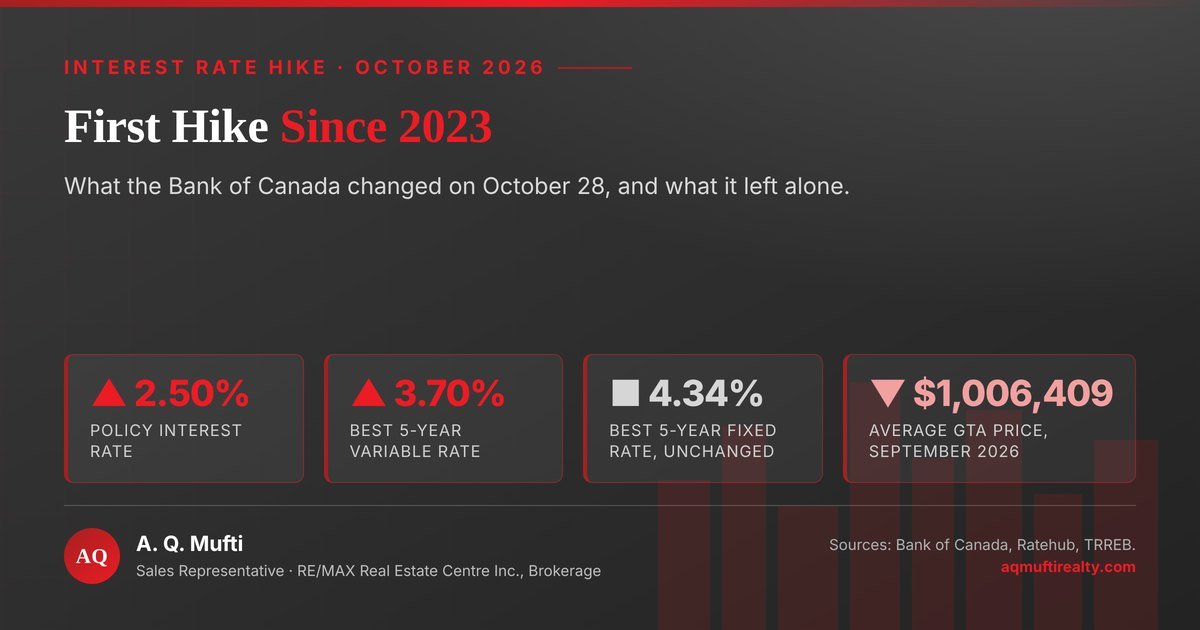
On October 28 the Bank of Canada raised its policy rate by a quarter point to 2.50%. That is the first increase since July 2023, so a whole generation of GTA buyers has never seen one.
Still, the headline number is not the number that decides your payment. Three others do, and the interest rate hike is the smallest of them.
The short version
- The rate went up a quarter point. The policy rate is 2.50%, up 25 basis points, and the Bank says more could follow.
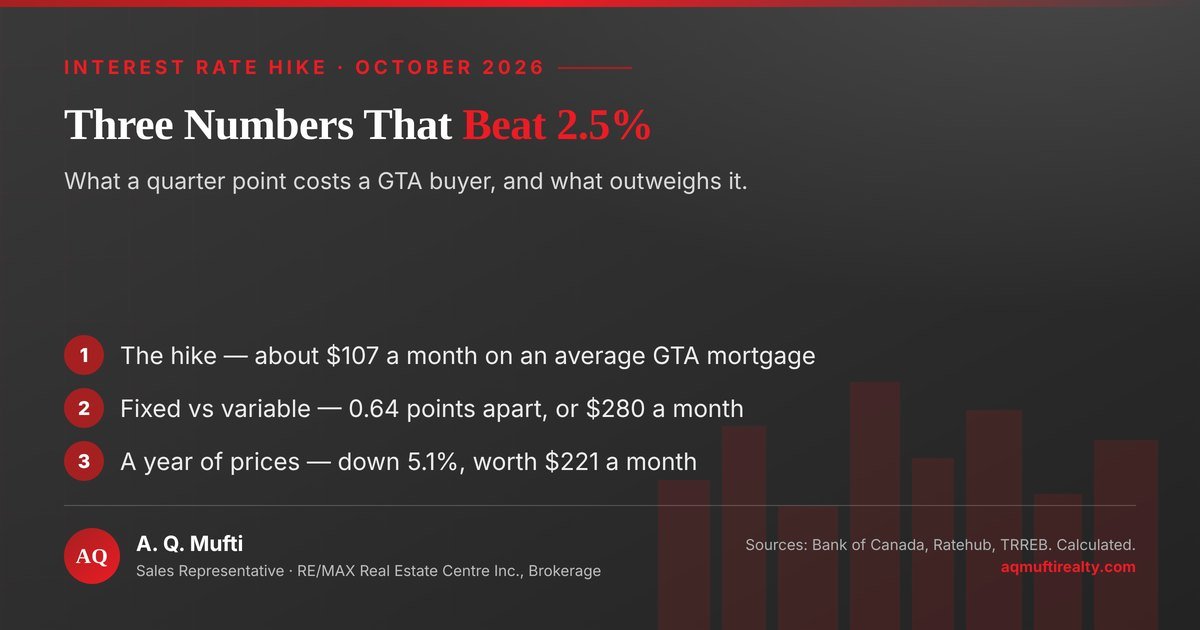
- It costs about $107 a month. That is what the interest rate hike adds to a variable mortgage on an average GTA home (calculated).
- Fixed rates did not move. The best five-year fixed rate is 4.34%, priced off bond yields rather than the Bank’s decision.
- Prices fell far more than rates rose. The average GTA price is down 5.1% in a year, worth about $221 a month (calculated).
- The next decision is December 9. So you have about six weeks before the question comes round again.
The decision in numbers
First, here is what the Bank published and what lenders did with it. Every line below shapes what the interest rate hike means for a GTA purchase, and none of it is a matter of opinion.
| Measure | Figure | Source |
|---|---|---|
| Policy interest rate after October 28 | 2.50% | Bank of Canada |
| Size of the increase | 25 basis points | Bank of Canada |
| Bank Rate | 2.75% | Bank of Canada |
| Last increase before this one | July 2023 | Bank of Canada |
| CPI inflation since April | about 3% | Bank of Canada |
| Inflation excluding gasoline, September | 2.2% | Bank of Canada |
| Inflation expected by the end of 2026 | about 3.5% | Bank of Canada |
| Inflation back near 2% | mid-2028 | Bank of Canada |
| Unemployment rate | about 6.5% | Bank of Canada |
| Best five-year variable rate, after the hike | 3.70% | Ratehub |
| Best five-year fixed rate | 4.34% | Ratehub |
| Average GTA selling price, September 2026 | $1,006,409 | TRREB |
| Next rate decision | December 9, 2026 | Bank of Canada |
What the interest rate hike actually changed
Start with the mechanics, because only one kind of borrowing moved on October 28. Indeed the Bank sets one rate, and lenders decide what to do with the rest.
The interest rate hike in two rates
The policy rate went to 2.50% and the Bank Rate to 2.75%, a quarter point higher in each case. Lenders then raised prime by the same quarter point.
So the interest rate hike passes straight through to anything priced off prime. That means variable mortgages and lines of credit, and it happens within days rather than at renewal.
Why the Bank moved at all
Oil has been the problem. Governor Tiff Macklem said an increase “is needed to reduce the risk that elevated energy prices could spill over and become generalized inflation,” the Bank set out in its decision.
Then he flagged what comes next. There “could be a need to raise the policy rate further,” he said, though “we will proceed carefully.”
Notably the rest of the picture is softer. Inflation outside gasoline ran at 2.2% in September, core measures sit close to 2%, and unemployment has held near 6.5% for months.
Number one: what the interest rate hike costs you
Now put a dollar figure on it. Abstract basis points persuade nobody, and the GTA has its own math.
How the interest rate hike lands on a GTA mortgage
Take the average GTA home at $1,006,409 and a 20% down payment. That leaves a mortgage of $805,127 (calculated).
The best five-year variable rate moves from 3.45% to 3.70%, Ratehub told MoneySense. Over 25 years the payment goes from $3,999 to $4,105, so the interest rate hike costs about $107 a month (calculated).
Put simply, that is $1,280 a year. Real money, and far less than most people brace for when they hear the word hike.
Thirteen dollars per $100,000
Here is the version you can do in your head. A quarter point adds about $13 a month for every $100,000 you owe, on a 25-year amortization (calculated).
So a $500,000 mortgage costs roughly $66 more a month, and a $300,000 mortgage about $40. Multiply by your own balance and you have your answer.
Number two: fixed or variable after the interest rate hike
Next the decision this actually forces. Of course a hike makes people want to lock in, yet the arithmetic argues the other way right now.
Why the best fixed rate did not move
Fixed rates follow the bond market. “Fixed mortgage rates are not directly affected by Bank of Canada rate decisions,” Ratehub’s Clay Jarvis told MoneySense, and they have been elevated since investors sold bonds through September and October.
So the best five-year fixed rate stayed at 4.34% while the variable rate rose. In other words the interest rate hike narrowed the gap without closing it.
The 0.64-point gap, in dollars
The spread still favors variable. At 4.34% the same $805,127 mortgage costs $4,385 a month, against $4,105 at 3.70% (both calculated).
That is $280 a month, or 0.64 of a percentage point (calculated). The Bank would have to raise again more than twice before fixed looked cheap by comparison.
Even so, a fixed rate buys certainty, and the Bank has said plainly that more increases are possible. Hence the honest answer depends on how much a predictable payment is worth to you, not on which rate is lower today.
Number three: the price drop that beats the interest rate hike
Now the number nobody puts in a headline. While rates were flat, GTA prices fell, and for a buyer that swamps everything above.
A 5.1% decline is worth $221 a month
The average GTA selling price was $1,006,409 in September, down 5.1% in a year, with the price index down 4.7%, TRREB reported.
Price that decline as a payment. At 3.70% the same buyer saves about $221 a month compared with last year’s average price (calculated), which is more than twice what the interest rate hike just added.
Therefore a buyer who waited a year is ahead, not behind. Sellers were the ones who paid for that quarter point, long before the Bank announced it.
What TRREB said three weeks before the decision
The board saw this coming. Buyers need confidence that “inflation will not put pressure on borrowing costs over the long term,” TRREB’s Jason Mercer said on October 6.
Granted that confidence took a knock on October 28. Equally, sales were already down 9% in September and new listings down 14.4%, so the market cooled while rates sat still.
What the interest rate hike means for your next move
Finally, the part that depends on where you are standing. The same quarter point reads differently to a renewer, a buyer and a seller.
If you are renewing
Check which rate you are actually on first. A variable mortgage has already changed; a fixed one has not changed at all until its term ends.
Also get your renewal quote in writing early. Lenders hold a rate for 90 to 120 days, so an offer secured now survives the December meeting.
If you are buying after the interest rate hike
Your pre-approval may now be stale. A quarter point shifts what you qualify for, and the stress test applies on top of whatever rate you are offered.
Yet your buying power on price is better than a year ago, not worse. That is the whole point of the third number.
If you are selling
Price to the market you are in rather than the one you remember. With sales down and listings down, the buyers still shopping are rate-sensitive and patient.
- Find out what rate you are on. Variable borrowers see this within one or two payments; fixed borrowers see nothing until renewal.
- Rerun your numbers at 3.70% and 4.34%. Then decide which payment you would rather live with for five years.
- Hold your pre-approval. Ask your lender to confirm the hold period in writing before December 9.
- Price a home before you price a rate. I can show you what $1 million buys in Mississauga, Oakville or Milton at current prices.
Want help with the second half of that? My mortgage calculator turns a rate into a monthly figure, the step-by-step guide for buyers covers the purchase itself, my home valuation tells a seller where they stand, and my monthly market updates track the price figures above.
Your questions on the interest rate hike
Short answers to what buyers and owners in Mississauga, Oakville and Milton have asked me since the announcement.
Does the interest rate hike change my fixed mortgage?
No. A fixed rate holds for the whole term, so nothing changes until you renew. The interest rate hike reaches you only at that point, and only at whatever rates are then.
When will my variable payment go up?
Within days. Lenders raised prime by the same quarter point, and variable mortgages are priced off prime, so the change shows up in your next payment or the one after.
Should I lock in after this interest rate hike?
The best variable rate is 3.70% and the best fixed is 4.34%, a gap of 0.64 points (calculated). Locking in costs about $280 a month on an average GTA mortgage, so the question is what certainty is worth to you.
Will the interest rate hike push GTA prices down further?
Nobody can promise that. Prices were already down 5.1% in a year while rates sat still, which suggests listings and jobs matter more here than a quarter point does.
When is the next Bank of Canada decision?
December 9, 2026. The Bank has also published its 2027 dates, beginning January 27, and I write up each one.
Sources and further reading
- The October 28 rate decision, from the Bank of Canada — the decision
- Rate announcement dates, from the Bank of Canada — what is next
- September 2026 market release, from TRREB — the GTA market
- Mortgage rates after the decision, from MoneySense — the rates
Keep reading on the blog
More guides and market analysis from this blog.
- GTA Mortgage Renewal in 2027 — if you renew soon
- GTA Home Sales, September 2026 — the latest data
- First Home Savings in Ontario — the down payment
- Closing Costs in Ontario, Itemized — the cash at closing
Ready to see what this means for your mortgage?
Tell me your balance, your renewal date and where you are looking, and I will put today’s rates and current Mississauga, Oakville and Milton prices beside them. No pressure, and no obligation.
Prefer to start with a number? Get a tailored home valuation or run the figures in the mortgage calculator.
Disclaimer: This article draws on the Bank of Canada’s October 28, 2026 rate decision and its published schedule, on TRREB’s September 2026 release, and on rate figures MoneySense reported from Ratehub. It offers information only. I calculated every dollar example of the interest rate hike, using semi-annual compounding over a 25-year amortization. Rates change daily, so confirm your position with a licensed mortgage broker before you act. Nothing here is tax, legal or financial advice. A. Q. Mufti – Sales Representative, RE/MAX Real Estate Centre Inc., Brokerage.
A. Q. Mufti — Sales Representative
RE/MAX Real Estate Centre Inc., Brokerage
MSc, PMP®, ABR®, SRS®, CNE®
416 908 5600 · 905 270 2000
info@aqmuftirealty.com
141-1140 Burnhamthorpe Rd. W., Mississauga ON L5C 4E9
Serving Mississauga, Oakville, Milton, Brampton, Toronto and the wider GTHA. More about how I work.