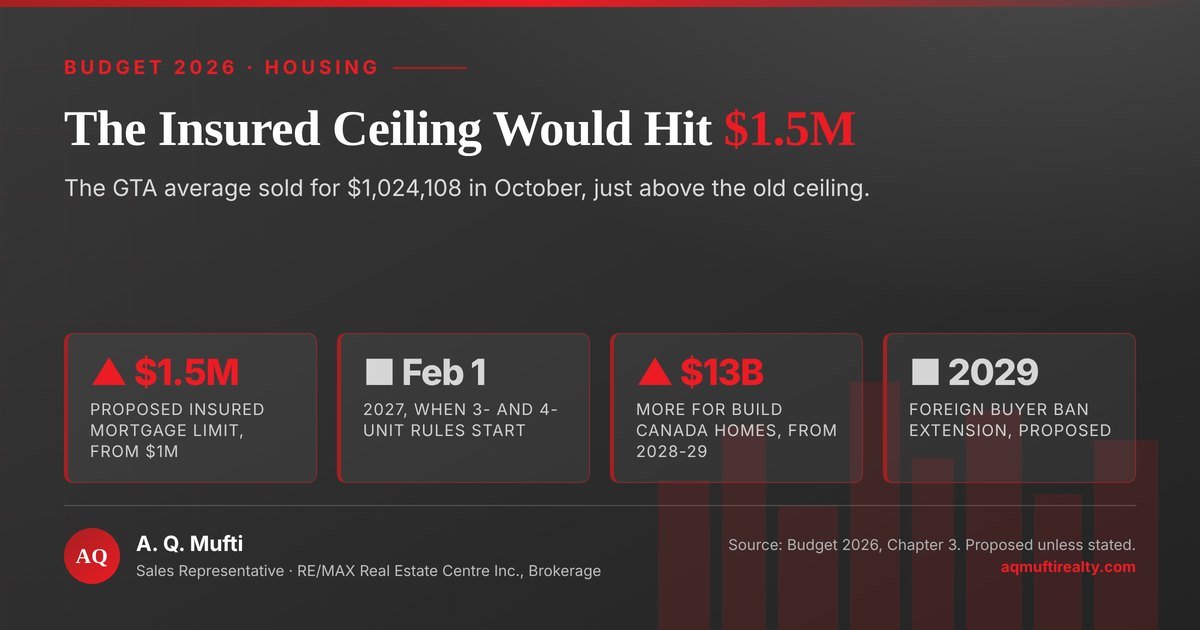
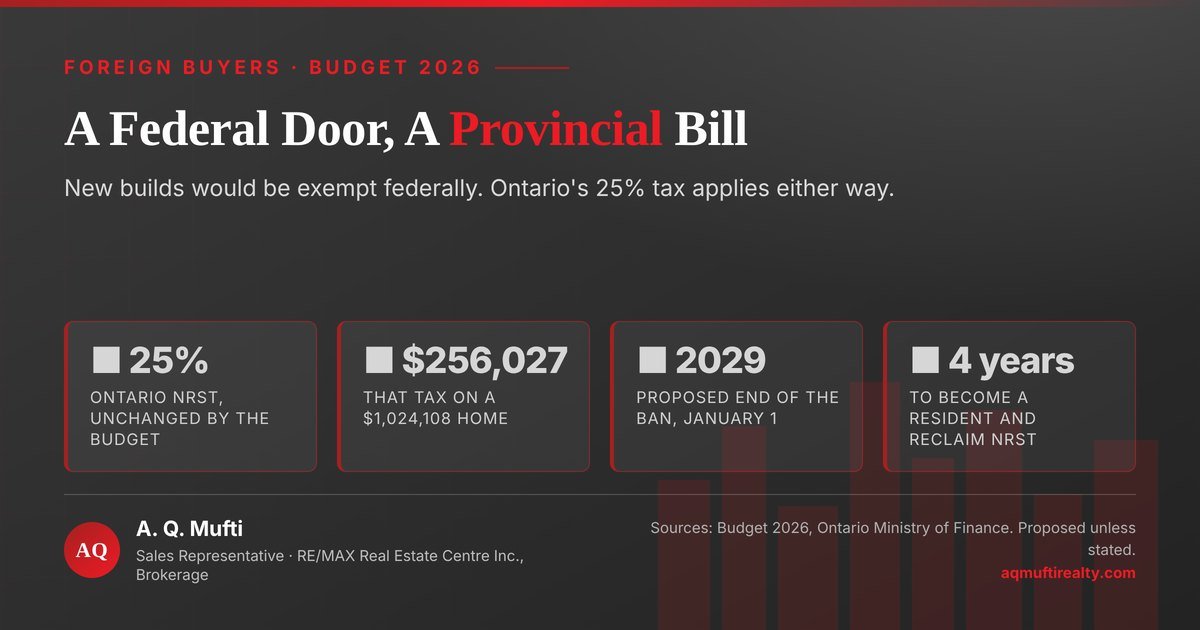
The foreign buyer ban after the 2026 budget, at a glance. Sources: Budget 2026 and Ontario Ministry of Finance.
The 2026 federal budget proposes opening new construction to non-Canadians while keeping resale closed. That sounds like a door swinging open. Before anyone walks through it, the foreign buyer ban needs reading alongside a provincial tax nobody mentioned.
Ontario charges non-residents 25% on the purchase price. On a home at the October 2026 regional average that is $256,027.00, calculated, and the federal budget does not touch it.
The short version
- The ban still stands. First, the prohibition on non-Canadians buying existing homes is in force now. Nothing in the budget changed that on the day it was tabled.
- The change is a proposal. The budget would extend the foreign buyer ban two years, to January 1, 2029, “while exempting new residential properties”. Legislation has to follow.
- Nobody has defined “new” yet. Consequently the budget sets no start date and gives no definition of a new residential property.
- Ontario’s 25% tax is untouched. The Non-Resident Speculation Tax applies anywhere in Ontario, on the full price, and sits on top of land transfer tax.
- There is a real rebate, with a clock. Notably, a foreign national who becomes a permanent resident within four years may recover the whole 25%.
The foreign buyer ban and the taxes beside it
First, here is what applies today against what the budget proposes. The foreign buyer ban is federal; the tax lines below it are provincial and entirely separate.
| Item | Position | Status |
|---|---|---|
| Ban on buying existing homes | Applies to non-Canadians | In force |
| Proposed end date | January 1, 2029 | Proposed |
| New residential properties | Would be exempt | Proposed, undefined |
| Purchase for development | Excluded from the prohibition | In force |
| Ontario NRST rate | 25% of the price | In force |
| NRST area | Anywhere in Ontario | In force |
| NRST and land transfer tax | NRST applies in addition | In force |
| Permanent resident rebate | Full NRST refunded, conditions apply | In force |
| Student and worker rebates | Withdrawn | Closed |
| First-time buyer refund | Citizens and permanent residents only | In force |
What the foreign buyer ban does right now
Start with the law as it stands, because that is what governs a purchase signed now.
The foreign buyer ban closes existing homes
Canada bars non-Canadians from buying a home, under an Act passed in 2022 and the rules beneath it. So the foreign buyer ban is not a plan. It is in force now.
One point is worth saying plainly. The Act sets no end date in its own text. Its repeal clause sits under amendments not in force. So this post gives no current end date, because no government page states one.
Exceptions the foreign buyer ban leaves open
Meanwhile the rules carve out several buyers. Notably, they exclude a purchase “for the purposes of development”. Refugees, some temporary residents and some spouses sit outside the ban too.
Hence the foreign buyer ban was never total. Granted, those carve-outs are narrow. Whether one fits a given buyer is a question for a lawyer, not an agent.
What the budget would change in the foreign buyer ban
Next, the part that made headlines. Read it with care. The wording does more work than the summaries let on.
Two years, to January 1, 2029
The budget would “extend the ban on foreign purchases of existing residential properties for two years, to January 1, 2029”, “while exempting new residential properties”, per Chapter 3. Its stated aim is to unlock investment in new supply.
Yet the same page says the government “will propose legislation and launch a regulatory process on this change in short order”. So both halves of it are plans, not law.
Nobody has defined a new residential property
Here is the gap that matters. The budget never says what “new residential properties” means, and sets no start date. Does a pre-construction deal count? An empty builder unit? A unit finished two years ago?
Those answers will come from a bill and from rules, not from a budget line. So anyone who signs now is betting on terms that do not yet exist.
Ontario’s 25% tax does not move with the foreign buyer ban
Then comes the provincial layer, which the budget leaves exactly where it was. Most coverage skipped this part.
Where the federal rule ends, the provincial tax begins
Ontario charges a Non-Resident Speculation Tax of 25%, in force since October 25, 2022. It catches foreign nationals, foreign firms and taxable trustees, on homes anywhere in Ontario.
Also, the province is blunt: “the NRST applies in addition to the general Land Transfer Tax in Ontario”. So a buyer it catches pays both, not one or the other.
It is charged on the whole price, not on your share
Equally, and this is often missed. If one buyer on title is a foreign national, the tax hits the full price. It is not split to match a share, and each buyer owes it.
Besides, Ontario’s page does not say whether a brand-new home escapes the tax. It covers land with one to six single-family homes, and lists no carve-out for new builds. So assume nothing here. Ask a real estate lawyer first.
One caution about sources. Ontario’s page still says the federal ban runs to the end of 2024, which is out of date. So check federal rules federally, and Ontario rules with Ontario.
What it actually costs: a worked example
Now put real numbers on it. The gap is wider than most people expect. Every figure below is an example, worked out by me, and your own deal will differ.
A $1,024,108 home in Mississauga
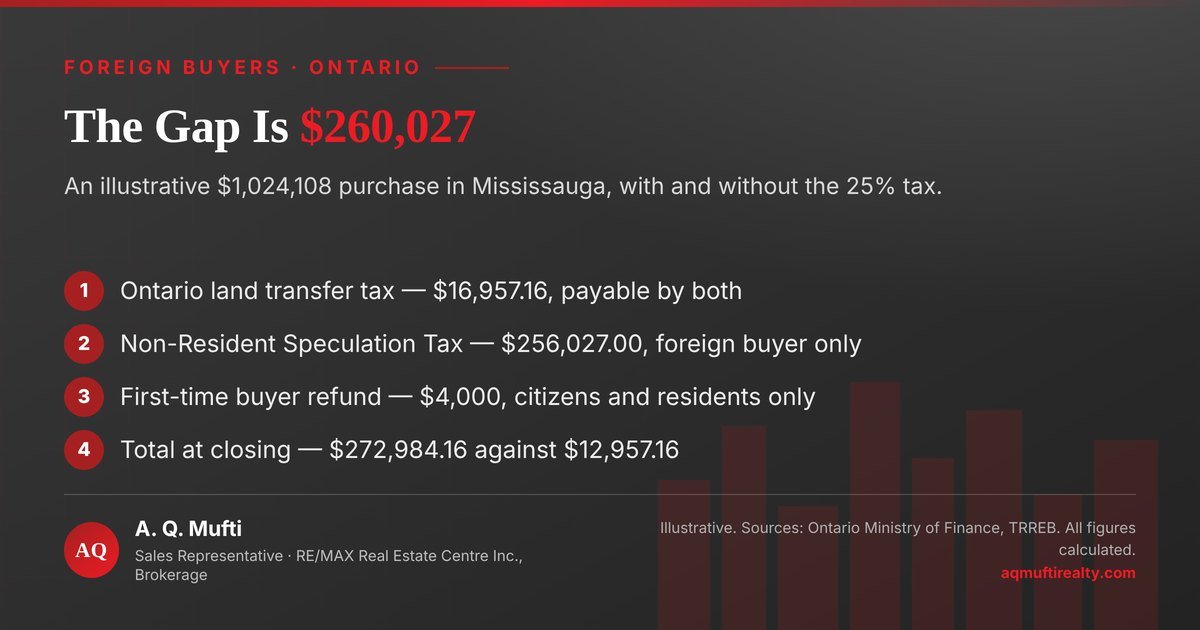
Take the October 2026 GTA average of $1,024,108, bought in Mississauga, which adds no city land transfer tax. Ontario land transfer tax comes to $16,957.16 on the province’s own published formula.
Add the 25% tax, which is $256,027.00. So the total at closing is $272,984.16, against $16,957.16 for a buyer the tax misses (all worked out by me).
The same purchase for a Canadian citizen
A Canadian citizen or permanent resident buying their first home can also claim a land transfer tax refund of up to $4,000. Ontario restricts that refund to citizens and permanent residents, and has done since January 1, 2017.
That buyer pays $12,957.16. The foreign national pays $272,984.16. Hence the gap on the same home is $260,027.00, or about 21 times the tax at closing. None of it turns on the foreign buyer ban.
In the end that number, not the foreign buyer ban itself, decides most deals. A federal door swinging open does nothing about a provincial bill worth a quarter of the price.
Foreign buyer ban strategy if you plan to move here
Finally, the practical question. The honest answer splits sharply by which of the two you are. So take them one at a time, and note that the foreign buyer ban is rarely the binding constraint.
If you intend to become a permanent resident
There is a real route here, and it is the best news in this post. Ontario offers a rebate of the whole 25% to a foreign national who becomes a permanent resident, if the conditions are met.
Those conditions are strict. Hold the home alone or with a spouse. Move in as your main home within 60 days of registration. Apply within 180 days of getting status.
Watch the four-year clock, and note a wrinkle. One Ontario page says you must become a permanent resident “within four years of the date the conveyance is registered”; another says “within four years from the date of the purchase or acquisition”. Those can differ on a pre-construction deal, so get the date confirmed in writing.
Ontario’s first-time buyer refund also allows 18 months after registration to gain status and then claim. So the two clocks interact. That is exactly why this belongs with an immigration lawyer, not a blog.
If you are buying purely as an investment
Here the math is colder. With no path to status there is no rebate, so the 25% is a lasting cost, not a timing one.
- Price the tax into your return, not around it. A quarter of the purchase price is not a closing cost. It is a large part of several years of yield.
- Do not pre-commit to the proposed exemption. The foreign buyer ban carve-out is not law, “new residential property” has no definition, and no start date exists.
- Check the student and worker rebates are gone. Those closed to agreements after March 29, 2022, and the deadline passed on March 31, 2025.
- Hire both advisers first. A real estate lawyer on tax and title, an immigration lawyer on status. I am neither, and here that matters most.
Want the groundwork in writing? For instance, my step-by-step guide for buyers runs from pre-approval to keys, and the monthly market updates track the figures as they change.
Your foreign buyer ban questions
Short answers to what non-resident buyers are asking me after the November 5, 2026 budget.
Does the foreign buyer ban stop a new build purchase?
Not on the strength of the budget. Its exemption for new residential properties is proposed, not law, and carries no start date. Until a bill passes, the foreign buyer ban and its written exceptions govern any purchase.
When does the foreign buyer ban end?
The budget proposes extending it two years, to January 1, 2029. No government page I could read states the current end date, and the Act carries no expiry in its own text, so this post does not guess at one.
Does Ontario’s tax outlast the foreign buyer ban?
Yes. The Non-Resident Speculation Tax is provincial and entirely separate from the federal foreign buyer ban. Nothing in the federal budget changes it, and it applies in addition to land transfer tax.
Can I get the 25% back if I become a permanent resident?
Ontario offers a rebate of the full NRST if you become a permanent resident within four years and meet the conditions, including occupying the home as your principal residence and applying within 180 days. Confirm your dates with a lawyer.
Does the tax apply if only one buyer is a foreign national?
Ontario applies it to the full value of the consideration if any one transferee is a foreign national, foreign corporation or taxable trustee. It is not prorated to that person’s ownership share.
Sources and further reading
- Budget 2026 – Chapter 3 — the proposal
- Justice Canada – the Act — the ban
- Justice Canada – regulations — exceptions
- Ontario – NRST — the 25%
- Ontario – NRST rebates — the rebate
- Ontario – land transfer tax — the formula
- Ontario – first-time buyer refund — the $4,000
Keep reading on the blog
More market analysis and guides from this blog.
- Federal Budget Housing and the $1.5M Truth — the budget
- Land Transfer Tax in the GTA — the other tax
- New Condo Purchase Risks in Ontario — pre-construction
- Average Selling Price, October 2026 — the market
Ready to look at this against a specific property?
Send me the area and price range you are considering and I will set out the figures that apply to it, and point you to the right lawyer before anything is signed. No pressure, and no obligation.
Prefer to start with a number? Get a tailored home valuation or run the figures in the mortgage calculator.
Disclaimer: Sources: Budget 2026, the federal Act and rules on purchases by non-Canadians, and the Ontario Ministry of Finance. General information only. The extension and the new-build exemption are proposals, not law. Every dollar figure is an example I worked out from published rates, so your own deal will differ. Ontario does not state publicly whether a new build escapes the 25% tax. Nothing here is legal, tax, immigration or financial advice. I am a salesperson, not a lawyer: retain both before you sign. A. Q. Mufti – Sales Representative, RE/MAX Real Estate Centre Inc., Brokerage.
A. Q. Mufti — Sales Representative
RE/MAX Real Estate Centre Inc., Brokerage
MSc, PMP®, ABR®, SRS®, CNE®
416 908 5600 · 905 270 2000
info@aqmuftirealty.com
141-1140 Burnhamthorpe Rd. W., Mississauga ON L5C 4E9
Serving Mississauga, Oakville, Milton, Brampton, Toronto and the wider GTHA. More about how I work.