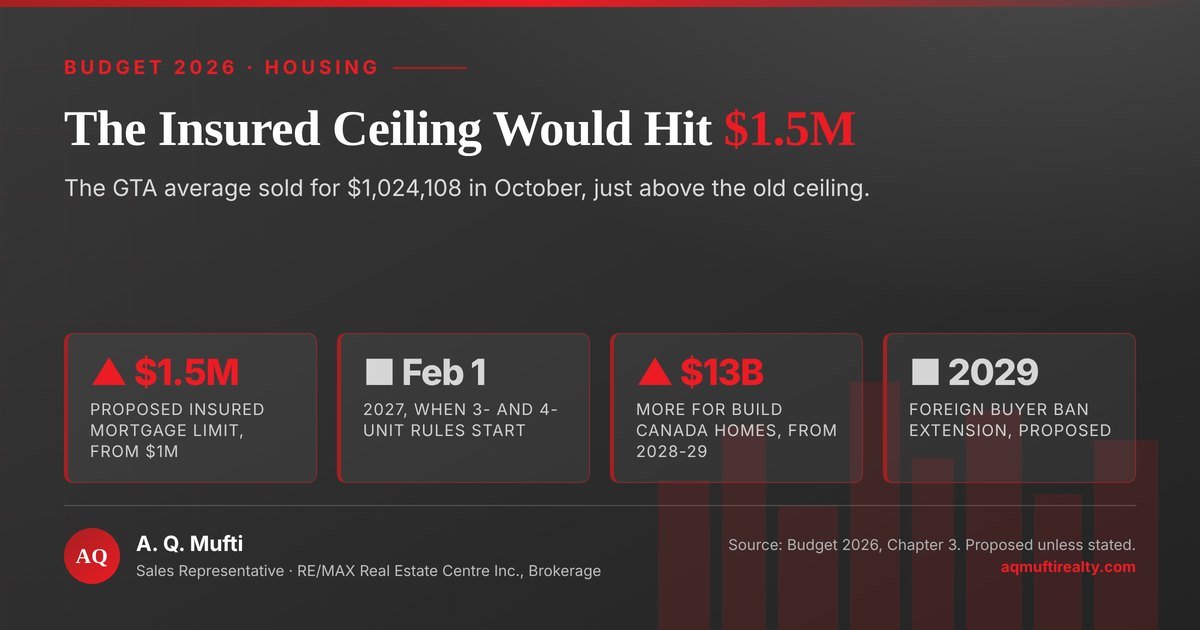
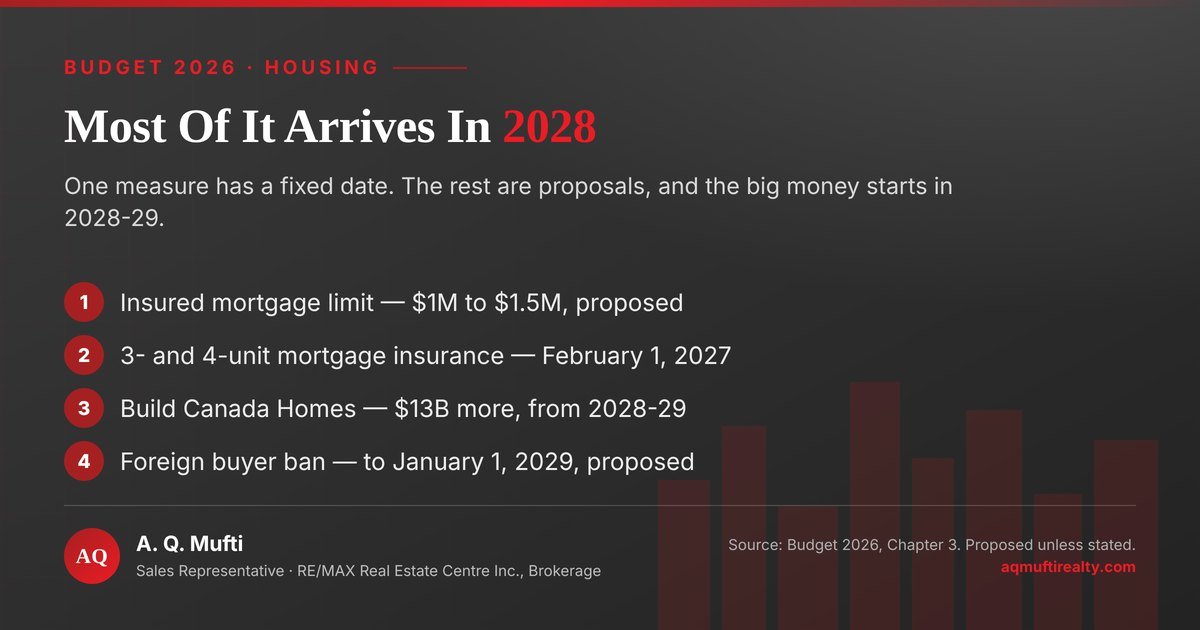
The 2026 federal budget housing measures at a glance. Source: Budget 2026, Chapter 3. Proposed unless stated.
Ottawa tabled its budget on November 5, 2026, and the housing section runs to billions. Most of it, though, is a supply story for 2028 and beyond. The federal budget housing measure that touches a Mississauga buyer soonest is far smaller and far more specific.
It is the insured mortgage price limit, proposed to rise from $1 million to $1.5 million. In a region where the average home sold for $1,024,108 in October, that single line moves the ceiling from just below the typical price to comfortably above it.
The short version
- The insured ceiling moves. First, the price limit for an insured mortgage is proposed to go from $1 million to $1.5 million. The GTA average sat about $24,100 above the old cap (calculated).
- One date is already fixed. Mortgage insurance for three- and four-unit homes “will come into effect on February 1, 2027”, which is the only hard date in the housing section.
- Longer amortizations widen. Thirty-year amortizations are proposed where at least one borrower is a first-time buyer, or where the home is newly built.
- The big money is later. Build Canada Homes gets $13 billion more, but starting in 2028-29. Its total capitalization reaches $45 billion, against a target of 200,000 homes in a decade.
- Nearly all of it is a proposal. Consequently no federal budget housing change here is law yet. A bill has to follow first.
The federal budget housing measures that matter here
First, here are the federal budget housing items a GTA buyer or owner would actually feel, with the date each one arrives. Everything is proposed unless the last column says otherwise.
| Measure | Amount or change | When |
|---|---|---|
| Insured mortgage price limit | $1M to $1.5M | Proposed |
| 30-year amortization | First-time buyers, or newly built homes | Proposed |
| Mortgage insurance, 3- and 4-unit homes | Private insurers on 5 to 50 units | February 1, 2027 |
| Insured construction financing, 3- and 4-unit | Up to 90% of value, no price maximum | Proposed |
| Build Canada Homes | $13B more; $45B total; 200,000 homes | From 2028-29 |
| Build Communities Strong Fund | $51B over 10 years, then $3B a year | From 2026-27 |
| Non-market housing starts | Tripling, to 24,000 a year | Over a decade |
| Ending homelessness | $11.2B over 4 years, plus $17.8B later | From 2027-28 |
| Foreign buyer ban | Extended to January 1, 2029; new builds exempt | Proposed |
| GST removed or reduced on new homes | Up to $50,000 for first-time buyers | Already in place |
The federal budget housing change that lands closest to home
Start with the insured mortgage, because it decides which homes a buyer with less than twenty per cent down can even consider.
Why $1.5 million is the federal budget housing number
The budget proposes lifting the price limit on an insured mortgage from $1 million to $1.5 million. It also opens thirty-year amortizations to two groups: first-time buyers, and anyone buying a newly built home. That is the change with the shortest path to your wallet.
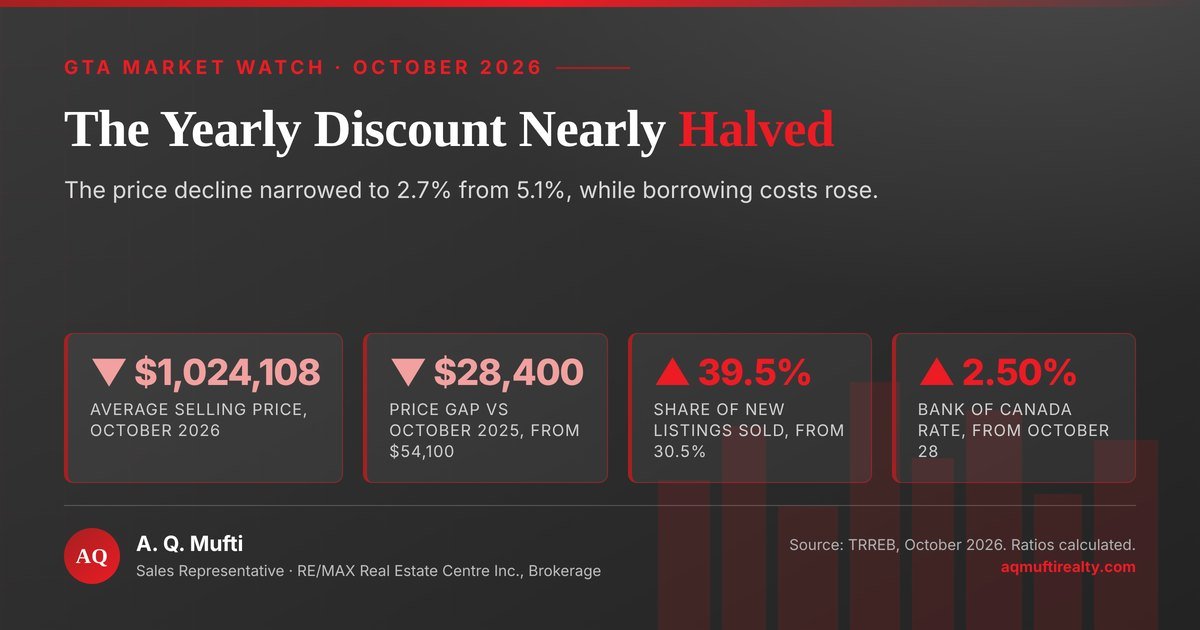
Now set that against this region. The average selling price across the GTA was $1,024,108 in October 2026. So the typical home sat roughly $24,100 above the old ceiling and sits about $475,900 below the new one (both calculated).
Therefore the effect is not a discount. It is access. A whole band of Mississauga and Oakville homes would come into range for a buyer who cannot put twenty per cent down.
The one federal budget housing date that is fixed
Most of the housing section avoids dates. One item does not. Mortgage insurance for three- and four-unit homes “will come into effect on February 1, 2027”, with private insurers covering buildings of five to fifty units. Mark that date.
Besides that, the budget would insure construction loans on newly built three- and four-unit homes up to ninety per cent of value. No price maximum applies, and the owner need not live there. That federal budget housing item targets small builders and owners adding a unit.
Where the federal budget housing money actually goes
Next, the headline spending. It is large, and it is mostly aimed at supply rather than at the buyer in front of me today.
Build Canada Homes, and the 2028 problem
Build Canada Homes gets another $13 billion over ten years. That brings its total funding to $45 billion, against a target of 200,000 homes in a decade, or 20,000 a year (calculated). It is the largest single commitment in the document.
However, that money starts in 2028-29. So a buyer house hunting now will not see one of those homes for years. Admittedly supply plans are slow by nature. Even so, the gap is worth saying plainly.
Development charges and the municipal layer
The Build Communities Strong Fund carries $51 billion over ten years from 2026-27, then $3 billion a year. The budget says it helps cities lower development charges. It gives no separate figure for those charges.
Furthermore the budget points to a tax partnership with Ontario that it says could reduce the cost of a home “by up to $200,000”. Notably, it attaches no cost and no start date to that figure. So treat it as a hope, not a number you can plan around.
What the federal budget housing plan does not change
Here is where federal budget housing coverage usually goes wrong. A reader can come away misled without anyone telling a lie.
The GST saving is an existing measure
The budget says first-time buyers are saving up to $50,000 through the removal or reduction of the GST on new homes. That is real money. Yet it describes a measure already in place, which the budget simply restates.
Hence a first-time buyer should not wait for it to arrive. It is available on qualifying new builds now, and my earlier guide to the new home HST rebate in Ontario walks through how the rebate actually works.
Almost every federal budget housing item is a proposal
Equally important: a budget proposes, it does not enact. On the foreign buyer change the document says the government “will propose legislation and launch a regulatory process on this change in short order”. That wording is plain about the order of events.
So the honest position is simple. As of November 6, 2026, no federal budget housing change above is law. Granted, such measures usually do pass. Nevertheless the terms can shift on the way, and anyone signing a deal on the strength of a press release takes a risk they need not take.
The foreign buyer change, in one paragraph
One federal budget housing measure deserves its own treatment. It gets a separate post on November 7, 2026, because the detail matters.
Extended to 2029, with new builds carved out
The budget proposes to “extend the ban on foreign purchases of existing residential properties for two years, to January 1, 2029”, “while exempting new residential properties”. In other words resale stays closed and new construction would open.
However the budget never defines “new residential properties”. It gives no start date, and the change is not law. Ontario also charges a 25% Non-Resident Speculation Tax, which no federal budget housing measure touches.
That combination is exactly why it needs its own post rather than a paragraph in this one. That piece works through the taxes, the exemptions that already exist, and the real arithmetic on a purchase.
How to use the federal budget housing news this month
Ultimately a budget earns attention only if it changes a decision. So here is what these federal budget housing items should change, and what they should not.
If you are buying
- Do not re-plan around the $1.5 million limit yet. It is proposed. Ask your lender what they will actually insure today, then test the payment in my payment calculator.
- Watch February 1, 2027 if you want a plex. Three- and four-unit mortgage insurance has a fixed start date. That is a real planning anchor, unlike the rest.
- Price the market you are in, not the one on offer later. Build Canada Homes money starts in 2028-29, so no federal budget housing spending changes supply now.
- Claim what already exists. The GST relief on qualifying new homes is in force now, and it is worth more to most first-time buyers than anything announced.
If you are selling or holding
- A higher insured ceiling widens your buyer pool. If it passes, homes between $1 million and $1.5 million become reachable for buyers with less than twenty per cent down.
- Added units get cheaper to finance. The proposed construction financing for three- and four-unit homes changes the math on adding a legal unit.
- Do not price in a proposal. My home valuation page works from comparable sales, which is the only evidence a buyer will accept.
Want the whole sequence in writing? For instance, my step-by-step guide for buyers runs from pre-approval to keys, and the monthly market updates track the figures as they change.
Your federal budget housing questions
Short answers to what buyers and owners are asking me about the November 5, 2026 budget.
Is the $1.5 million insured mortgage limit in effect now?
No. It is proposed in the budget, and the budget says legislation and regulation follow. Ask your lender what they will insure today rather than planning on the proposed figure.
What federal budget housing measure has a firm date?
Mortgage insurance for three- and four-unit homes, which the budget says comes into effect on February 1, 2027. Private insurers would cover buildings of five to fifty units.
Does the federal budget housing plan lower prices here?
Not directly, and not soon. The supply money starts in 2028-29. The near-term federal budget housing change is access to insured financing at higher prices, which affects who can buy rather than what a home costs.
Is the GST saving on new homes something new?
No. The budget restates an existing measure, which it says is worth up to $50,000 to first-time buyers on new homes. It is available now on qualifying purchases.
Can foreign buyers purchase in Canada now?
The ban on purchases of existing homes stays in place, and the budget proposes extending it to January 1, 2029 while exempting new residential properties. That change is not law. A separate post covers it in detail.
Sources and further reading
- Budget 2026 – Chapter 3 — the measures
- Budget 2026 – home — the documents
- TRREB – October 2026 — $1,024,108
- Bank of Canada – rate — borrowing costs
Keep reading on the blog
More market analysis and guides from this blog.
- Average Selling Price, October 2026 — the market
- The New Home HST Rebate in Ontario — the GST relief
- GTA Mortgage Renewal in 2027 — renewals
- The First Home Savings Account in Ontario — saving up
Ready to work out what this means for your own purchase?
Send me the area and price range you are watching and I will put these measures beside the comparable sales that actually apply to it, buying or selling. No pressure, and no obligation.
Prefer to start with a number? Get a tailored home valuation or run the figures in the mortgage calculator.
Disclaimer: This article draws on Budget 2026, Chapter 3, published by the Government of Canada on November 5, 2026, and on TRREB’s October 2026 market release. It offers information only. Every budget measure described here is a proposal unless the article says otherwise, and proposals can change before they become law. I calculated the comparisons against the GTA average selling price and the per-year figures. Nothing here is financial, mortgage, tax or legal advice, and mortgage insurance decisions rest with your lender and insurer. A. Q. Mufti – Sales Representative, RE/MAX Real Estate Centre Inc., Brokerage.
A. Q. Mufti — Sales Representative
RE/MAX Real Estate Centre Inc., Brokerage
MSc, PMP®, ABR®, SRS®, CNE®
416 908 5600 · 905 270 2000
info@aqmuftirealty.com
141-1140 Burnhamthorpe Rd. W., Mississauga ON L5C 4E9
Serving Mississauga, Oakville, Milton, Brampton, Toronto and the wider GTHA. More about how I work.