What a first home savings account and an RRSP withdrawal add up to on a GTA purchase. Sources: the Canada Revenue Agency, FCAC and TRREB. Dollar examples calculated.
Most savings deadlines are soft. You hear about an RRSP in February, you send money, and it still counts for last year. A first home savings account does not work that way.
Here the window shuts on December 31 and nothing reopens it. So a buyer who means to start one in the new year has already given up a year of room, and a deduction worth claiming.
The short version
- The year is the deadline. Contributions to a first home savings account count for the calendar year they are made in. There is no 60-day window into January, unlike an RRSP.
- Opening it costs nothing and banks room. Open an account before December 31 and $8,000 of room is yours, even with $0 in it.
- The limits are $8,000 a year and $40,000 for life. Unused room carries forward, but only $8,000 of it, so the most you can put in one year is $16,000.
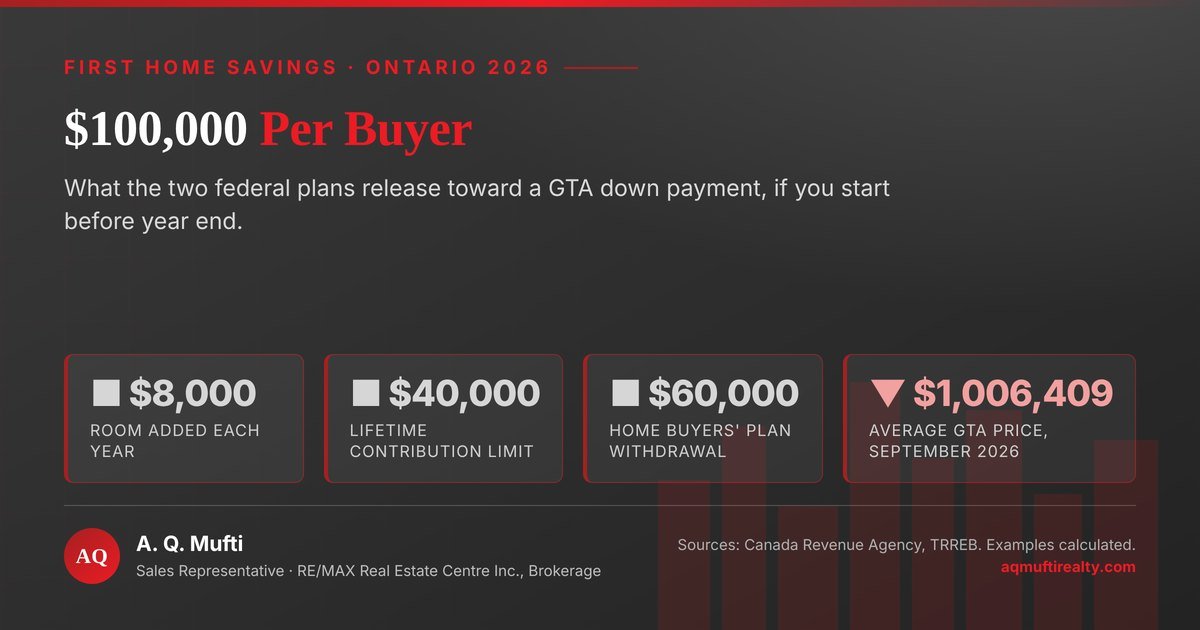
- You can stack it with an RRSP withdrawal. The Home Buyers’ Plan adds up to $60,000, and the CRA lets you use both on the same home.
- That is $100,000 per buyer. Two buyers reach $200,000, which is about 99% of a 20% down payment on an average GTA home (calculated).
The limits in numbers
First, here is what the federal rules publish. Every line below shapes what a first home savings plan can do for a GTA purchase, and none of it is a matter of opinion.
| Measure | Figure | Source |
|---|---|---|
| Room added each year | $8,000 | CRA |
| Most unused room you can carry forward | $8,000 | CRA |
| Largest amount you can contribute in one year | $16,000 | Calculated |
| Lifetime deduction limit | $40,000 | CRA |
| Contribution period | Jan 1 to Dec 31 | CRA |
| Tax on an excess amount | 1% a month | CRA |
| Home Buyers’ Plan withdrawal limit | $60,000 | CRA |
| Minimum age to open an account | 18 | CRA |
| Longest the account can stay open | 15 years | CRA |
| Average GTA selling price, September 2026 | $1,006,409 | TRREB |
What a first home savings account actually is
Start with the shape of it. Indeed this account borrows the best feature from each of the two plans buyers already know, which is why it is worth a look before year end.
A deduction going in, nothing owed coming out
Money you put in reduces your taxable income, the way an RRSP contribution does. Then a withdrawal to buy a qualifying home comes out untaxed, the way a TFSA withdrawal does, the CRA explains on its overview page.
So the first home savings account is the rare case where both ends are free. An RRSP taxes the money later. A TFSA gives you no deduction now.
Who is allowed to open one
The bar is low and the CRA sets it out plainly. You are a qualifying individual if you are “18 years of age or older,” “a resident of Canada” and “a first-time home buyer for the purposes of opening an FHSA.”
Also note what is missing from that list. No income test, no minimum deposit, and no requirement to be house hunting yet.
The first home savings deadline with no grace period
Now the part that catches people. Of course most savers assume a February top-up is fine, because that is how an RRSP behaves.
Why December 31 is a hard line
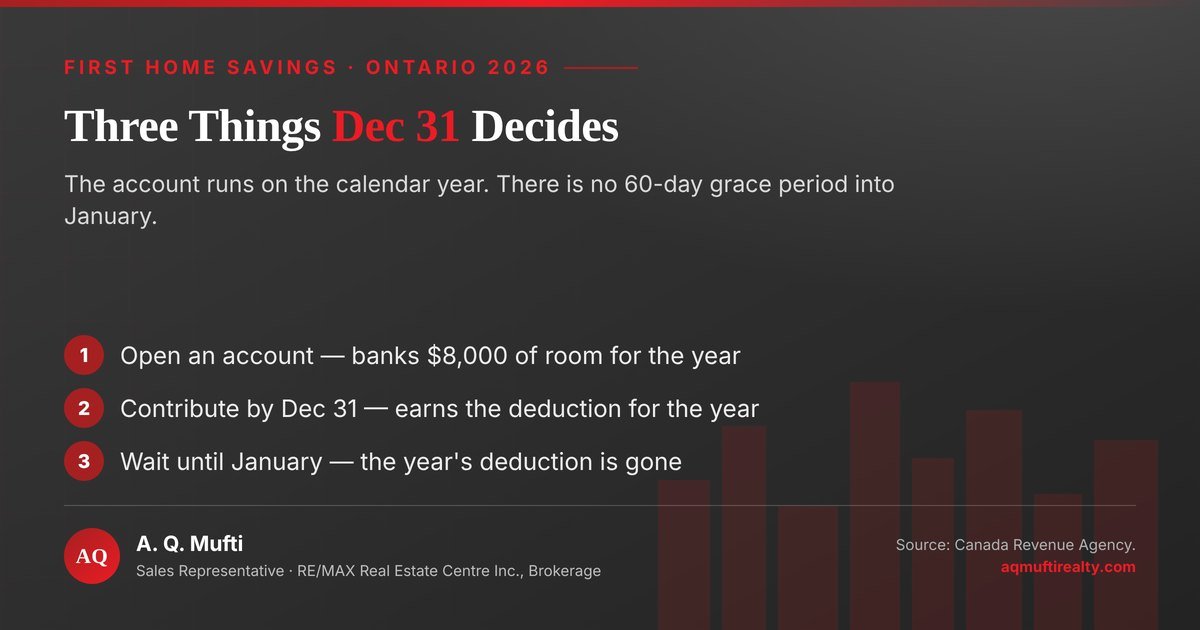
The CRA is direct about the window. “The contribution period for FHSAs is from January 1 to December 31 of the same year,” it states on its deductions page.
Then it closes the obvious workaround. A contribution made in the new year “cannot be deducted on your income tax and benefit return for the previous year, unlike contributions to an RRSP.”
What opening an account before year end banks
Here is the quieter point, and the reason this is urgent rather than merely useful. Room does not build up before you open an account. The CRA puts first-year room at “$8,000 as this was the first year that she opened an FHSA” in its own worked example.
Still, nothing says you must fund it. Open a first home savings account in December with nothing in it and you have $8,000 of 2026 room on the books, which carries into next year.
Put simply, waiting until January costs a year of room and a year of deduction. Opening the account costs a form.
First home savings and the Home Buyers’ Plan together
Next, the plan most GTA buyers already have. An RRSP can lend you your own money for a purchase, and the two accounts do not compete.
The $60,000 an RRSP will release
The ceiling is now substantial. “Currently, the HBP withdrawal limit is $60,000,” the CRA writes on its Home Buyers’ Plan page.
Then the key sentence for anyone weighing one against the other: you may use both plans on the same qualifying home “as long as you meet all of the conditions at the time of each withdrawal.” Hence a first home savings account is an addition, not a substitute.
A repayment break on a 2026 withdrawal
Yet the two differ in one large way. An RRSP withdrawal is a loan to yourself and you pay it back over 15 years. Nothing comes back out of the other account.
Even so, the timing has softened. For withdrawals made from 2026 through 2028, “the start of the 15-year repayment period is deferred to the fifth year following the year of the first withdrawal.”
Therefore a withdrawal this year gives you until 2031 before the first repayment falls due (calculated). That is five years of mortgage payments without a second claim on the same budget.
What first home savings buys on a GTA purchase
Now translate it into dollars at closing. Abstract limits do not help anyone choose, and the GTA has its own arithmetic.
The down payment you actually need
The rules tier by price. FCAC sets the minimum at “5% of the first $500,000 of the purchase price” plus “10% for the portion of the purchase price above $500,000,” and 20% once a home reaches $1.5 million.
So apply that to the market as it stands. The average GTA selling price was $1,006,409 in September, down 5.1% in a year, with the index down 4.7%, TRREB reported.
That puts the minimum down payment at $75,641 and a full 20% at $201,282 (both calculated). Below 20% you also buy mortgage loan insurance, because FCAC notes you “typically need” it under that mark.
Two buyers, one first home savings plan
Here the numbers start to work. One buyer who fills the account and uses the RRSP plan has $100,000 available, which clears the $75,641 minimum with $24,359 to spare (calculated).
Then double it for a couple. Two buyers reach $200,000, about 99% of a full 20% down payment on that average price (calculated), which is the difference between paying insurance and not.
Of course filling a first home savings account takes five years at $8,000 (calculated), so this is a plan rather than a purchase. Equally, five years is exactly why the December date matters.
Rules that can cost you your first home savings
Next the fine print, because two of these rules carry a real cost. Neither is hard to avoid once you have read them.
The 1% monthly tax on going over
Overshoot your room and the charge is monthly, not annual. You “pay a tax of 1% on the highest excess FHSA amount in the month for each month,” and it runs “until the excess FHSA amount is eliminated.”
Also, pulling the extra back out does not rescue the deduction. An excess “you designate as a withdrawal cannot be deducted on your income tax and benefit return for any year.”
Six conditions on a withdrawal
A tax-free withdrawal is not automatic either. The CRA lists six conditions, and two of them bite on timing:
- File Form RC725 with your account issuer before the money comes out.
- You must be a first-time home buyer at the moment of the withdrawal.
- A written agreement to buy or build must be in hand, completing “before October 1 of the year following the date of the withdrawal.”
- The home must not have been acquired “more than 30 days before making the withdrawal.”
- Canadian residency must hold from the first withdrawal until you take title.
- You must intend to live there “within one year after buying or building it.”
Therefore a withdrawal follows an accepted offer, not a hopeful search. That sequence is worth planning with your agent before you write anything.
When the first home savings window closes
Finally, the account has a lifespan. A first home savings plan ends on December 31 of the year the earliest of three events happens: “the 15th anniversary of opening your first FHSA,” the year “you turn 71 years of age,” or “the year following your first qualifying withdrawal.”
So the 15-year clock starts the day you open the account, which is the one argument for not opening it a decade early. Weigh that against a year of room, and for most buyers in their twenties or thirties the room wins.
How to use first home savings before December 31
Finally, the practical part. None of this needs a rate forecast, which is why it is worth doing now rather than in the spring.
Before December 31
- Open the account, even empty. Room starts the year you open one, so a December signature banks $8,000 you cannot get back later.
- Check your room before you send money. Your CRA account shows it. The penalty for guessing high is 1% a month.
- Next, move the contribution, not the deduction. You can contribute now and claim the deduction in a later, higher-income year.
- Tell your accountant it is not an RRSP. February money counts for the new year, and that surprises people who have filed RRSP receipts for decades.
Before you make a first home savings withdrawal
- Get the offer accepted first. A withdrawal needs a written agreement behind it, so the paperwork order is fixed.
- Then file Form RC725 with your issuer. No form, no tax-free withdrawal, however clearly you qualify.
- Check the completion date. It has to land before October 1 of the following year, which matters on a long pre-construction closing.
- Also price the home before you plan the cash. I can tell you what $100,000 down buys in Mississauga or Milton today.
Want help with the second half of that? My mortgage calculator turns a down payment into a monthly figure, the step-by-step guide for buyers covers the purchase itself, and my monthly market updates track the price figures above.
Your questions on first home savings
Short answers to what buyers in Mississauga, Oakville and Milton ask me most about saving a down payment.
Do I need a first home savings account if I have an RRSP?
They do different jobs, and the CRA lets you use both on the same purchase. An RRSP withdrawal under the Home Buyers’ Plan has to be repaid over 15 years. A first home savings withdrawal does not.
How much can I put in this year?
Up to $8,000 of room per year, plus at most $8,000 of unused room carried forward, so $16,000 at the outside (calculated). Over your lifetime the deduction limit is $40,000.
Does opening the account cost me anything?
No, and opening one before December 31 banks $8,000 of room for the year even if you contribute nothing. The one trade-off is that the 15-year clock starts that day.
What happens to my first home savings if I never buy?
Your account has to close by the end of its 15-year period, or the year you turn 71. Generally you can then transfer the balance “on a tax-deferred basis” into an RRSP or RRIF, the CRA says, rather than taking it as taxable income.
Can I contribute in February and claim it for last year?
No. The contribution period runs January 1 to December 31, and the CRA says money added later cannot be deducted for the previous year, unlike an RRSP contribution.
Sources and further reading
- FHSA overview, from the CRA — the basics
- Deductions and the year end, from the CRA — the cutoff
- Definitions and limits, from the CRA — the room
- Closing an account, from the CRA — if you never buy
- Home Buyers’ Plan, from the CRA — the $60,000
- Minimum down payment, from FCAC — the tiers
- September 2026 market release, from TRREB — the market
Keep reading on the blog
More guides and market analysis from this blog.
- Closing Costs in Ontario, Itemized — the other cash
- Land Transfer Tax in the GTA — on closing day
- The New Home HST Rebate in Ontario — on a new build
- GTA Home Sales, September 2026 — the market
Ready to see what your down payment buys?
Tell me what you have saved and where you are looking, and I will put current Mississauga, Oakville and Milton prices beside it so you know what you are aiming at. No pressure, and no obligation.
Prefer to start with a number? Get a tailored home valuation or run the figures in the mortgage calculator.
Disclaimer: This article draws on the Canada Revenue Agency’s first home savings account pages, its Home Buyers’ Plan page, the Financial Consumer Agency of Canada and TRREB. It offers information only. I calculated the down payment figures, the $16,000 one-year maximum, the five years to reach the lifetime limit and the 2031 repayment date. Tax rules change and every purchase differs, so confirm your position with an accountant or a licensed mortgage broker before you act. Nothing here is tax, legal or financial advice. A. Q. Mufti – Sales Representative, RE/MAX Real Estate Centre Inc., Brokerage.
A. Q. Mufti — Sales Representative
RE/MAX Real Estate Centre Inc., Brokerage
MSc, PMP®, ABR®, SRS®, CNE®
416 908 5600 · 905 270 2000
info@aqmuftirealty.com
141-1140 Burnhamthorpe Rd. W., Mississauga ON L5C 4E9
Serving Mississauga, Oakville, Milton, Brampton, Toronto and the wider GTHA. More about how I work.