The principal residence exemption on an Ontario sale, at a glance. Sources: the Canada Revenue Agency and TRREB. Dollar examples calculated.
You sell the family home, you move, and no tax follows. Yet that ending is not automatic. You must claim the principal residence exemption on paper, in the year you sell.
In fact the CRA asks every seller to report the sale now, even when nothing is owed. Then three situations can shrink the claim or wipe it out, and two of them are common in the GTA.
The short version
- It is the default, not a gift. The principal residence exemption covers the gain on the home you lived in, plus up to half a hectare of land.
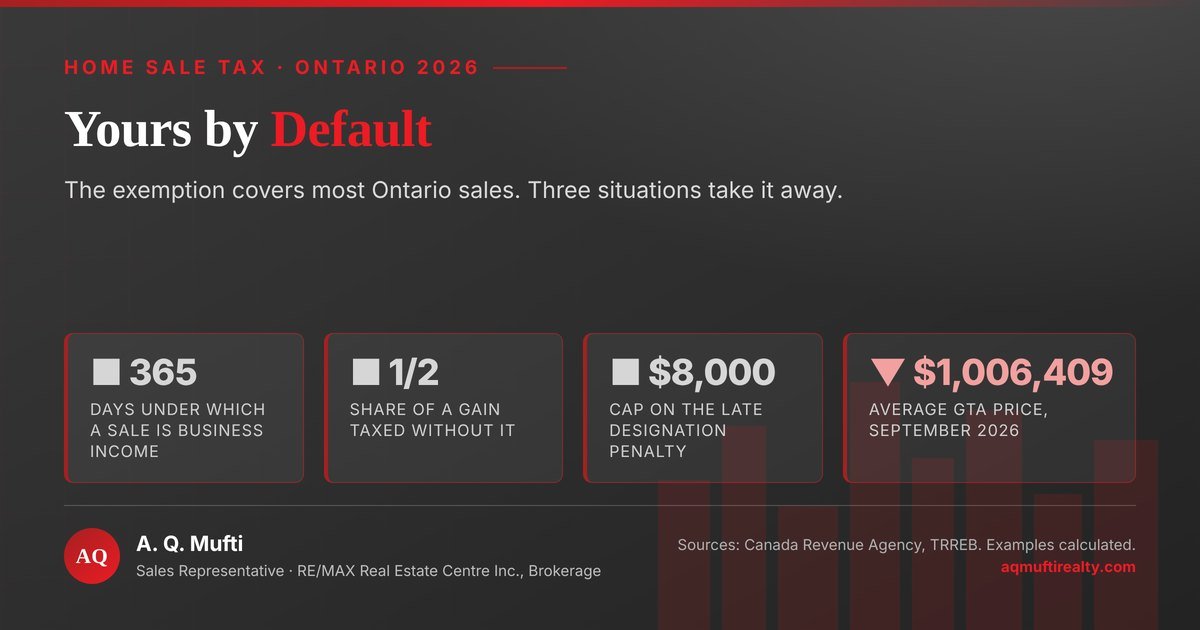
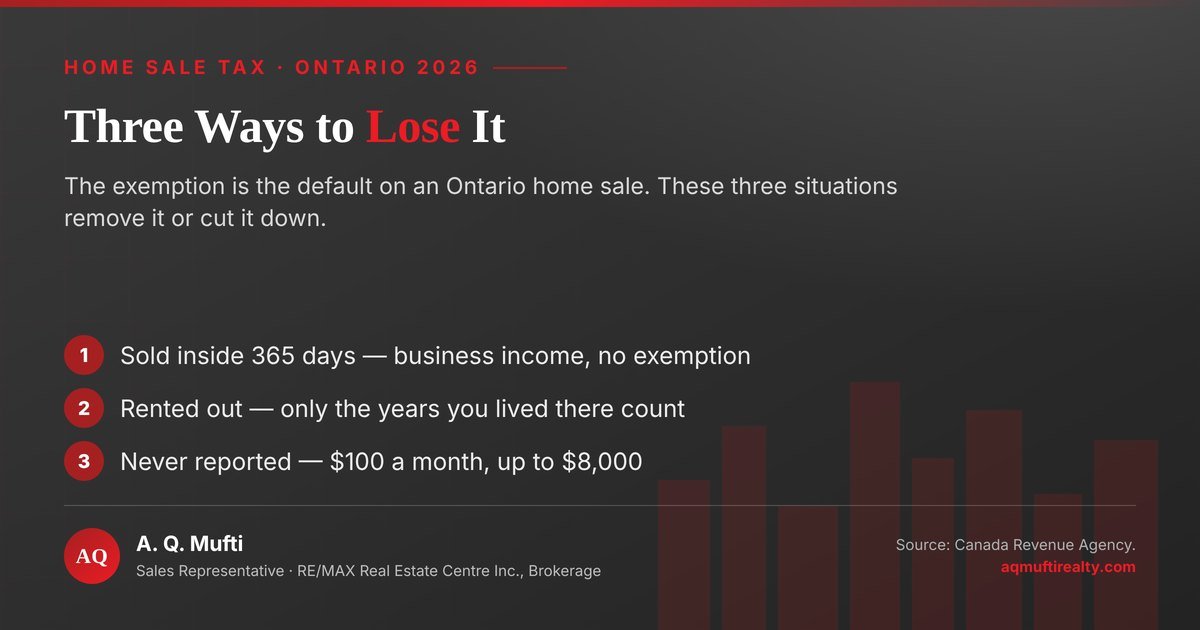
- Yet you must still report the sale. Schedule 3 and Form T2091 claim it. File that designation late and the penalty runs $100 a month, up to $8,000.
- Sell inside 365 days and it vanishes. Then the profit is business income, fully taxed, and the CRA says the exemption is not available at all.
- Renting the home changes the math. Still, one election can hold the claim for four more tax years while a tenant lives there.
- One home per family, per year. So a couple cannot designate two properties for the same tax year.
The rules in numbers
First, here is what the CRA publishes. Each line below shapes a principal residence exemption on an Ontario sale, and none of it is a matter of opinion.
| Measure | Figure | Source |
|---|---|---|
| Ownership that triggers the flipping rule | under 365 days | CRA |
| Tax treatment of a home caught by it | business income | CRA |
| Share of a capital gain that is taxable | one half | CRA |
| Penalty for a late designation | $100 a month | CRA |
| The most that penalty can reach | $8,000 | CRA |
| Homes a family may designate each year | one | CRA |
| Land that normally counts with the home | half a hectare | CRA |
| Years the claim can run while you rent | four | CRA |
| Average GTA selling price, September 2026 | $1,006,409 | TRREB |
What the principal residence exemption actually covers
First, start with what you own. Indeed the rule is wider than most sellers expect, and narrower in one place that catches people out.
How the exemption is calculated
The CRA sets out a formula, A × (B ÷ C), in its folio on principal residences. Here B begins at “1 + the number of tax years ending after the acquisition date.”
Then that extra one does real work. It lets both homes count in the year you sell one and buy the next, so a normal move costs you nothing.
The half hectare limit
Land counts too, up to a point. The folio treats “one-half hectare of land or less, including the area on which the housing unit stands” as part of the home.
Yet a bigger lot does not fully qualify. Land beyond that “will not qualify as part of a principal residence, except to the extent that the taxpayer establishes” it was needed to use and enjoy the house.
So a wide lot in Milton or rural Caledon deserves a second look. Also, a family unit may name just one property for a given year, which matters if you own a cottage as well. In short, the principal residence exemption is one claim a year, not one per owner.
The principal residence exemption is not automatic
Next, the step that trips up honest sellers. Nothing here is about owing tax. It is about filing.
Two forms claim the principal residence exemption
Since 2016 the sale goes on “Schedule 3, Capital Gains of the T1 Income Tax and Benefit Return.” For a sale in 2017 or later you also file Form T2091, the CRA states on its reporting page.
Then read the condition plainly. The CRA “will only allow the principal residence exemption if you report the sale and designation” on the return for the year of the sale.
The $8,000 penalty for filing late
Miss it and you can still ask the CRA to amend the return. Still, the agency “will accept a late designation in certain circumstances, but a penalty may apply.”
That penalty is the lesser of two amounts: $8,000, or “$100 for each complete month from the original due date to the date your request was made in a form satisfactory to the CRA.”
Put simply, the cap arrives after 80 months, which is six years and eight months (calculated). Hence a form nobody filed is the cheapest mistake to avoid on this list.
The 365 day rule that cancels a principal residence exemption
Now the rule that surprises sellers most. It is recent, it is strict, and it does not care what you meant to do.
When a quick sale becomes business income
Here the CRA treats a home as flipped when it was “owned by the taxpayer for less than 365 consecutive days prior to the disposition,” per its page on property flipping. The rule applies “in respect of transactions occurring on or after January 1, 2023.”
Then the result is blunt. Such a profit is “fully taxable as business income,” so it never reaches the capital gains side, and the CRA states that the “Principal Residence Exemption is not available.”
Also note the reach. That same page says the rule covers residential property “(including rental property),” so the rule strips the principal residence exemption from an investor who sells early just as it does from an owner.
Nine life events that protect the principal residence exemption
Yet the rule bends for real life. A sale escapes it when it happens because of, or in anticipation of, one of nine events the CRA lists:
- Death of the seller, or of someone related to them.
- A related person joins the household, or the seller joins theirs.
- Marriage or common-law breakdown, after at least 90 days living separate and apart.
- Serious illness or disability.
- A threat to the personal safety of the seller or a related person.
- Involuntary job loss, for the seller or their partner.
- An eligible relocation, for the seller or their partner.
- Insolvency of the seller.
- Destruction or expropriation of the property.
Therefore a forced move is not a flip. Of course the paperwork still has to show it, which is a conversation for your accountant rather than your agent.
Renting out a home and the principal residence exemption
Here is the GTA case that comes up most. You move, you keep the condo, you rent it out. Then you sell it years later.
The election that pauses the clock
Switching a home fully to rental use is a tax event by itself. The folio says the owner “is deemed by paragraph 45(1)(a) to have disposed of the property” on the day the use changes.
Yet you can defer that. The owner may elect “under subsection 45(2) to be deemed not to have made the change in use of the property,” which keeps the gain untaxed for now.
Four years of cover while you rent
Then the election buys time, not forever. A property “can qualify as a taxpayer’s principal residence for up to four tax years” while it is in force.
Still, one move cancels it. “If CCA is claimed on the property, the election is considered to be rescinded,” so writing the building down against rent costs you the shelter.
In other words a rented year is not always a lost year for the principal residence exemption. Equally, the claim covers the years you lived there and the years the election protects, not every year you held the title.
What a lost principal residence exemption costs
Now translate the rules into money. A missed form sounds minor, and a tax bill does not.
Half the gain is taxable
When the exemption does not apply, the gain behaves like any other. “Fifty percent of the capital gain would be taxable,” the CRA writes in its capital gains guide, which puts the inclusion rate at one half.
So take a $200,000 gain on a long-held home. Lose the exemption and $100,000 joins your income for the year (calculated), taxed at whatever rate that income reaches.
A principal residence exemption on a GTA sale in dollars
Gains of that size are ordinary here. The average GTA selling price was $1,006,409 in September, down 5.1% in a year, with the index down 4.7%, TRREB reported.
Then compare the flipping case. The same $200,000 counts as business income, so the CRA taxes the full $200,000 rather than $100,000 (calculated), twice the taxable amount on one sale.
Besides, the penalty sits on top of that. A principal residence exemption you forgot to claim can cost the tax on the whole gain plus $8,000, and none of it was unavoidable.
How to protect your principal residence exemption
Finally, the practical part. None of it needs a forecast, which is why it is worth doing early.
Before you list
- Pin down your dates. Note when you bought, when you moved in, and when you moved out. Those dates drive the formula.
- Count the days. If you have held the home under 365 days, raise it with your accountant before you sign anything.
- Measure the lot. Anything over half a hectare needs a reason, so gather it now rather than at filing time.
- Next, list every property you own. You may designate just one for a year, and a cottage competes with the house.
If your principal residence exemption may be at risk
- Do not claim CCA on a rented home. It rescinds the 45(2) election and costs you four years of cover.
- Then file the designation on time. The form is free. The late penalty is $100 a month.
- Get the gain priced before you list. Know the number first, so the tax is a decision rather than a shock in April.
- Also bring in an accountant, not just an agent. I can tell you what the home will sell for. Only they can file the return.
Want help with the first half of that? My home valuation gives you a price to work from, the step-by-step guide for sellers covers the sale itself, and my monthly market updates track the price figures above.
Your questions on selling
Short answers to what owners in Mississauga, Oakville and Milton ask me most about tax on a sale.
Do I pay tax when I sell my home in Ontario?
Usually not, if it was your home for every year you owned it. The exemption shelters the gain, though you still have to report the sale on your return.
Does the principal residence exemption apply automatically?
No. The CRA allows the principal residence exemption only if you report the sale and file the designation for the year you sold, on Schedule 3 and Form T2091.
What if I sell within a year of buying?
Then the flipping rule may apply. The CRA taxes a home owned under 365 consecutive days as business income, with no exemption, unless one of nine life events caused the sale.
Can I claim the principal residence exemption on a rented condo?
Partly. The claim covers the years you lived there, and a subsection 45(2) election can add up to four more rental years, provided you never claim CCA.
Can my spouse and I each claim one?
No. A family unit may designate just one property for a given tax year, so a second home does not get its own shelter for the same year.
Sources and further reading
- CRA – principal residence folio — the formula
- CRA – reporting the sale — the penalty
- CRA – property flipping — 365 days
- CRA – capital gains guide — one half
- TRREB – September 2026 — the market
Keep reading on the blog
More guides and market analysis from this blog.
- Pricing a Home in a Balanced Market — on selling
- Renovations That Add Value — before you list
- Land Transfer Tax in the GTA — the other tax
- GTA Home Sales, September 2026 — the market
Ready to find out what your home is worth?
Send me your address and the year you bought, and I will put a current price beside it so you can take a real number to your accountant. No pressure, and no obligation.
Prefer to start with a number? Get a tailored home valuation or run the figures in the mortgage calculator.
Disclaimer: This article draws on the Canada Revenue Agency’s folio S1-F3-C2, its reporting and property flipping pages, its capital gains guide T4037, and TRREB. It offers information only. I calculated the dollar examples and the 80 months the late penalty takes to reach its cap. Tax rules change and every sale differs, so confirm your position with an accountant before you file. Nothing here is tax, legal or financial advice. A. Q. Mufti – Sales Representative, RE/MAX Real Estate Centre Inc., Brokerage.
A. Q. Mufti — Sales Representative
RE/MAX Real Estate Centre Inc., Brokerage
MSc, PMP®, ABR®, SRS®, CNE®
416 908 5600 · 905 270 2000
info@aqmuftirealty.com
141-1140 Burnhamthorpe Rd. W., Mississauga ON L5C 4E9
Serving Mississauga, Oakville, Milton, Brampton, Toronto and the wider GTHA. More about how I work.