Most buyers budget for the price and the down payment. Then the lawyer calls, and a second bill appears. Closing costs in Ontario are the charges that land on the day the deal completes, and your mortgage will not cover most of them. So they have to come out of cash you have already saved.
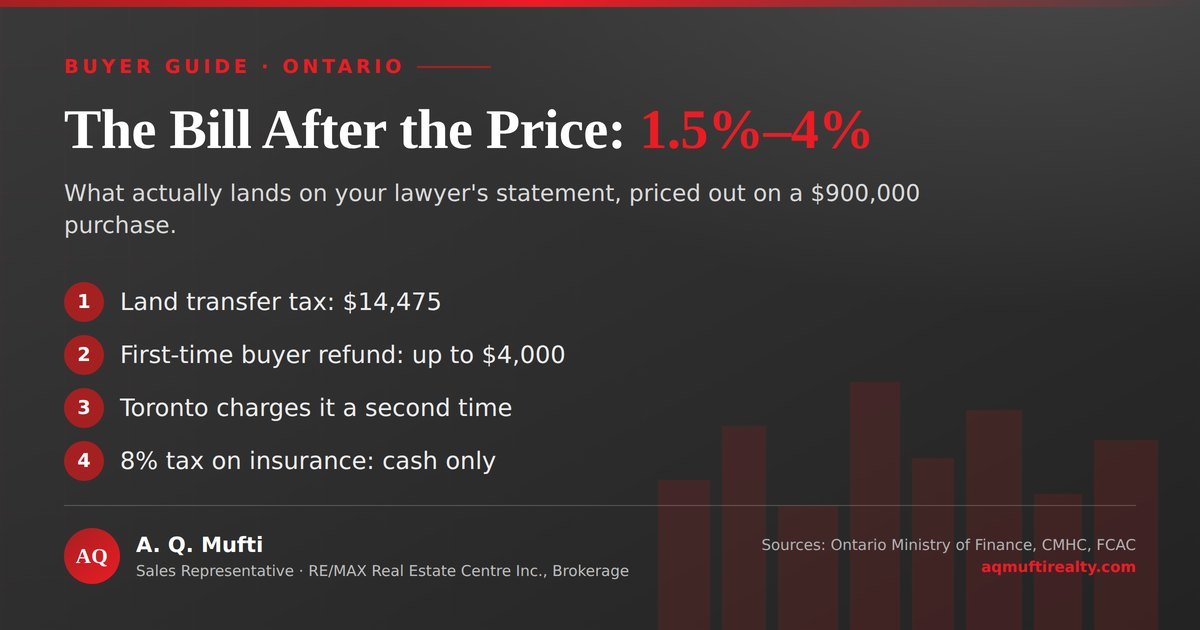
How much cash? The Financial Consumer Agency of Canada tells buyers to plan for 1.5% to 4% of the purchase price. On a $900,000 home that means roughly $13,500 to $36,000 (calculated). Closing costs in Ontario swing that widely because two lines dominate them, and this guide starts with those two.
Every figure below comes from a government source, and I label every one I worked out myself as calculated. Nothing here is an estimate dressed up as a fact.
The short version
- Budget 1.5% to 4% of the price. For closing costs in Ontario, that is the federal consumer agency’s own guidance, not a rule of thumb from an agent.
- Land transfer tax is the largest line. On a $900,000 purchase it comes to $14,475 (calculated).
- First-time buyers get up to $4,000 back. The refund wipes out the tax entirely on the first $368,000 of the price.
- Toronto charges the tax twice. The city adds its own tax on top of the provincial one. Mississauga does not.
- You cannot finance one of the taxes. Ontario charges 8% on your mortgage insurance premium, and you hand over that 8% in cash.
Closing costs in Ontario on a $900,000 purchase, itemised
Here is a worked example. The buyer puts down the legal minimum and buys in Mississauga, not Toronto.
| Line | Amount | Source |
|---|---|---|
| Ontario land transfer tax | $14,475 (calculated) | Ontario Ministry of Finance rates |
| Less first-time buyer refund | up to −$4,000 | Ontario Ministry of Finance |
| Minimum down payment | $65,000 (calculated) | Financial Consumer Agency of Canada |
| Mortgage insurance premium, 4.00% on $835,000 | $33,400 (calculated), you may add it to the loan | CMHC |
| Ontario 8% tax on that premium | $2,672 (calculated), cash only | Ontario RST and CMHC |
| Lawyer, title insurance, inspection, adjustments | part of the 1.5%–4% band | Financial Consumer Agency of Canada |
| Buying the same home in Toronto instead | a further $14,475 (calculated), plus a $102.56 fee | City of Toronto |
What closing costs in Ontario actually cover
Your down payment is not a closing cost. It is part of the price. Closing costs sit on top, and they fall into two groups.
First come the taxes. Law fixes them, so nobody negotiates them. Then come the services you buy: a lawyer, a title insurer, a home inspector, sometimes a surveyor. The federal consumer agency lists home inspection fees, legal fees, property tax adjustments and title insurance among the one-time costs to expect.
So the taxes decide most of your number. Therefore the rest of this guide starts with them, and the professional fees come last.
Land transfer tax: the largest of the closing costs in Ontario
Ontario charges land transfer tax on a sliding scale. The province publishes the brackets, and they have not changed since 2017:
- 0.5% on the first $55,000
- 1.0% from $55,001 to $250,000
- 1.5% from $250,001 to $400,000
- 2.0% above $400,000
- 2.5% above $2,000,000, on homes with one or two units
Run a $900,000 purchase through that ladder and you get $14,475 (calculated). Notice how the top bracket dominates. Half a million dollars of the price sits above $400,000, and it alone accounts for $10,000 of the bill.
The first-time buyer refund
Ontario refunds up to $4,000 to qualifying first-time buyers. In practice the province charges no tax at all on the first $368,000 of the price. Above that, you simply receive the $4,000 maximum. Our example buyer therefore pays $10,475 instead of $14,475 (calculated).
The conditions are strict. You must be at least 18. Also, you cannot have owned a home anywhere in the world, and neither can your spouse during your marriage. Furthermore, you must hold Canadian citizenship or permanent residence, move in within nine months, and claim within 18 months. Nobody qualifies twice.
Buy in Toronto and you pay it twice
The City of Toronto levies its own tax on top of the provincial one. Up to $2,000,000 the city’s brackets mirror the province exactly, so our $900,000 buyer would owe another $14,475 (calculated). Above $3,000,000 the city rates climb steeply, reaching 8.60% past $20,000,000. Toronto also adds an administration fee of $102.56 plus HST.
That doubling costs real money. Mississauga, Oakville, Milton and Brampton all sit outside the city line, so buyers there pay the provincial tax only. On this example the gap reaches $14,475 (calculated) before anyone discusses the price.
How a small down payment adds to closing costs in Ontario
Two of the largest closing costs in Ontario follow directly from the size of your down payment. Canada sets a minimum by price band, and the rules work in tiers: 5% under $500,000; 5% on the first $500,000 and 10% on the rest up to $1.5 million; then 20% at $1.5 million and above.
For our $900,000 home the minimum works out to $65,000 (calculated). That leaves a mortgage of $835,000, which is about 92.8% of the value. Anything above 80% needs mortgage loan insurance.
CMHC publishes its premium rates by loan-to-value band. At 92.8% the rate is 4.00%, so the premium comes to $33,400 (calculated). Happily, you can add that premium to the mortgage and pay it off over the amortisation.
The tax you cannot roll into the mortgage
Here is the trap. Ontario applies 8% retail sales tax to insurance premiums, and CMHC states plainly that you cannot add this provincial tax to the loan amount. So our buyer owes $2,672 in cash on closing day (calculated), purely in tax on an insurance policy.
Most first-time buyers have never heard of this line until their lawyer sends the statement of adjustments. Yet it is larger than a home inspection and a title insurance policy put together.
The service fees, and how to keep closing costs in Ontario down
Legal fees, title insurance, the home inspection and the property tax adjustment make up the rest. These vary by file, by lawyer and by property, so I will not invent a number for you. Ask for a written quote instead, and ask what it leaves out.
Two lines catch people out. A property tax adjustment reimburses the seller for taxes they paid past your closing date, so an early-year closing can mean a larger cheque. And a condominium purchase needs a status certificate, which the corporation charges for.
Five ways to shrink the bill
- Claim the refund properly. Your lawyer can usually apply it at registration, so you never advance the $4,000 at all.
- Reach 20% down if it is close. Crossing that line removes the premium and the 8% tax on it together.
- Get the legal quote in writing. Compare the all-in figure, including disbursements, not the headline fee.
- Budget the cash-only lines separately. Run your numbers in the payment calculator, then set the closing cash aside in its own account.
- Compare municipalities before you shortlist. The same house costs thousands less outside Toronto, purely in tax.
Handled this way, closing costs in Ontario stop being a shock and become a line in the plan. My step-by-step guide for buyers sets out the order to do everything in, and the home finder will flag listings that fit the budget you have actually worked out.
Your questions about closing costs in Ontario, answered
Short answers to what buyers ask me most before they sign.
How much should I set aside for closing costs in Ontario?
Plan for 1.5% to 4% of the purchase price, which is the Financial Consumer Agency of Canada’s own guidance. On a $900,000 home that means about $13,500 to $36,000 (calculated). Closing costs in Ontario reach the top of that band when you buy in Toronto or put down less than 20%. Where you land depends mostly on the land transfer tax and whether you need mortgage insurance.
Can I add closing costs to my mortgage?
Mostly no. You can add the mortgage insurance premium itself to the loan. However, CMHC states that the provincial sales tax on that premium cannot go there. Land transfer tax and legal fees also come from your own cash on closing day.
How much land transfer tax will I pay in Mississauga?
Mississauga sits outside Toronto, so you pay the provincial tax only. On a $900,000 purchase the published brackets give $14,475 (calculated). A qualifying first-time buyer pays $10,475 (calculated) after the refund.
Who counts as a first-time buyer in Ontario?
You must be 18 or older and must never have owned a home anywhere in the world. Your spouse must not have owned one while married to you. Furthermore, you must be a citizen or permanent resident and occupy the home within nine months.
Is mortgage insurance the same as mortgage life insurance?
No, and the names confuse people constantly. Mortgage loan insurance protects the lender if you default, and you must buy it below 20% down. Mortgage life insurance is a separate, optional policy that pays out your balance if you die.
When do I actually have to pay all of this?
Your lawyer collects most of it a day or two before closing, in one certified payment. Land transfer tax falls due at registration. Budget for the deposit far earlier, though, because it goes in with the offer.
Sources and further reading
- Ontario — calculating land transfer tax — the rate brackets behind the table
- Ontario — land transfer tax refunds for first-time buyers — the $4,000 maximum and the conditions
- Government of Canada — buying a home — the 1.5% to 4% closing-cost guidance
- Government of Canada — down payment rules — the minimum by price band
- CMHC — what mortgage loan insurance costs — premium rates and the tax you cannot finance
- Ontario — retail sales tax on insurance — the 8% rate
- City of Toronto — land transfer tax rates — the second tax Toronto buyers pay
Keep reading on the blog
More practical guides and market analysis from this blog.
- Ten Essential Steps for First-Time Buyers in Mississauga — the order to do things in
- Condo or Townhouse: What Suits a First Purchase — how the carrying costs differ
- GTA Real Estate Fall 2026: What Buyers Must Do Now — where the market sits this season
- How a Rate Cut Opens a Buying Window — what happened last time borrowing costs moved
Ready to put a real number on your purchase?
Send me the price range you are shopping in and the municipality you like, and I will price the closing costs in Ontario that apply to you, line by line, before you write an offer. No pressure, and no obligation.
Prefer to start with a number? Get a tailored home valuation or run the figures in the mortgage calculator.
Disclaimer: This guide summarises published rates from the Ontario Ministry of Finance, the City of Toronto, CMHC and the Financial Consumer Agency of Canada as they stood in September 2026. I provide it for information only, and it is not financial, mortgage, tax or legal advice. Rates change. Confirm your own figures with your lawyer and mortgage professional. A. Q. Mufti is a registered Sales Representative with RE/MAX Real Estate Centre Inc., Brokerage, Ontario, Canada.
A. Q. Mufti — Sales Representative
RE/MAX Real Estate Centre Inc., Brokerage
MSc, PMP®, ABR®, SRS®, CNE®
416 908 5600 · 905 270 2000
info@aqmuftirealty.com
141-1140 Burnhamthorpe Rd. W., Mississauga ON L5C 4E9
Serving Mississauga, Oakville, Milton, Brampton, Toronto and the wider GTHA. More about how I work.