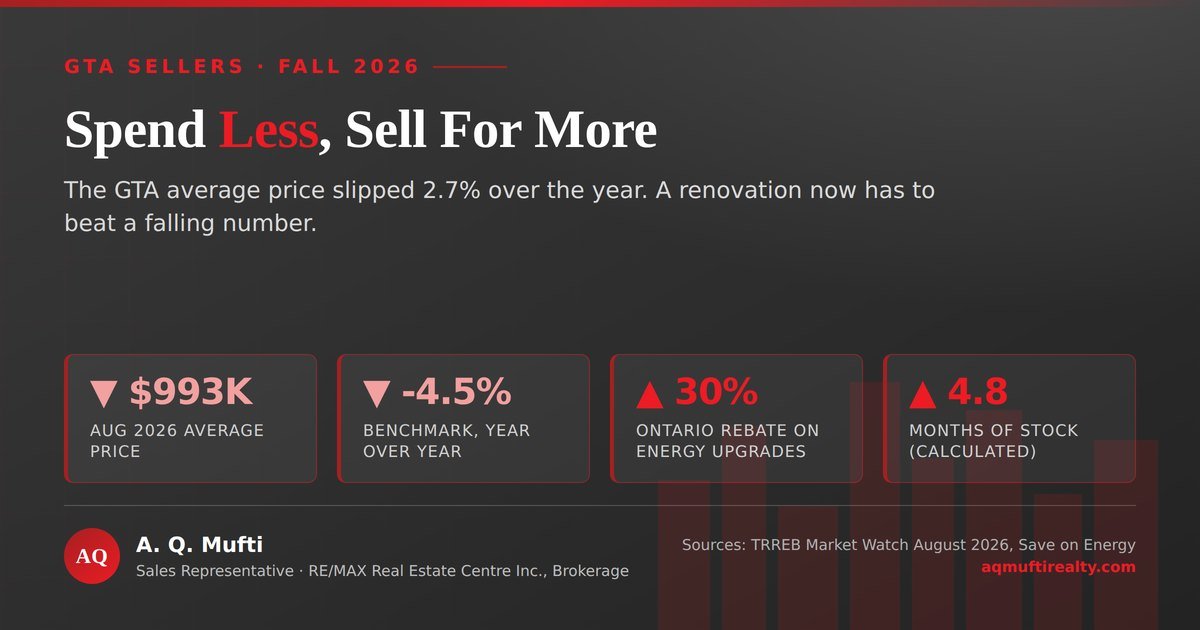
Renovations that add value, at a glance. Sources: TRREB Market Watch for August 2026, the Save on Energy rebate list and the Government of Ontario. Ratios calculated.
Every seller I meet asks the same question before listing. Typically, they ask what to renovate. However, the better question is whether to renovate at all this year. After all, the average GTA selling price fell 2.7% over twelve months. So renovations that add value are a much shorter list than the internet suggests.
Now, this is not a list of trendy upgrades. Instead, it is the test I use at a kitchen table before a client spends a dollar. Indeed, some work pays for itself twice over. Meanwhile, plenty of it just moves money from your account into a buyer’s hopes.
The short version
- The market sets the ceiling. First, the GTA average sale price was $993,410 in August 2026, down 2.7% in a year. So a renovation now has to beat a falling number.
- Rebates are the only sure return. Notably, Ontario’s Home Renovation Savings Program pays up to 30% on energy upgrades. That is cash in hand before a buyer ever sees the house.
- Condition beats ambition. Repairs, paint and a clean furnace story are the renovations that add value most often, because they take away a buyer’s reason to discount.
- Paperwork is part of the value. Typically, work done without a permit shows up during a deal. And in Ontario the permit is the owner’s job.
- Your street sets a limit. Above the ceiling your neighborhood supports, the extra spend rarely comes back.
What Ontario pays toward renovations that add value
These are the rebates listed by Save on Energy for the Home Renovation Savings Program, current on the day I wrote this. Amounts depend on the gear and the home. So check yours before you buy anything.
| Upgrade | Rebate | Notes |
|---|---|---|
| Cold climate air source heat pump | up to $7,500 | set by the size installed |
| Ground source heat pump | up to $12,000 | the largest item |
| Insulation | up to $7,700 | attic alone pays $1,250 |
| Windows and doors | $100 per rough opening | ENERGY STAR certified only |
| Air sealing | up to $250 | often bundled with insulation |
| Smart thermostat | $100 | the cheapest item that counts |
| Home energy check | $600 | paid when upgrades are bundled |
| Solar panels and battery storage | up to $10,000 | a longer payback than the rest |
Why renovations that add value look different this fall
Generally, renovation advice ages badly. Most of it was written for a rising market. So the math that worked in 2021 no longer holds.
The Toronto Regional Real Estate Board reported 5,057 sales in August 2026 at an average price of $993,410. That is down 2.7% against August 2025. Meanwhile the composite benchmark fell 4.5% over the same year. It tracks a like-for-like home, so a change in the mix cannot flatter it.
In practice, that 2.7% is worth about $27,600 on the average sale (calculated). In other words, a seller starts that far behind last year. And that is before spending a dollar.
The math a softer market imposes
Meanwhile, supply tells the other half. Also, new listings came in at 12,075, down 14.1%. Next, active listings sat at 24,482, down 11.3%. So stock is thinner than last year, yet prices still slipped.
Divide those figures and the market reads clearly. Specifically, active listings against monthly sales give roughly 4.8 months of stock. Sales against new listings give about 42% (both calculated). Therefore buyers have time. And time is what lets them push on condition.
Put simply, renovations that add value here are the ones that take away a buyer’s excuse to wait. Anything else is a bet on a number that is going the wrong way.
Renovations that add value with a rebate attached
There is one group of jobs where the return is known before you list. Notably, it is the group most sellers skip.
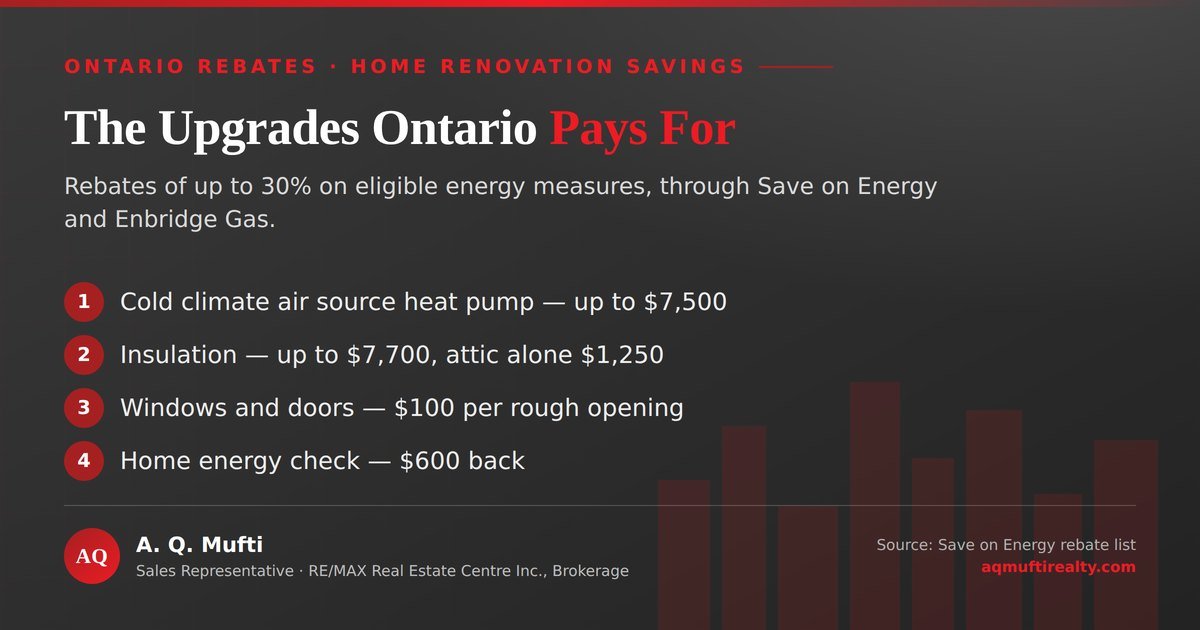
Ontario runs the Home Renovation Savings Program through Save on Energy and Enbridge Gas. The province describes it as rebates for up to 30 per cent off eligible energy-saving measures. It opened on 28 January 2025. Also, it covers windows, doors, insulation, air sealing, smart thermostats, heat pumps, solar and battery storage.
The published rebate list is specific rather than vague. For example, a cold climate air source heat pump earns up to $7,500. Insulation earns up to $7,700. Meanwhile a smart thermostat returns $100 and a home energy check $600.
Where the rebate money actually lands
Stack the practical items on one house and the total is striking. A heat pump, insulation, air sealing, a thermostat and the energy check come to about $16,150 (calculated from the published amounts, before any caps).
Furthermore, that cash arrives whether or not the house sells for more. Unlike a new kitchen, it does not rest on a buyer sharing your taste. Equally, the work sits where a home inspector looks hardest.
Admittedly, none of this is glamorous. Still, insulation and heating are the renovations that add value where part of the cost comes back. And the buyer’s inspector turns into an ally rather than a problem.
The renovations that add value least before a sale
Now for the harder half. What follows is my judgment as an agent, not a statistic. Indeed, honest payback figures for one GTA street do not exist in any published table.
Typically, deep, taste-led work is the usual casualty. For example, a gut kitchen in your style rarely reads as a gift to someone else. Instead, it reads as a choice already made. And buyers discount choices they did not make.
Pools, wine rooms and big landscaping jobs behave the same way. In fact, a pool narrows your field of buyers rather than widening it. Families with small children often rule one out.
The ceiling your street sets
Every street carries a price ceiling, and it moves slowly. Spend past it and the extra does not come back, however good the work is.
A half-done project is worse still. For instance, an open basement with a permit pulled and nothing closed in invites every buyer to guess the worst number. So either finish it properly or put it back plainly.
To be clear, none of this means a tired house should be listed as is. Rather, the renovations that add value are usually the small, dull ones. The bold ones belong to the years you live there.
Paperwork decides whether renovations that add value survive
Ultimately, a renovation is only worth what it is worth on closing day. So the file matters as much as the finish.
Here, Ontario is direct about this. The province states that any home renovation contract worth more than $50 must be in writing. It also says the building permit is your job, not your contractor’s.
Your city enforces the Building Code, and the powers are real. Inspectors visit while work is under way. They can also issue stop work and compliance orders. Moreover, where an order is ignored, the city can take the owner to court.
What to gather before you list
Buyers and their lawyers ask for the same few papers every time. So gather them early, rather than in the middle of a deal.
- Permits and final sign-offs for any structural, electrical, plumbing or heating work.
- The written contract and the final invoice for each trade.
- Warranty papers for the roof, windows, furnace or heat pump.
- Rebate approvals, which also prove the gear qualified.
Certainly, missing paperwork is not fatal. Still, it turns a selling point into a question, and questions get priced. So the renovations that add value are the ones you can prove.
How to test renovations that add value on your own home
Generally, averages are a useful guide. Still, your house is not an average. So five questions settle most of it before any money moves.
- Would a buyer notice it in the first ten minutes? If not, it belongs to the years you live there, not to the listing.
- Does it take away a reason to discount? A failing roof, a 20-year furnace or damp are deductions waiting to happen.
- Is a rebate attached? Check the Save on Energy list first, because that part of the return does not rest on the market.
- Does it stay under the street’s ceiling? Ask for a current valuation of your home before you commit, not after.
- Can you prove it? Permit, contract, invoice, warranty. If a trade will not put it in writing, that is your answer.
Answer yes to four of the five and the work is probably worth doing. Conversely, two or fewer and the money is better left in the price.
Planning the move as well? My step-by-step guide for sellers sets out the order of events from prep to closing. The payment calculator will show what the next purchase really costs. And for buyers reading this from the other side, the guide for buyers covers what to look for in a redone listing.
Your questions about renovations that add value
Short answers to what sellers are asking me this month.
Should I renovate before selling in a softer market?
Usually not deeply. The GTA average price fell 2.7% in a year, so a large job has to beat a falling number. However, repairs, paint and a clean furnace story still earn their cost back.
Which renovations that add value carry a government rebate?
Energy upgrades. Ontario’s Home Renovation Savings Program covers insulation, air sealing, windows, doors, smart thermostats, heat pumps, solar and battery storage. The rebate, overall, runs up to 30 percent of eligible costs.
Does work done without a permit stop a sale?
Rarely on its own, yet it almost always costs money. Buyers price the doubt, lenders and insurers ask questions, and an Ontario city can issue a compliance order against the owner.
Is a finished basement one of the renovations that add value?
It can be. The test is whether it is permitted, dry and finished to the standard of the rest of the house. Those are the renovations that add value below grade. Conversely, a half-done basement or a damp one cuts what a buyer offers.
What should I do first if I am listing soon?
First, get a valuation. Then fix defects before you upgrade anything. Afterward, look at the rebate list, since that work is partly refunded whatever the market does next. Those two steps cover most renovations that add value.
Sources and further reading
- TRREB – Market Watch, August 2026 — 5,057 sales, average price $993,410, new and active listings
- Save on Energy – Home Renovation Savings Program — the published rebate amounts by upgrade
- Government of Ontario – smart energy choices at home — up to 30 percent off eligible measures, from 28 January 2025
- Government of Ontario – your rights when renovating — written contracts above $50, and whose job the permit is
- Government of Ontario – regulatory roles in renovations — inspections, stop work orders and prosecution
Keep reading on the blog
More market analysis and practical guides from this blog.
- GTA Home Prices: August 2026 — the numbers behind the ceiling on your street
- Closing Costs in Ontario, Itemized — what leaves the account on closing day
- New Home HST Rebate: The Surprising $130,000 Gap — if a new build is the alternative to renovating
- GTA Real Estate Fall 2026: What Buyers Must Do Now — the wider market backdrop
Ready to talk about your next move?
Send me your address before you call a contractor. I will walk the house with you and tell you plainly which work a buyer in your price band will pay for. I will also tell you what I would leave alone. No pressure, and no obligation.
Prefer to start with a number? Get a tailored home valuation or run the figures in the mortgage calculator.
Disclaimer: This article draws on TRREB Market Watch data, the Save on Energy rebate list and Government of Ontario guidance, and it offers information only. I calculated the stock, ratio and rebate totals from the published figures. Rebate rules and amounts depend on your home and your equipment, and programs change, so confirm your own position before spending. Nothing here is financial, mortgage, tax or legal advice. A. Q. Mufti is a registered Sales Representative with RE/MAX Real Estate Centre Inc., Brokerage, Ontario, Canada.
A. Q. Mufti — Sales Representative
RE/MAX Real Estate Centre Inc., Brokerage
MSc, PMP®, ABR®, SRS®, CNE®
416 908 5600 · 905 270 2000
info@aqmuftirealty.com
141-1140 Burnhamthorpe Rd. W., Mississauga ON L5C 4E9
Serving Mississauga, Oakville, Milton, Brampton, Toronto and the wider GTHA. More about how I work.