
Category: Blog

Your blog category

  • Government Announces Boldest Mortgage Reforms in Decades to Unlock Homeownership for More Canadians: A Step Towards My Long-Advo

    Government Announces Boldest Mortgage Reforms in Decades to Unlock Homeownership for More Canadians: A Step Towards My Long-Advo

    Government Announces Boldest Mortgage Reforms in Decades to Unlock Homeownership for More Canadians: A Step Towards My Long-Advo

    “If you’ve been thinking about buying your first home but felt daunted by the rigorous qualification process, these new measures are designed to level the playing field. By easing the mortgage stress test and increasing the accessibility of government-backed loans, you now have more options to explore…”

    In a long-overdue move, the Canadian government has recently introduced its boldest mortgage reforms in decades, aimed at easing the path to homeownership for millions of Canadians. This historic reform, as outlined in the latest announcement from the Department of Finance here, marks a significant shift in the national approach to home financing and reflects a growing acknowledgment of the challenges facing first-time homebuyers in today’s market.

    For years, I have consistently advocated for more intuitive solutions that would help prospective buyers—especially first-time buyers—overcome the numerous obstacles preventing them from achieving the dream of homeownership. I floated this idea back in 2017 when the housing market was in a similar crisis, and no one was talking about it. While the path has been long, it’s incredibly gratifying to see the government finally listening to what many in the housing and real estate sectors have been pushing for.

    The Mortgage Reforms: A Game Changer for Buyers

    According to the government’s release, these reforms tackle many of the barriers that Canadians have faced, especially in the wake of skyrocketing housing prices and stringent mortgage qualification rules. The measures include relaxed mortgage stress tests, enhanced first-time homebuyer programs, and tailored incentives designed to make purchasing a home more accessible for everyday Canadians.

    Here are the key highlights of the reform:

    1. Easing of the Mortgage Stress Test: A recalibration of the stress test will allow buyers to qualify for higher mortgage amounts, reflecting more realistic market conditions and buyer incomes. This is particularly important for young Canadians and families who have been priced out of urban markets in recent years.
    2. Enhanced First-Time Homebuyer Incentives: New measures are being introduced that provide first-time buyers with increased financial support through government-backed loans, which will lower the amount of a traditional mortgage they need to secure, easing the financial burden.
    3. Increased Housing Supply and Affordability Initiatives: The government has also pledged to work with local municipalities to increase housing supply, aiming to bring balance to the supply-demand issue that has exacerbated housing affordability.

    Finally, a Shift Towards Common-Sense Solutions

    For about a decade, I’ve worked with first-time buyers, investors, and homeowners, and I’ve witnessed firsthand the increasing difficulty in qualifying for mortgages and securing affordable homes. In my work, I’ve consistently pushed for the government to recognize the need for flexible mortgage solutions that take into account the real-world challenges buyers face.

    When I advocated for these changes years ago, I highlighted that many buyers were being shut out due to inflexible and outdated qualification criteria. It’s exciting to see that my voice, along with others in the industry, has contributed to shaping this new framework that reflects the reality of modern homeownership.

    These reforms are more than just a step in the right direction; they’re a monumental shift towards making the Canadian dream of owning a home attainable for more people. First-time homebuyers can now feel empowered to step into the market with a renewed sense of hope.

    What Does This Mean for First-Time Buyers?

    If you’ve been thinking about buying your first home but felt daunted by the rigorous qualification process, these new measures are designed to level the playing field. By easing the mortgage stress test and increasing the accessibility of government-backed loans, you now have more options to explore.

    These reforms will also have a ripple effect across the housing market, likely bringing more balance to supply and demand, particularly in high-demand urban areas.

    Looking Forward: More Work to Be Done

    While these reforms represent a huge victory for prospective homebuyers, the work isn’t over. It’s crucial to ensure that the rollout of these new measures is smooth and effective. Additionally, I will continue advocating for further refinements to address specific issues that arise as these policies take effect.

    In conclusion, this reform package is a massive win for Canadians. It feels like the culmination of years of hard work and advocacy, and I am thrilled to see that the government is finally taking decisive action to make homeownership a reality for more people.

    As always, I remain committed to supporting my clients in navigating these changes and making informed decisions that help them achieve their dreams of homeownership.

    Let’s chat if you have any questions about how these changes might impact your home-buying journey!

    Source:

    1. Government announces boldest mortgage reforms in decades to unlock … 
    2. 30 Year Mortgages for First-Time Buyers of New Builds 
    3. Government announces 30 year amortizations for insured mortgages to put … 
    4. Breaking: Federal government raises CMHC insured mortgage cap to $1.5 … 

    If you have any questions or would like to discuss your unique needs and goals, please don’t hesitate to contact me at 416-908-5600.

    If you found this review helpful, I would greatly appreciate it if you could kindly leave a Google Review for my real estate services at

    A. Q. Mufti Google Review

    Thank you for your continued support!

    A. Q. Mufti

    Your Trusted Realtor in Mississauga, Oakville, Milton and beyond.

  • Inflation Expected to Drop to Lowest Level Since 2021: What It Means for Homeowners and the Real Estate Market

    Inflation Expected to Drop to Lowest Level Since 2021: What It Means for Homeowners and the Real Estate Market

    Inflation Expected to Drop to Lowest Level Since 2021: What It Means for Homeowners and the Real Estate Market

    According to a recent article in The Toronto Star, economists are forecasting inflation to drop to 2.1%, the lowest level since March 2021. This decline in inflation could have profound implications for the Bank of Canada (BoC) and the real estate market, particularly for homeowners and prospective buyers. If inflation continues on this downward trajectory, it may prompt the BoC to cut interest rates faster than anticipated, leading to potential relief for current mortgage holders and those trying to qualify for their dream homes.

    Why Lower Inflation Could Trigger Faster Rate Cuts

    Inflation plays a critical role in shaping the BoC’s interest rate policies. Over the past year, rising inflation led to aggressive rate hikes to curb spending and slow down the economy. However, as inflation approaches the BoC’s 2% target, the central bank could shift gears and begin lowering interest rates. A reduction in rates would help ease the financial strain on homeowners, particularly those whose mortgages are up for renewal. For first-time buyers, lower rates would mean more affordable borrowing, making it easier to qualify for a mortgage and, ultimately, achieve homeownership.

    Boost for Homeowners and Real Estate Activity

    If the BoC responds quickly to falling inflation by cutting rates, it could serve as a lifeline for homeowners. Many Canadians who locked in their mortgages at higher rates are facing significant financial pressure as their renewal dates approach. A decrease in interest rates would lower monthly mortgage payments, allowing homeowners to manage their finances more comfortably and avoid defaulting on their loans.

    Additionally, potential buyers who have been priced out of the market due to rising borrowing costs may find it easier to qualify for mortgages under a lower interest rate environment. This would lead to renewed interest in the housing market, creating more opportunities for both buyers and sellers.

    A Shot in the Arm for the Real Estate Market

    The real estate market has been relatively stagnant due to high borrowing costs, but falling inflation and subsequent rate cuts could provide the shot in the arm needed to spur more activity. Lower rates would make financing more affordable, encouraging both investors and homebuyers to re-enter the market. This increased activity would likely boost home sales and possibly lead to a more balanced market where supply can better meet demand.

    The easing of inflation could also improve consumer confidence. As borrowing becomes more affordable, prospective buyers may feel more confident about making significant purchases like homes, further stimulating the real estate sector.

    Looking Ahead

    While inflation is expected to ease to 2.1%, the BoC’s response will be key in determining how quickly the real estate market can rebound. Faster rate cuts would not only provide relief for current homeowners but also open doors for first-time buyers to qualify for their dream homes sooner than expected.

    In conclusion, the anticipated drop in inflation offers a glimmer of hope for homeowners and those looking to enter the housing market. If the BoC moves swiftly to cut rates, it could mark the beginning of renewed activity in real estate, helping more Canadians realize their homeownership goals while revitalizing the market.

    This shift would not only bring stability to the housing sector but also provide a pathway for sustained economic growth.

    Useful Links for Further Reading:

    1. Bank of Canada Interest Rate Decisions
      Bank of Canada – Interest Rates
      Stay updated on the latest interest rate decisions from the Bank of Canada and how they impact the economy.
    2. Government of Canada Mortgage Programs
      Canada Mortgage and Housing Corporation (CMHC)
      Explore programs designed to help first-time buyers, including insurance options and mortgage calculators.
    3. Mortgage Rate Comparison
      RateHub – Compare Mortgage Rates
      Compare the latest mortgage rates from Canadian lenders to find the best deal for your financial situation.
    4. Real Estate Market Trends
      Canadian Real Estate Association (CREA)
      Access up-to-date data on housing market trends, including pricing, sales, and inventory levels across Canada.
      By using these resources, you can stay informed about how changes in inflation and interest rates affect your financial planning, mortgage options, and real estate opportunities.

    Note: Today’s (September 17, 2024) news is that the inflation has already dropped to 2%.

    If you have any questions or would like to discuss your unique needs and goals, please don’t hesitate to contact me at 416-908-5600. I’m here to help you find the perfect, tailor-made solution.

    If you found this review helpful, I would greatly appreciate it if you could kindly leave a Google Review for my real estate services at

    A. Q. Mufti Google Review

    Thank you for your continued support!

    A. Q. Mufti

    Your Trusted Realtor in Mississauga, Oakville, Milton and beyond.

  • How Bank of Canada Rate Cuts Could Impact Housing Market and Home Prices

    How Bank of Canada Rate Cuts Could Impact Housing Market and Home Prices

    How Bank of Canada Rate Cuts Could Impact Housing Market and Home Prices

    In light of current economic conditions, experts predict that the Bank of Canada (BoC) could reduce its policy interest rate by 0.5% by the end of 2024, potentially followed by further cuts in early 2025. These projections are based on factors such as the weakening labor market and rising unemployment, with economists believing more aggressive rate cuts are necessary to stave off recession and ease mortgage pressures​(blogTO)​(Mortgage News Canada). But what does this mean for the housing market, and could it lead to a rise in home prices?

    The Relationship Between Interest Rates and Housing Prices

    Historically, interest rate cuts have a significant impact on the housing market. Lower interest rates generally reduce the cost of borrowing, making it easier for homebuyers to afford mortgages. When rates fall, variable-rate mortgage holders immediately benefit from lower monthly payments, while fixed-rate mortgages tend to decrease as well. This leads to increased demand for homes, as more buyers enter the market with greater purchasing power.

    In Canada, the BoC’s policy rate is closely tied to commercial banks’ prime rates, which influence variable mortgage rates. As mortgage rates drop, housing becomes more affordable for a larger segment of the population, particularly first-time buyers. This surge in demand typically pushes home prices upward due to increased competition for available properties.

    More information on the relationship between rates and the housing market can be found here:

    If the BoC implements a 0.5% rate cut in the coming months, it would signal a significant shift from the tightening policies of the past few years. The housing market, which has already seen high demand, could experience further price increases as more potential buyers rush to take advantage of lower borrowing costs.

    However, while rate cuts may stimulate demand, they also carry the risk of exacerbating affordability issues in certain markets. Canadian cities like Toronto and Vancouver have already faced rapid home price growth over the past decade. Lower interest rates could further inflate these prices, making it increasingly difficult for buyers, particularly those with lower incomes, to find affordable housing. As a result, while rate cuts might benefit those already in the market or able to qualify for a mortgage, they could worsen housing affordability for others.

    For detailed insights into how a rate cut could impact prices, see:

    Mortgage Renewal Pressure

    Another factor driving the BoC’s forecasted rate cuts is the looming mortgage renewal crisis. Over the next two years, nearly half of all Canadian mortgages will come up for renewal, many of which were locked in at historically low rates. Borrowers could face mortgage payment increases of 30–40% upon renewal​(Mortgage News Canada). A reduction in rates could help mitigate this financial pressure, offering relief to homeowners facing substantial hikes in their monthly payments.

    You can read more on the mortgage renewal challenges here:

    While the Bank of Canada’s potential rate cuts will likely bring some immediate relief to borrowers, the broader housing market could face both positive and negative consequences. On one hand, lower interest rates could spur housing demand, increasing competition and pushing up home prices. On the other hand, this rising demand might further deepen affordability challenges, particularly in already-expensive urban markets. For prospective buyers, homeowners, and policymakers alike, the next few months will be pivotal in determining the future of Canada’s housing market.

    For more detailed updates and news, stay informed with these resources:

    If you have any questions or would like to discuss your unique needs and goals, please don’t hesitate to contact me at 416-908-5600. I’m here to help you find the perfect, tailor-made solution.

    If you found this review helpful, I would greatly appreciate it if you could kindly leave a Google Review for my real estate services at

    A. Q. Mufti Google Review

    Thank you for your continued support!

    A. Q. Mufti

    Your Trusted Realtor in Mississauga, Oakville, Milton and beyond.

  • Doug Ford Got My Idea, But Not Quite Right. Doug Ford’s Tunnel Proposal is Very Expensive and Would Take Decades to Complete

    Doug Ford Got My Idea, But Not Quite Right. Doug Ford’s Tunnel Proposal is Very Expensive and Would Take Decades to Complete

    Doug Ford Got My Idea, But Not Quite Right. Doug Ford’s Tunnel Proposal is Very Expensive and Would Take Decades to Complete

    For years, I have been advocating for a monorail system above Highway 401 and the QEW, offering an efficient, green, and space-saving solution to Ontario’s traffic congestion. Doug Ford got my idea, but not quite right as his tunnel plan misses the mark. The idea of expanding transportation infrastructure is sound, but tunneling under Highway 401 presents enormous financial and logistical challenges.

    1. Tunneling: An Expensive and Slow Process

    The costs and timelines for underground transportation projects have been prohibitive across North America. A good example is Boston’s “Big Dig” tunnel project, which was initially estimated at $2.8 billion, ballooned to over $14.6 billion and took over 15 years to complete, CBC-Article.  This project, which aimed to ease congestion in the city, ran into numerous technical difficulties, cost overruns, and significant delays. These kinds of risks make large-scale tunneling projects like Ford’s proposal under Highway 401 incredibly daunting.

    Similarly, Seattle’s Alaskan Way Viaduct replacement tunnel experienced serious delays and budget increases, with costs ultimately reaching between $3.4 billion and $4.1 billion and taking several years longer than planned, Seattle TimesThe Alaskan Way Viaduct.

    The Spadina Subway Extension in Toronto took almost a decade to complete, despite being a shorter and less complex endeavor than tunneling under Highway 401, CBC-Spadina Subway.

    Tunneling, especially beneath one of North America’s busiest highways, will undoubtedly face similar obstacles. Environmental assessments, geological difficulties, and disruptions to existing infrastructure will make it costly and time-consuming, likely stretching the timeline into decades.

    Ford’s project could realistically take decades to plan, approve, and build, delaying the immediate need for traffic relief and risking potential obsolescence by the time it is completed.

    Is this really the most effective solution when faster, more practical alternatives are available?

    2. The Monorail: A Faster, Greener, and More Affordable Solution

    Unlike tunneling, my proposed monorail system would be built above existing highways, utilizing current real estate and minimizing disruptions. This would make it significantly cheaper and quicker to implement. By running on green energy, the monorail system would also help reduce Ontario’s carbon footprint, offering an environmentally friendly alternative to traditional road expansions or underground tunnels.

    Building the monorail system from Milton to Pickering along Highway 401 and from Hamilton to downtown Toronto along the QEW would help alleviate congestion without the astronomical costs and delays of a tunnel. Further expansions along major corridors such as Erin Mills Parkway, Highway 400, and the DVP would provide scalable, flexible transportation options for future growth.

    The Future of Transportation in Ontario

    As we face mounting traffic congestion and environmental concerns, it’s crucial that we adopt solutions that are not only practical but also forward-thinking. A monorail powered by green energy provides a sustainable alternative that would promote public transit use and reduce the number of cars on the road. More importantly, this solution could be implemented in a fraction of the time and cost required for a tunnel under Highway 401.

    If you have any questions or would like to discuss your unique needs and goals, please don’t hesitate to contact me at 416-908-5600. I’m here to help you find the perfect, tailor-made solution.

    If you found this review helpful, I would greatly appreciate it if you could kindly leave a Google Review for my real estate services at

    A. Q. Mufti Google Review

    Thank you for your continued support!

    A. Q. Mufti

    Your Trusted Realtor in Mississauga, Oakville, Milton and beyond.


  • Good News for Homeowners: Mortgage Stress Test Dropped for Renewals – What It Means for You

    Good News for Homeowners: Mortgage Stress Test Dropped for Renewals – What It Means for You

    Good News for Homeowners: Mortgage Stress Test Dropped for Renewals – What It Means for You

    The recent announcement by the Office of the Superintendent of Financial Institutions (OSFI) brings great news for homeowners and prospective buyers alike. As of 2024, borrowers who are renewing their mortgages will no longer be subject to the mortgage stress test, a move that can make homeownership more accessible, especially in a time when affordability has been strained by rising interest rates. This shift provides potential relief for many and opens doors for more buyers to enter or stay within the housing market.

    For homebuyers, this change can directly impact your purchasing power. The stress test, which was initially introduced to ensure borrowers could handle interest rate hikes, required lenders to assess borrowers’ finances against the higher of their contract rate plus 2% or the Bank of Canada’s qualifying rate. With the removal of this test at renewal, homeowners looking to renew their mortgages may no longer face as many hurdles in securing financing, which could be a great financial relief for many families.

    So, what does this mean for you as a potential homebuyer? Firstly, it provides greater flexibility and potential for lower costs when you’re ready to renew your mortgage. Secondly, it eases the financial pressures associated with rising rates, making it a great time to consider homeownership if you’ve been on the fence.

    As a professional Realtor, I can help you navigate these new market conditions and ensure you make the most of this opportunity. Whether you’re a first-time buyer or looking to renew your mortgage, I’ll guide you through the process and help you find your dream home, tailored to your needs and budget.

    For more details on this significant change, you can read the full article in Globe&Mail.

    Let’s turn this market change into an advantage for your homeownership journey! Reach out today, and together we can take the next step towards finding your dream home.

    If you have any questions or would like to discuss your unique needs and goals, please don’t hesitate to contact me at 416-908-5600. I’m here to help you find the perfect, tailor-made solution.

    If you found this review helpful, I would greatly appreciate it if you could kindly leave a Google Review for my real estate services at

    A. Q. Mufti Google Review

    Thank you for your continued support!

    A. Q. Mufti

    Your Trusted Realtor in Mississauga, Oakville, Milton and beyond.

  • Interest Rates Set to Fall: What This Means for Homebuyers?

    Interest Rates Set to Fall: What This Means for Homebuyers?

    Good news is on the horizon for prospective homebuyers and the broader economy. According to Deloitte’s recent report, Canada’s economic growth is expected to continue moderately in the coming year, and more importantly, interest rates are forecasted to drop below 3% by 2025. This marks a significant shift, particularly for those who have been waiting for the right time to buy a home or secure more affordable mortgage terms.

    The past few years have seen rising interest rates, which made financing more expensive and put homeownership out of reach for many. However, with inflation easing and economic pressures stabilizing, this predicted drop in rates signals new opportunities for buyers. Lower interest rates mean not only reduced monthly mortgage payments but also more borrowing power, giving buyers the ability to afford homes that may have been previously unattainable.

    How This Impacts the Housing Market

    A decrease in interest rates is likely to revitalize activity in the real estate market. As financing becomes more affordable, demand for homes will increase, potentially driving home prices upward in some areas. While this could mean increased competition, it also presents a unique opportunity for savvy buyers to lock in favorable rates and secure their dream homes before prices rise further.

    Whether you’re a first-time homebuyer or someone looking to move into a larger space, these market shifts provide a window of opportunity. Navigating the housing market can be complex, especially during periods of transition, which is why having an experienced real estate professional is crucial.

    How I Can Help You

    As a dedicated real estate agent, I am here to guide you through these changing dynamics. My goal is to help you not only find the right property but also secure the best possible deal, particularly as interest rates become more favorable. I can provide insights on the timing of your purchase, financing options, and neighborhoods that fit both your needs and budget.

    With the right strategy, you can make the most of the expected rate cuts and achieve homeownership sooner than you might think. Together, we can navigate this evolving landscape and make your dream of owning a home a reality. Now is the perfect time to plan for your future.

    To learn more about the economic forecast and how it might impact your home-buying plans, you can read the full article here.

    If you have any questions or would like to discuss your unique needs and goals, please don’t hesitate to contact me at 416-908-5600. I’m here to help you find the perfect, tailor-made solution.

    If you found this review helpful, I would greatly appreciate it if you could kindly leave a Google Review for my real estate services at

    A. Q. Mufti Google Review

    Thank you for your continued support!

    A. Q. Mufti

    Your Trusted Realtor in Mississauga, Oakville, Milton and beyond.

  • Navigating Mortgage Foreclosures: Hope on the Horizon for Homebuyers

    Navigating Mortgage Foreclosures: Hope on the Horizon for Homebuyers

    Navigating Mortgage Foreclosures: Hope on the Horizon for Homebuyers

    The recent spike in power-of-sale listings due to rising interest rates has left many homeowners in difficult financial positions. According to a recent report, mortgage lenders have been forced to repossess homes from over-leveraged homeowners who can no longer meet their payments, resulting in a doubling of foreclosure listings. While this is undoubtedly a sad reality for those losing their homes, there is a silver lining for potential homebuyers: hope is on the horizon.

    The Bank of Canada (BOC) has a history of reducing rates in times of financial strain. With the anticipated rate cut of 0.5% this month, buyers could soon see significant relief in their monthly mortgage payments. Lower interest rates will not only make homeownership more affordable by reducing monthly payments but will also ease the qualification criteria, opening doors for first-time buyers or those looking to upgrade their homes.

    Additionally, the housing market has cooled down since BOC rates started increasing. Properties are now taking over 35% more days to sell compared to previous years, and prices have dropped by 1%. This creates a unique opportunity for prospective buyers to purchase homes at lower prices and lock in potentially more favorable mortgage rates once the BOC’s rate cuts take effect.

    Although foreclosures are a difficult chapter for many homeowners, the easing of interest rates and falling home prices offer a window of opportunity for buyers to step into the market with more confidence and financial stability.

    However, with the anticipated BOC rate cuts, the housing market will likely become more active, which could pave the way for increased property prices in the near future. The combination of lower interest rates and improved affordability will fuel demand, gradually leading to price increases.

    Given the shifting market conditions, it’s crucial to speak with professional Realtors who understand these dynamics and can help guide you through the process. Navigating this evolving market carefully is essential to balancing your budget and achieving your dream of owning a home. Working with an expert ensures that you make informed decisions, capitalizing on the current opportunities before prices begin to rise again.

    To learn more about the foreclosures and how they might impact your home-buying plans, you can read the full article Power-of-sale listings more than double

    As a Realtor, I can help guide you through these dynamic changes, ensuring you are well-positioned to make the most of these emerging opportunities. With the right strategies, you can find your dream home, benefit from lower rates, and secure your financial future.

    If you have any questions or would like to discuss your unique needs and goals, please don’t hesitate to contact me at 416-908-5600. I’m here to help you find the perfect, tailor-made solution.

    If you found this review helpful, I would greatly appreciate it if you could kindly leave a Google Review for my real estate services at

    A. Q. Mufti Google Review

    Thank you for your continued support!

    A. Q. Mufti

    Your Trusted Realtor in Mississauga, Oakville, Milton and beyond.
  • October 2024 Market Report

    October 2024 Market Report

    October 2024 Market Report: GTA Real Estate Trends

    The Toronto Regional Real Estate Board (TRREB) recently reported a notable increase in home sales across the Greater Toronto Area (GTA) for October 2024. This growth marks a 44.4% increase in sales from October 2023, reaching a total of 6,658 transactions. The boost in market activity is largely attributed to the recent reductions in interest rates, which encouraged more buyers to enter the market after a period of hesitation.

    Key Highlights:

    • Sales Increase Across Property Types: All property categories saw increased sales, with townhouses leading at a 56.8% rise, followed by detached homes (46.6%) and semi-detached homes (44%). Condo sales also rose by 33.4%.
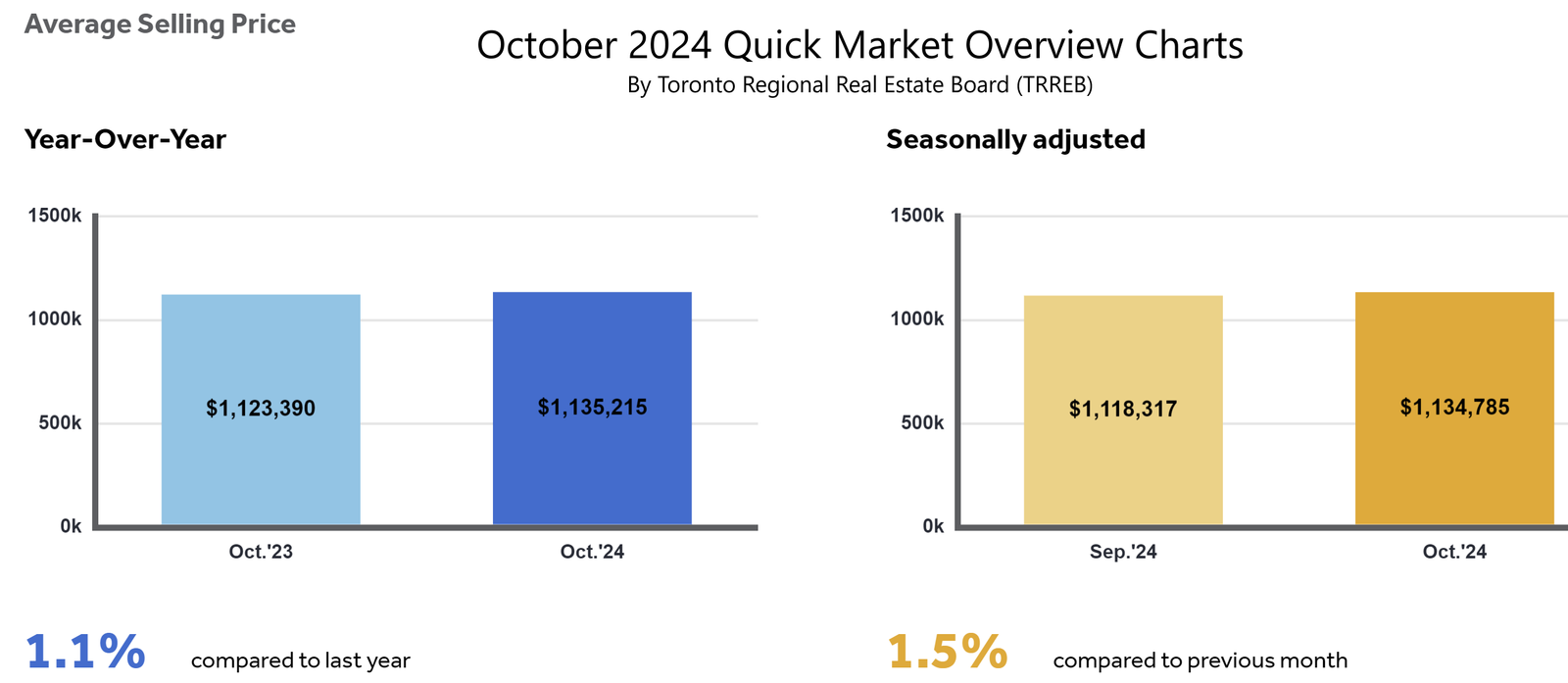
    • Average Selling Price: The average price saw a modest increase of 1.1% year-over-year, reaching $1,135,215. However, the MLS Home Price Index benchmark dipped by 3.3% compared to October 2023.
    • New Listings: The total number of new listings increased by 4.3%, totaling 15,328 in October. This provides ample choice for buyers, which TRREB’s Chief Market Analyst Jason Mercer suggests will help keep prices stable in the short term.

    Insights and Market Outlook:

    TRREB President Jennifer Pearce noted that lower borrowing costs have created a more favorable environment for affordability, pushing potential buyers to take action. However, with inventory expected to decrease gradually and housing construction lagging behind population growth, there is a likelihood of upward pressure on prices by spring 2025. TRREB has also advocated for policies to support affordability, including reducing taxes on home buyers.

    As the Bank of Canada’s rate cuts continue, it will be interesting to see how these dynamics evolve in the coming months and how they impact affordability and accessibility for both new and returning buyers.

    For further details, you can visit TRREB’s official market report at https://trreb.ca/wp-content/files/market-stats/market-watch/mw2410.pdf

    If you found this review helpful, I would greatly appreciate it if you could kindly leave a Google Review for my real estate services at

    A. Q. Mufti Google Review

    Thank you for your continued support!

    A. Q. Mufti

    Your Trusted Realtor in Mississauga, Oakville, Milton and beyond.

  • You could be richer by $1,421…

    You could be richer by $1,421…

    Ontario Trillium Benefit (OTB) Payments: What to Expect

    The Ontario Trillium Benefit (OTB) offers essential financial support to low- and middle-income Ontarians through monthly payments, with the next scheduled for Friday, November 8. Here’s a complete breakdown:

    What is the OTB?

    The OTB combines three provincial credits:

    1. Ontario Energy and Property Tax Credit: Helps with property and energy taxes.
    2. Northern Ontario Energy Credit: Assists with high energy costs in northern Ontario.
    3. Ontario Sales Tax Credit: Provides relief from sales tax expenses.

    Who is Eligible?

    To qualify, residents must be eligible for at least one of the credits above and meet specific conditions:

    • Ontario Energy and Property Tax Credit: Requires renting or paying property taxes, being an Ontario resident, and age 18+.
    • Northern Ontario Energy Credit: Only for those living in designated northern regions.
    • Ontario Sales Tax Credit: For Ontario residents, age 19+, or those married or in common-law relationships.

    How Much Will You Receive?

    Your total OTB depends on income, household size, and credit eligibility:

    • Ontario Energy and Property Tax Credit:
      • Up to $1,248 (aged 18-64), $1,421 (65+), and $277 for residents on reserves or in long-term care.
    • Northern Ontario Energy Credit: Up to $180 (for northern residents only).
    • Ontario Sales Tax Credit: Up to $360 per person, with additional amounts for spouses or dependents.

    Payment Details

    Payments are typically issued monthly on the 10th, with an annual lump-sum option in June for those eligible for more than $360. If you’re married, payments go to the spouse whose tax return is assessed first. Ensure direct deposit with the CRA for timely deposits.

    How to Apply

    The OTB is automatically assessed when filing your annual tax return. For late returns or missed payments, contact the CRA.

    Important Reminder

    Be cautious of scams! The Ontario government will never ask for personal information via text to receive benefits.

    If you found this review helpful, I would greatly appreciate it if you could kindly leave a Google Review for my real estate services at

    A. Q. Mufti Google Review

    Thank you for your continued support!

    A. Q. Mufti

    Your Trusted Realtor in Mississauga, Oakville, Milton and beyond.

  • Toronto to extend down payment assistance to higher-income earners

    Toronto to extend down payment assistance to higher-income earners

    Toronto to extend down payment assistance to higher-income earners

    Toronto’s recent proposal to extend down payment assistance to higher-income earners has sparked significant discussion. This initiative aims to support households earning between $125,000 and $150,000 annually—those in the 80th income percentile—who, despite their earnings, find it challenging to enter the city’s competitive housing market.

    Ontario Housing Market

    Pros of the New Housing Policy:

    1. Broadened Access to Homeownership: By targeting higher-income earners who still struggle with housing affordability, the program acknowledges that even middle to upper-middle-class families face barriers in Toronto’s real estate market. This initiative could enable a broader segment of the population to achieve homeownership.
    2. Retention of Middle-Class Residents: Assisting this income bracket may help retain professionals and middle-class families within the city, contributing to a diverse and stable community.
    3. Stimulated Housing Market: Providing down payment assistance can invigorate the housing market by enabling more qualified buyers to participate, potentially leading to increased property transactions and economic activity.

    Cons of the New Housing Policy:

    1. Resource Allocation Concerns: Critics argue that directing assistance to higher-income earners may divert resources from lower-income individuals who are in greater need of support. This shift could exacerbate existing inequalities in housing accessibility.
    2. Potential Market Inflation: Introducing additional purchasing power into an already heated market might inadvertently drive up home prices further, counteracting the program’s intent to make housing more affordable.
      Harvard JCHS
    3. Limited Impact on Affordability: Some experts suggest that without addressing the underlying issue of housing supply, such demand-side interventions may have a minimal effect on overall affordability and could lead to unintended economic consequences.

    While Toronto’s proposed policy to extend down payment assistance to higher-income earners aims to address housing accessibility challenges for a broader segment of residents, it raises important questions about resource allocation and potential market impacts. Balancing the needs of various income groups and implementing complementary measures to increase the housing supply will be crucial in ensuring the effectiveness and equity of this initiative.

    If you found this review helpful, I would greatly appreciate it if you could kindly leave a Google Review for my real estate services at

    A. Q. Mufti Google Review

    Thank you for your continued support!

    A. Q. Mufti

    Your Trusted Realtor in Mississauga, Oakville, Milton and beyond.

A. Q. Mufti, REALTOR® — Mississauga, Oakville, Milton and the GTA49 Google reviews
Let's Connect!