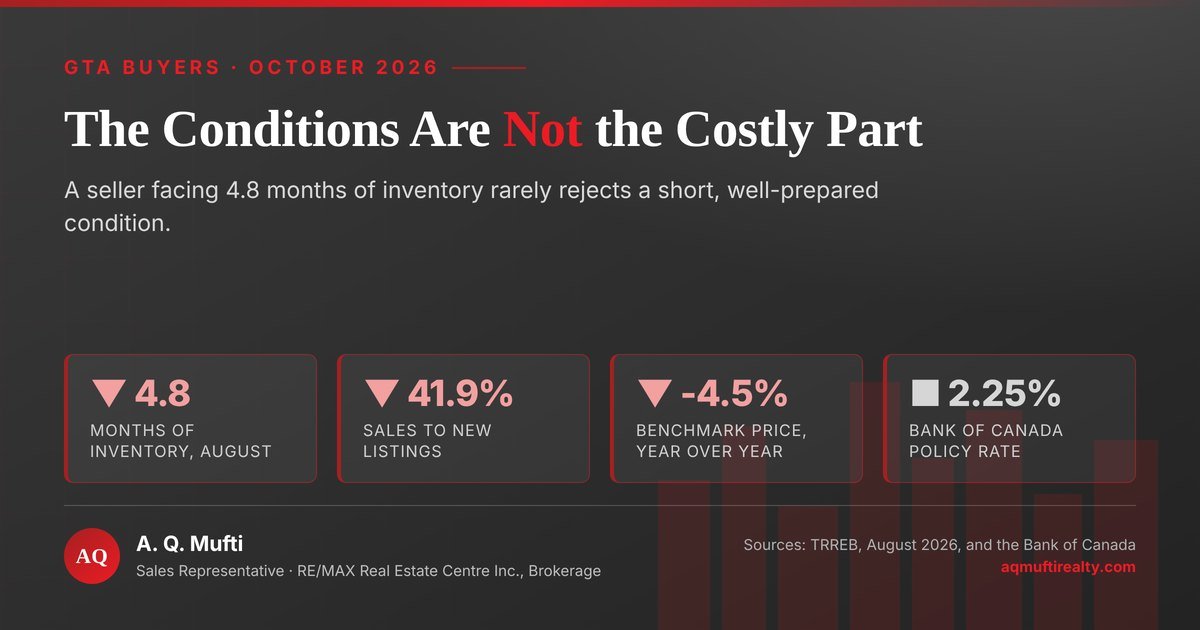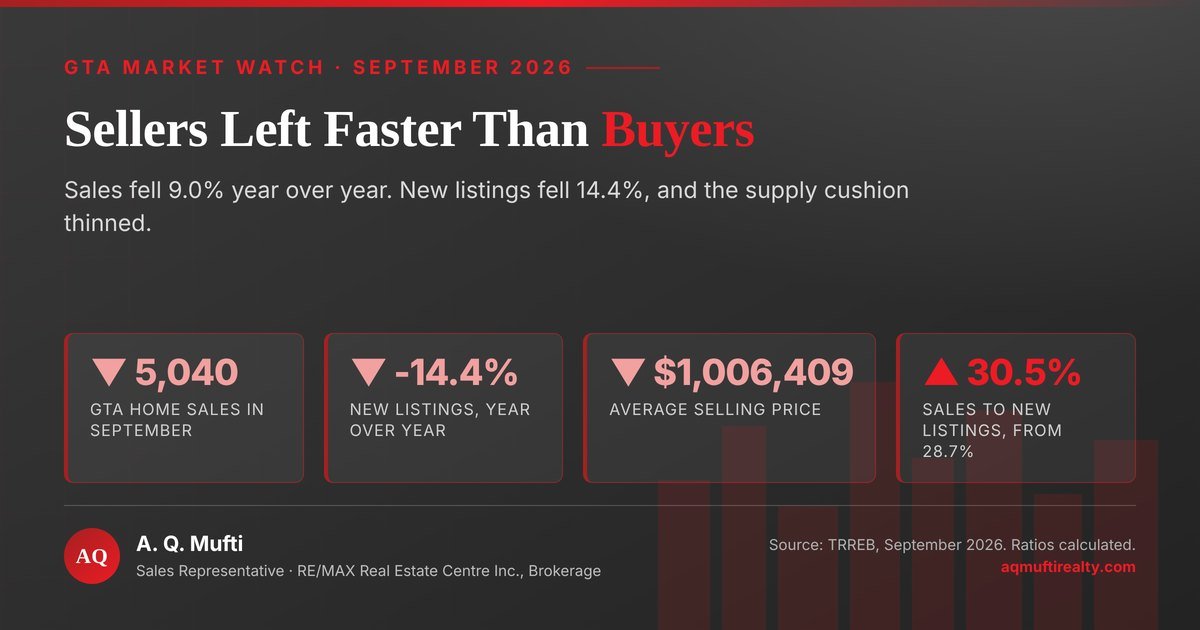
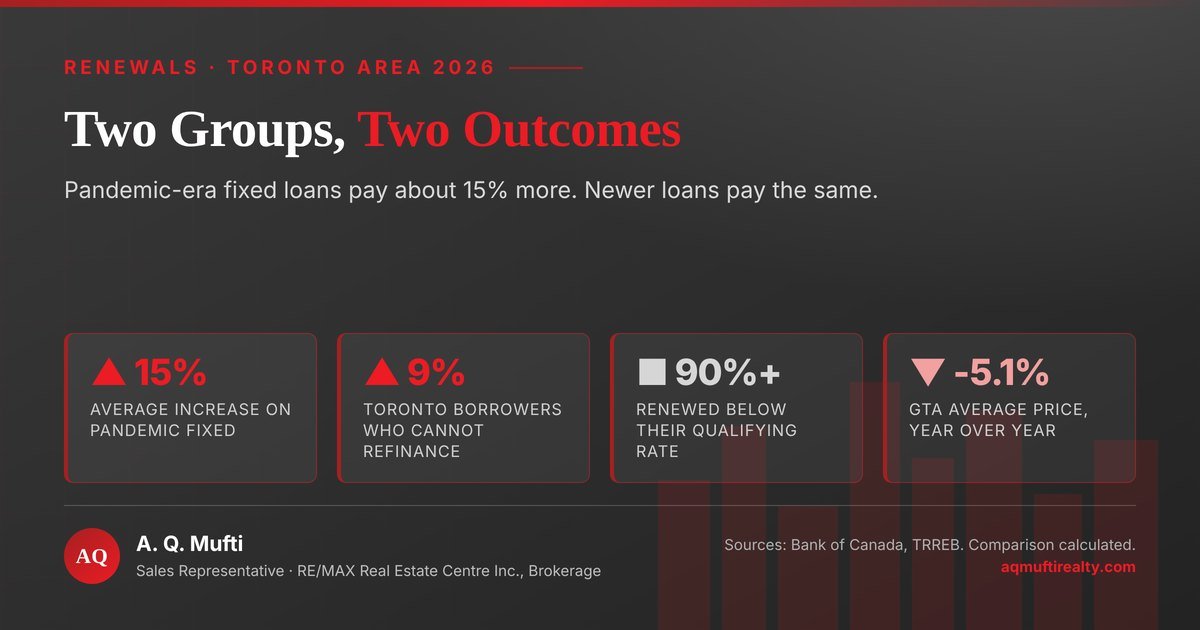
A GTA mortgage renewal in 2026, at a glance. Sources: the Bank of Canada and TRREB. Payment examples calculated.
Your lender mails one page and names one rate. Yet a GTA mortgage renewal is far more negotiable than that letter suggests.
Notably, the Bank of Canada now splits renewing borrowers into two groups. One pays about 15% more. Yet the other pays the same.
The short version
- Two groups, two outcomes. Next, pandemic-era five-year fixed loans are about 12% of all Canadian mortgages. On average their payments then rise about 15%.
- Yet newer loans see no change. Another 14% of mortgages renew with payments that, on average, hold flat.
- Also, the stress test no longer applies if you move. In short, a straight switch to a new lender skips the qualifying rate, so a GTA mortgage renewal can be shopped.
- Still, Toronto is the exposed market. Here, about 9% of Toronto-area borrowers renewing in 2027 could not refinance, against 4% nationally.
- Falling prices tighten that further. Another 10% drop would take the Toronto share to about 12%, and prices are down 5.1% in a year.
A renewal in numbers
First, here is what the Bank of Canada published this year. Each figure below shapes a GTA mortgage renewal, and none of it comes from a lender’s sales desk.
| Measure | Figure | Source |
|---|---|---|
| Pandemic-era fixed loans renewing | about 12% of mortgages | Bank of Canada |
| Their average payment increase | about 15% | Bank of Canada |
| Loans renewing with no change | about 14% of mortgages | Bank of Canada |
| Renewed below their qualifying rate | more than 90% | Bank of Canada |
| Could not refinance in 2027, Toronto | about 9% | Bank of Canada |
| Same, if prices fell 10% more | about 12% | Bank of Canada |
| GTA average price, September 2026 | $1,006,409 | TRREB |
What a GTA mortgage renewal looks like in 2026
First, start with the split. Indeed the single most useful thing you can know is which of two groups holds your loan.
The GTA mortgage renewal that costs 15% more
The last five-year fixed loans signed during the pandemic are coming due now. The Bank calls this group “about 12% of all outstanding mortgages in Canada,” in its report on household debt.
Then the arithmetic is blunt for them. “On average, these borrowers will see their payments increase by about 15%,” the Bank writes, which it calls roughly in line with past increases.
The GTA mortgage renewal that costs nothing extra
Meanwhile a second group renews in the same window. These loans “represent about 14% of outstanding mortgages” and were signed after rates rose in 2022 and 2023.
Their result is different. “These borrowers, on average, will not see their payments change at renewal,” the Bank says. So a GTA mortgage renewal in this group is a paperwork exercise, not a budget event.
Also, timing matters. Nearly every borrower facing a large increase will have renewed by the second half of 2027, which puts a visible end to this cycle.
The stress test no longer blocks a GTA mortgage renewal
Next, the rule that used to trap renewing borrowers with their own lender. It changed, and surprisingly few people seem to know.
What a straight switch means
The qualifying rate is “the greater of the mortgage contract rate plus 2% or 5.25%,” per the regulator’s own page. That hurdle once kept borrowers from moving.
Now read what the same page says. OSFI states: “We do not expect lenders to apply the minimum qualifying rate for uninsured straight switches at renewal.”
A straight switch is narrow but common. You move to another federally regulated lender, and you do not lengthen the amortization or increase the loan.
The $3,000 you may add
Separately, the federal rules match. Finance Canada removed “the requirement to apply the minimum qualifying rate on low-ratio mortgages” when they switch lenders at renewal, in its December 2024 announcement.
Still, one allowance helps the move. The balance “may be increased by $3,000 to cover related transaction costs such as penalties or fees.” However, “equity take out is not permitted.”
Put simply, that is leverage. A GTA mortgage renewal you can take elsewhere is a rate you can negotiate, and the first offer is rarely the last one.
Why falling prices matter to a GTA mortgage renewal
Of course, switching assumes a lender will have you. Here the Toronto area stands apart from the country, and not in a good way.
The Toronto number the Bank published
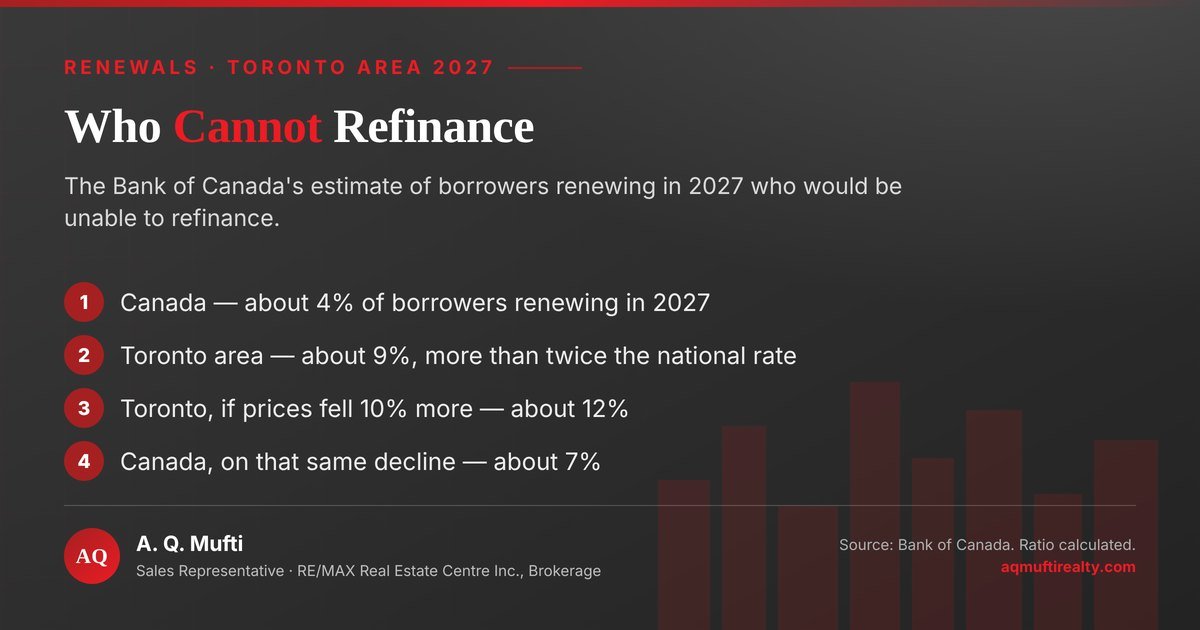
In fact a small share of borrowers cannot refinance at all. The Bank puts it at “an estimated 4% in 2027, or about 9% of borrowers in the Toronto area.”
That is more than twice the national rate (calculated). Equity is the reason: refinancing needs room between the loan and the value of the home.
What another 10% would do
The Bank also tested a further decline. If house prices fell another 10%, “that share would rise modestly to about 7% nationally and 12% in the Toronto area.”
Now set that beside the market. The average GTA selling price was $1,006,409 in September, down 5.1% in a year, and the index fell 4.7%, TRREB reported.
So the stress test is not the binding constraint on a GTA mortgage renewal any more. Appraised value is, for roughly one Toronto-area borrower in eleven.
What a GTA mortgage renewal costs in dollars
Now translate 15% into money. A percentage is easy to shrug off, and a monthly figure is not.
Your GTA mortgage renewal in monthly dollars
First, take three payment levels. A 15% increase adds about $375 a month at $2,500, about $480 at $3,200, and about $600 at $4,000 (all calculated).
Annually that is $4,500, $5,760 and $7,200 (calculated). Hence a GTA mortgage renewal in the pandemic-era group is a real change to a household budget, not a rounding error.
Where the cushion came from
Still, there is good news buried in the Bank’s wording. “More than 90% of borrowers who renewed in the past 12 months did so at rates below their qualifying rates.”
In other words the stress test worked. Borrowers were tested at the contract rate plus two points, and most renewed under that ceiling.
Yet rates help too. The Bank held its policy rate at 2.25% on September 2, “with the Bank Rate at 2.5%,” it said that day. Its next decision lands on October 28.
Arrears and what they say about a GTA mortgage renewal
Next, the question every headline raises. If payments are rising, are people falling behind?
What the numbers actually say
Borrowers more than 60 days late on at least one account sit at 1.3% among mortgage holders and about 2.5% among those without a mortgage, the Bank reports.
Also, mortgage accounts 60 days behind are only slightly above the 2018 to 2019 average. Equally, the Bank notes lenders “have not seen a broad rise in loan losses.”
The group under the most strain
Averages hide the pressure, though. Here, arrears have risen most among borrowers carrying large balances relative to income, who hold about 17% of outstanding mortgage balances.
Geography narrows it further. Strain is sharpest among Toronto-area borrowers who signed in 2022 and 2023, a group holding roughly 2% of balances.
Therefore a GTA mortgage renewal deserves attention well before the letter arrives, particularly for anyone in that 2022 cohort.
How to prepare for a GTA mortgage renewal
Finally, the practical part. None of it, in short, requires a forecast, which is exactly why it is worth acting on.
If your GTA mortgage renewal is within a year
- Start four to six months out. Lenders can hold a rate for you, and a GTA mortgage renewal arranged under deadline pressure is the expensive kind.
- Get a competing quote in writing. A straight switch skips the qualifying rate, so the quote is credible and your lender knows it.
- Model the payment, not the rate. Run the numbers through my payment calculator before you reply to anyone.
- Next, keep the amortization as it stands. Stretching it lowers the payment and disqualifies the switch, which costs you the leverage.
If you may need to refinance
- Check your equity first. Here, with the index down 4.7%, a 2022 purchase may appraise below what the owner expects.
- Then ask what the lender will lend against. The appraisal, not the stress test, is the live constraint on a GTA mortgage renewal today.
- Do not wait for October 28. One decision rarely moves a five-year fixed rate much, and the calendar does not pause.
Want the wider picture as it moves? For instance, my monthly market updates track the price and inventory figures above, and the step-by-step guide for buyers covers financing from pre-approval onward.
Your renewal questions
Short answers to what owners in Mississauga, Oakville and Milton ask me most about renewing.
Will my payment rise at a GTA mortgage renewal?
Generally it depends on when you signed. Pandemic-era fixed borrowers see payments rise about 15% on average, while loans signed after 2022 see no average change.
Do I have to pass the stress test to switch lenders?
Not for a straight switch. So OSFI does not expect lenders apply the minimum qualifying rate, provided you do not increase the loan or extend the amortization.
What stops someone from refinancing?
Equity, mostly. The Bank estimates about 9% of Toronto-area borrowers renewing in 2027 could not refinance, rising to about 12% if prices fell another 10%.
How early should I start a GTA mortgage renewal?
Four to six months ahead. That leaves time to collect a competing quote and to hold a rate, rather than accepting whatever arrives in the mail.
Can I add my switching costs to the balance?
Up to $3,000, under the federal rules, to cover penalties and fees. Taking equity out is not permitted on that basis.
Sources and further reading
- Bank of Canada – households — the shares
- OSFI – qualifying rate — the switch
- Finance Canada – switches — the rules
- Bank of Canada – September — 2.25%
- TRREB – September 2026 — the market
Keep reading on the blog
More guides and market analysis from this blog.
- GTA Home Sales, September 2026 — the market
- Land Transfer Tax in the GTA — the tax
- Closing Costs in Ontario — the extras
- Pricing a Home in a Balanced Market — on selling
Ready to run your renewal numbers with me?
Send me your renewal date, your current payment and the rate your lender has offered, and I will put it beside what comparable homes in your area are appraising at now. No pressure, and no obligation.
Prefer to start with a number? Get a tailored home valuation or run the figures in the mortgage calculator.
Disclaimer: This article draws on the Bank of Canada’s Financial Stability Report 2026, the Office of the Superintendent of Financial Institutions, the Department of Finance Canada and TRREB. It offers information only. I calculated the three payment examples, their annual totals and the comparison between the Toronto and national refinancing shares. Rates and rules change, so confirm your own terms with your lender or a licensed mortgage broker. Nothing here is financial, mortgage, tax or legal advice. A. Q. Mufti – Sales Representative, RE/MAX Real Estate Centre Inc., Brokerage.
A. Q. Mufti — Sales Representative
RE/MAX Real Estate Centre Inc., Brokerage
MSc, PMP®, ABR®, SRS®, CNE®
416 908 5600 · 905 270 2000
info@aqmuftirealty.com
141-1140 Burnhamthorpe Rd. W., Mississauga ON L5C 4E9
Serving Mississauga, Oakville, Milton, Brampton, Toronto and the wider GTHA. More about how I work.