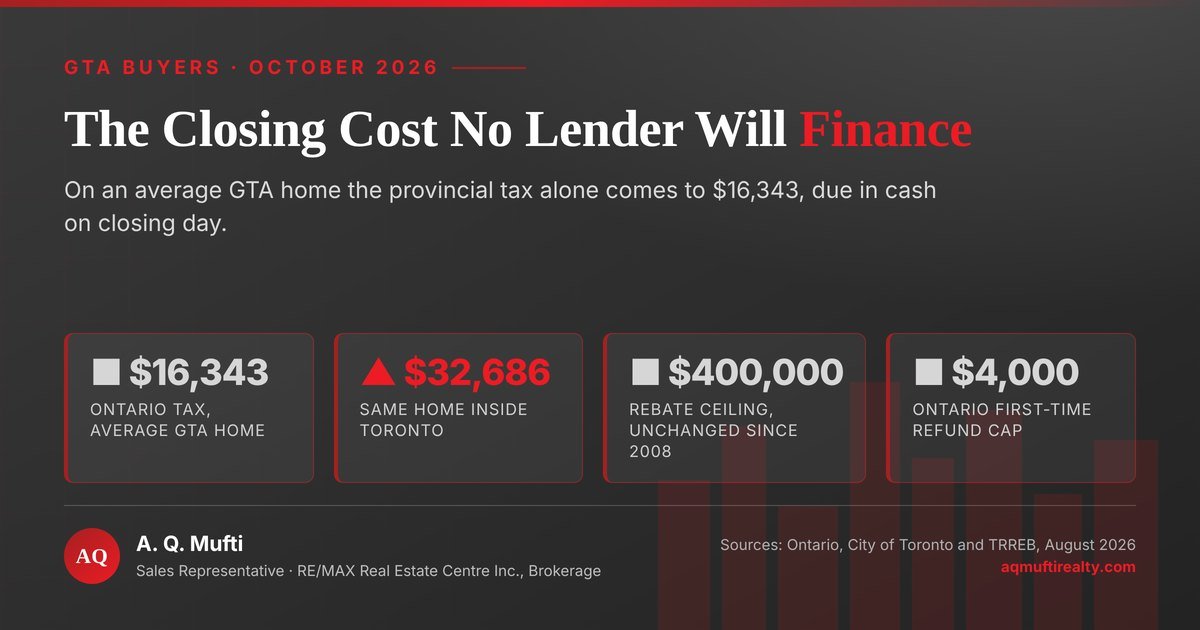
The land transfer tax on an average GTA home, at a glance. Sources: Ontario, Toronto and TRREB. Totals calculated.
Buyers budget for the down payment and the lawyer. Then, about a week before closing, they meet the one cost nobody advertises. The land transfer tax arrives as cash, on closing day, and no lender will finance it.
Meanwhile the amount surprises almost everyone. On the average GTA home it comes to $16,343 (calculated). Furthermore, one address in this region charges it twice.
The short version
- Budget $16,343 on an average home. First, Ontario’s land transfer tax took that from August’s GTA average of $993,410 (calculated). It is due in cash at closing.
- Toronto charges a second one. The city levies its own municipal tax at the same rates. So the same purchase costs $32,686 there (calculated).
- Peel and Halton do not. Buy in Mississauga, Oakville or Milton and you pay the province only. That gap is real money, not a rounding error.
- The rebate has not moved since 2008. Notably, Toronto’s first-time buyer rebate still stops at $400,000 of price. Ontario refunds up to $4,000.
- Luxury rates changed in April. Graduated Toronto rates now climb to 8.60% above $20 million. They took effect on 1 April 2026.
Land transfer tax by purchase price
First, these land transfer tax totals use the brackets in force today. The middle column is what a Peel or Halton buyer pays. The right column adds Toronto’s own tax.
| Purchase price | Ontario only | Toronto total |
|---|---|---|
| $500,000 | $6,475 | $12,950 |
| $700,000 | $10,475 | $20,950 |
| $898,510 | $14,445 | $28,890 |
| $993,410 | $16,343 | $32,686 |
| $1,275,221 | $21,979 | $43,959 |
How the land transfer tax is actually calculated
Start with the brackets, because the headline rate misleads people. Generally, the land transfer tax climbs in steps, and each step applies only to the money inside it.
Ontario charges 0.5% on the first $55,000, then 1.0% to $250,000, then 1.5% to $400,000, then 2.0% on everything above that. Above $2,000,000 the rate reaches 2.5% on a home with one or two single family residences.
So the arithmetic is dull but unforgiving. On August’s GTA average of $993,410 the bill works out to $16,343 (calculated). Meanwhile a $1.5 million purchase owes $26,475.
Why it has to be cash
Here is the practical problem. Your mortgage funds the purchase price, not the cost of transferring the deed.
Consequently this tax sits beside the legal fees, the title insurance and the adjustments, all payable on the day. Therefore it belongs in your deposit math from the first showing, not the last week.
Where a second land transfer tax applies
Now for the part that decides tens of thousands of dollars. Ontario is one province with two bills, and only one city sends the second.
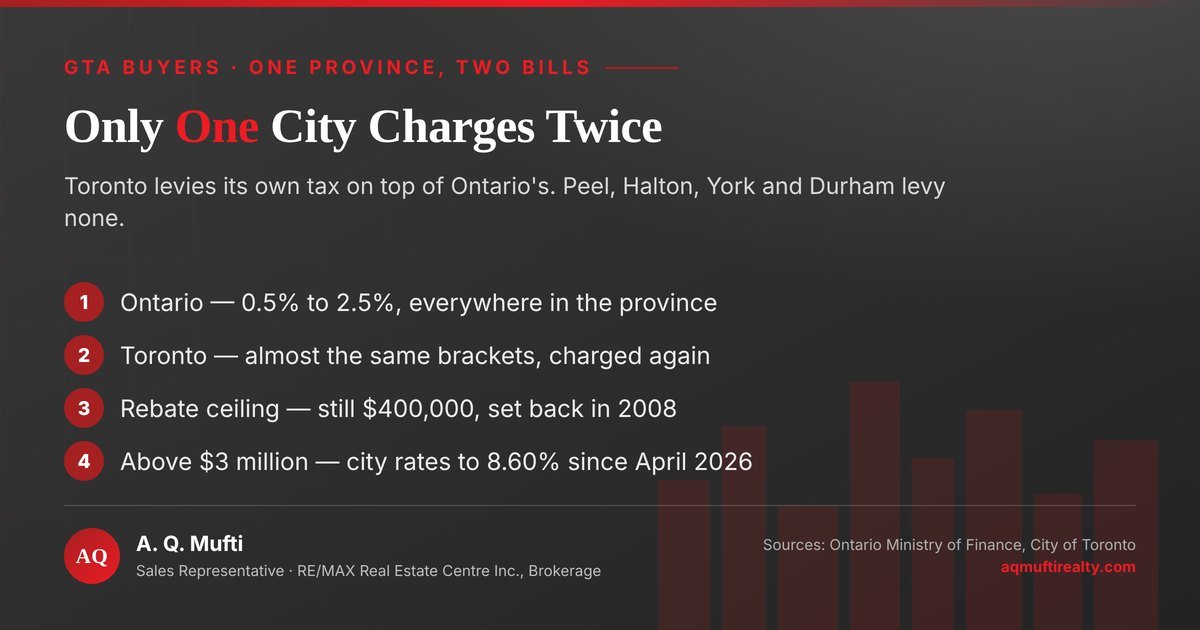
The province says plainly that if you buy in the City of Toronto, you may also pay that city’s own municipal tax. No other municipality in the GTA charges one today.
Toronto mirrors the provincial brackets
The city’s schedule is not a small surcharge either. Instead, it copies the provincial steps almost exactly: 0.5%, then 1.0%, then 1.5%, then 2.0% above $400,000, and 2.5% above $2 million.
In practice, that doubles the bill. The same $993,410 purchase costs $32,686 in land transfer tax inside Toronto and $16,343 in Mississauga (both calculated). A separate administration fee of $102.56 plus HST applies as well.
Mississauga’s own August average was $898,510, where the provincial tax alone runs $14,445 (calculated). Equally, a Toronto buyer at that price would owe $28,890. Nobody writes that check twice by choice.
The land transfer tax rebate that stopped working
First-time buyers get relief, and the relief has aged badly. Both governments offer a refund, and both ceilings were set for a different market.
Four thousand dollars, and a 2008 ceiling
Ontario refunds a maximum of $4,000, which it describes as removing the tax on the first $368,000 of price. Toronto rebates up to $4,475, the exact amount its tax reaches at $400,000 (calculated).
That $400,000 figure was chosen in 2008 and has not been touched since. Back then it covered an average home. Today it covers two fifths of one.
Consider a first-time buyer paying the GTA average. Her land transfer tax falls to $12,343 in Peel after the refund, or $24,211 in Toronto after both (calculated). Hence the rebate softens the blow without changing the decision.
Eligibility is strict in both programs. You must be 18, must never have owned a home anywhere, and must move in within nine months. Also, your spouse cannot have owned one during your marriage.
Why the land transfer tax is a municipal election issue
This cost has become political, which is unusual for a closing-day line item. Ontario votes in municipal elections on Monday, October 26, and the tax is on the agenda.
What the real estate board is arguing
TRREB published two statements in late September. It says the municipal tax adds over $18,000 on an average-priced Toronto home, and that the two taxes combined can exceed $36,000.
Our own arithmetic agrees with theirs. An $18,000 municipal bill corresponds to a price near $1,076,250, and doubling it gives about $36,100 (both calculated). The board’s numbers and the rate tables tell the same story.
Daniel Steinfeld, TRREB’s president, put the position bluntly. “That is not a housing affordability strategy,” he said. “It is a home-ownership dream killer.”
The warning that matters outside Toronto
Here is why Peel and Halton readers should care. The board also warns that other GTA municipalities could adopt a similar tax, which in million-dollar communities would approach or exceed $20,000 before the provincial bill.
Nothing of the kind is on the table in Mississauga today. Still, candidates are being asked, and the answers are worth hearing before you vote.
Keep the scale in mind as you listen. Peel and Halton buyers already compete with Toronto on price, and a second tax here would add roughly $14,000 to an average local purchase (calculated). Afterward, that cash would come straight out of down payments.
Land transfer tax rates on higher-value homes
One change already landed this year, and it affects the top of the market. Toronto rebuilt its luxury brackets in April.
Since 1 April 2026, city rates climb above $3 million: 4.40% to $4 million, then 5.45%, then 6.50% to $10 million, 7.55% to $20 million and 8.60% beyond that. Ontario, by contrast, still tops out at 2.5%.
What that means for a $4 million purchase
The gap at that level is no longer a doubling. Instead, the municipal share overtakes the provincial one and keeps climbing, so the two bills stop looking alike.
Few GTA purchases reach that band. Nevertheless, anyone shopping above $3 million inside Toronto should price the land transfer tax before choosing between a city address and a suburban one.
Budgeting for land transfer tax before you offer
Ultimately, the land transfer tax is a planning problem rather than a tax problem. You cannot avoid the bill, but you can stop it ambushing you.
- Set the cash aside first. Work out the tax on your target price, then treat it as untouchable. Consequently your down payment stops shrinking at the worst moment.
- Price two addresses, not one. Run the same purchase inside and outside Toronto. Afterward the comparison usually answers itself.
- Claim both refunds if you qualify. A first-time buyer in Toronto can claim the provincial and the municipal rebate, worth $8,475 together.
- Apply within 18 months. Ontario gives you that long after registration. Otherwise the refund simply expires.
- Add the small fees. Toronto’s $102.56 administration charge plus HST is easy to forget, as are registration costs.
- Test the payment at your real ceiling. Run the numbers on my payment calculator using the price you can close on, not the price you were pre-approved for.
Work through those six and the closing-day total holds no surprises. Equally, you will know which side of the city limit your money goes further.
Want the whole sequence in writing? For instance, my step-by-step guide for buyers runs from pre-approval to keys. My home valuation page similarly sets a realistic target before you shop, and the monthly market updates track the prices above.
Your land transfer tax questions
Short answers to what buyers are asking me this fall.
How much land transfer tax will I pay in Mississauga?
On August’s Mississauga average of $898,510 the provincial land transfer tax comes to $14,445 (calculated). The city levies no municipal tax of its own, so that is the whole bill.
Why does Toronto charge twice?
The city has its own taxing power and uses it, applying almost the same brackets as the province. No other GTA municipality charges one today.
Can I add the tax to my mortgage?
No. Your mortgage funds the purchase price, and this cost falls outside it. Therefore it has to be cash on closing day, beside your legal fees.
What does a first-time buyer get back?
Ontario refunds up to $4,000, and Toronto up to $4,475 inside the city. Both require that you have never owned a home anywhere and that you move in within nine months.
Could Mississauga ever add a land transfer tax?
No proposal exists today. However, TRREB has warned that other GTA municipalities could adopt one, which is why the October 26 vote is worth watching.
Sources and further reading
- Ontario – rates — brackets
- Ontario – refund — $4,000
- Toronto – rates — the city
- Toronto – rebate — $4,475
- TRREB – statement — the ask
- TRREB – August 2026 — prices
- Mississauga – vote — Oct 26
Keep reading on the blog
More guides and market analysis from this blog.
- Closing Costs in Ontario — the rest
- Oakville or Milton — towns
- GTA Home Prices, August 2026 — context
- New Home HST Rebate — new builds
Ready to see the real closing-day total?
Send me the price range you are shopping in and I will put the whole closing-day number in front of you, including the tax, the fees and what changes if you cross the city limit. No pressure, and no obligation.
Prefer to start with a number? Get a tailored home valuation or run the figures in the mortgage calculator.
Disclaimer: This article draws on Ontario and City of Toronto rate and rebate pages, on TRREB statements of September 2026 and on the City of Mississauga. It offers information only. I calculated every dollar total here from the published rate schedules. Rates and rebates change, so confirm the figures with your lawyer before you close. Nothing here is financial, mortgage, tax or legal advice. A. Q. Mufti – Sales Representative, RE/MAX Real Estate Centre Inc., Brokerage.
A. Q. Mufti — Sales Representative
RE/MAX Real Estate Centre Inc., Brokerage
MSc, PMP®, ABR®, SRS®, CNE®
416 908 5600 · 905 270 2000
info@aqmuftirealty.com
141-1140 Burnhamthorpe Rd. W., Mississauga ON L5C 4E9
Serving Mississauga, Oakville, Milton, Brampton, Toronto and the wider GTHA. More about how I work.